| Author |
 Replies: 8 / Views: 744 Replies: 8 / Views: 744 |
|
|
Valued Member
United States
314 Posts |
OK, the last time I posted for help in this forum I got a little carried way and promised myself I wouldn't let that happen again. So here it goes: I recently inherited my grandfather's coin collection and came across the item in the picture below. I believe it is a die for a commemorative coin or perhaps a medal from the Civil War era. It appears to be for surviving members of Iowa's Martyr Regiment, the 38th, Infantry Volunteers. There are two dates, one clearly reads 1865, the other is not so clear - perhaps 1862, the year the regiment mustered in to the service. If anyone in this forum has more and/or clarifying information about it, I'd love to hear it. 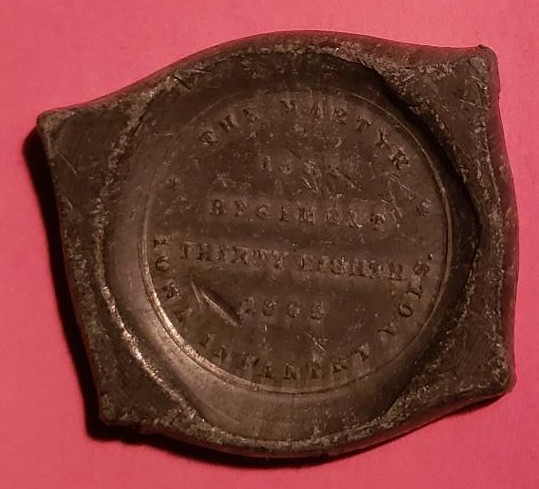 Edited by jdsstrat
02/13/2025 9:16 pm
|
|
|
|
Pillar of the Community
United States
1918 Posts |
Don't see how it could be a die unless test punched on something to see here or mirrored
|
|
Bedrock of the Community
 United States
27514 Posts |
 to the CCF, jdsstrat! By any chance is this item made of lead? I think that it's a die trial piece, not a die. I can't help you with the medal, however. Inordinately fascinated by bits of metal with strange markings and figures
|
|
Valued Member
 United States
314 Posts |
You see, that's why I will continue to post here. The wisdom! I didn't know what else to call it, but since you mention "test punched" can you tell me if that sort of thing was common? It may explain why the comparables I have been able to find so far are close to this design but not exactly the same.
|
|
Moderator
United States
34575 Posts |
@jds, yes could by a trial strike. Can you please post a pic of the other side? Whatever it is, this is a pretty interesting one.
"If you climb a good tree, you get a push."
-----Ghanaian proverb
"The danger we all now face is distinguishing between what is authentic and what is performed."
-----King Adz
|
|
Valued Member
United States
314 Posts |
Yes, I am pretty sure that it is made of lead. And actual dies were made of steel? Is that right? How uncommon are die trial pieces? 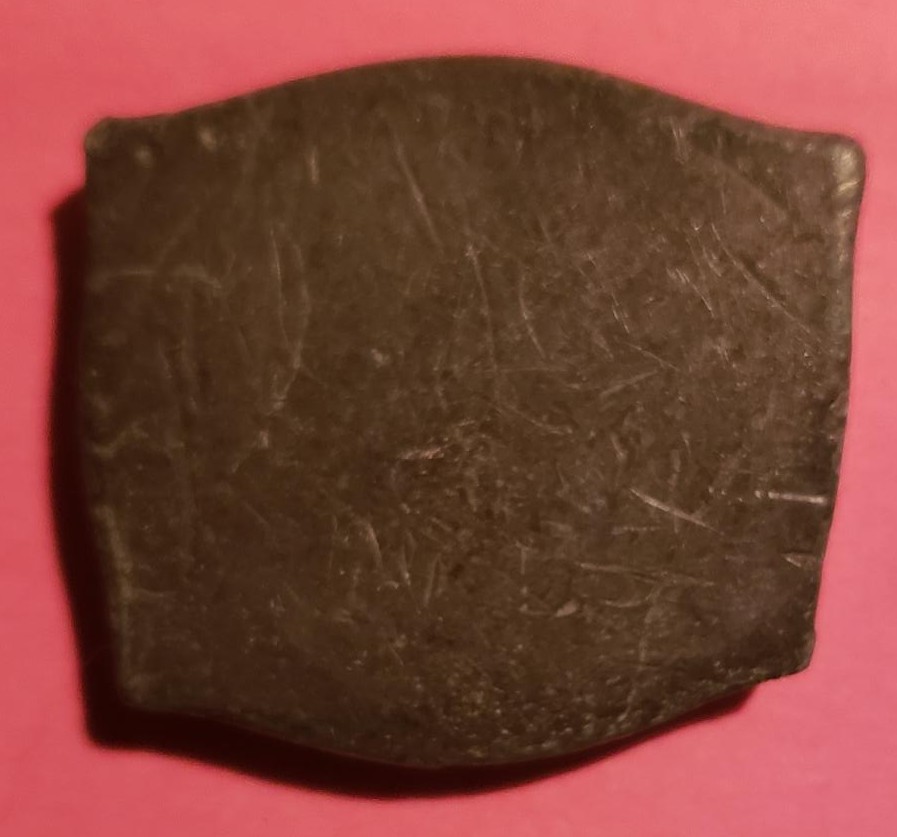 |
|
Valued Member
United States
314 Posts |
Edited by jdsstrat
02/13/2025 10:10 pm
|
|
Moderator
Australia
17037 Posts |
Die trials, also known as "lead pulls", were and still are very frequently done by badge, token and medal manufacturers, as well as official government mints.
A die for a medal is initially made from soft steel - it has to be soft so the details can be carved or stamped into it. It then has to be hardened prior to actually being used to strike coins or medals, but a hardened die cannot then be edited or altered easily. So to make sure the customer is happy with the design (and to make sure there's no mis-spellings, upside-down or backwards-facing letters, or other correctable mistakes) before the dies are hardened, a test piece is often made from the raw un-hardened die. As this die is still soft, such a test piece cannot be made at full pressure from the press, nor can it be made from the same hard metal as the final medal; you need a soft metal, like lead. Hence, a "lead pull". Depending on the customer, more than one such test piece might end up being made.
Once the test piece is examined and everyone is happy with the die, the die can be hardened and go on to produce the actual medals.
What happens to the lead pulls afterwards depends on the manufacturer. Sometimes the customer keeps it. Sometimes the manufacturer keeps it. More often than not, it just ends up in the scrap lead bucket and melted down to make the next test-piece.
Die pulls are collectable, and can be more valuable than the actual medals they imitate. But it's a very niche collector market, even more niche than medal-collecting. It's the sort of thing only an auction can determine "true market value" for, since they come up so rarely.
Don't say "infinitely" when you mean "very"; otherwise, you'll have no word left when you want to talk about something really infinite. - C. S. Lewis
|
|
Valued Member
United States
314 Posts |
So if I am understanding you correctly, Sap, the unhardened die for the medal about to be produced was first used to strike this lead pull as a kind of test. Is that right? No actual test coin was produced, just this lead pull for examining purposes, which explains why the image is not reversed? Am I understanding you correctly? Once it passed the examination, then the unhardened die is hardened for production of the actual medal. Correct?
Edited by jdsstrat
02/14/2025 06:46 am
|
| |
Replies: 8 / Views: 744 |
|







 Posted 02/13/2025 9:29 pm


