Collectors of the Modern US Commemorative Coin series are likely familiar with the three-coin 1993 program that marked the 50th Anniversary of World War II. During the same time frame as that program was being introduced and considered by the US Congress, Gus Yatron (D-PA) introduced a coin bill that sought Silver Dollars (SDs) "in commemoration of the 50th anniversary of the allied invasion of Normandy, better known as D-Day, and for other purposes."
The bill included a "Findings" section to provide background and context for the coin proposal:
The Congress finds that--
(1) June 6, 1994, will mark the 50th anniversary of the allied invasion of Normandy;
(2) this invasion is considered the greatest amphibious assault in the history of warfare;
(3) approximately 154,000 troops took part in this attack, including 70,500 Americans, and the assault included an armada of 5,000 ships and an air campaign of 11,000 sorties;
(4) those participating in this fierce struggle were forced to confront powerful German divisions that were well fortified by the steep bluffs lining much of the beach front;
(5) this movement to capture a 55 mile stretch of French beaches resulted in a total of approximately 9,000 casualties, about one-third of which were fatalities;
(6) with this landing by the allies, the downfall of Nazi Germany had begun, as a pathway to the mainland for troops and supplies had heroically been established;
and
(7) the importance of this successful invasion cannot be understated, as the allies achieved a major victory in their World War II battles with the Germans that would forever change the course of history.The bill followed its "Findings" section with:
It is the sense of the Congress that--
(1) the 50th anniversary of these heroic landings at Normandy should not go unrecognized; and
(2) the United States should recognize this anniversary by minting and issuing coins to commemorate this event.The coin program was to feature up to 1 million SDs, with Uncirculated and Proof versions to be struck. The silver to be used for the coins was to come from the US' Strategic and Critical Materials Stock Pile; if all 1 million SDs were to have been struck, ~773,500 troy ounces of the Stockpile's silver would have been needed.
Though the bill included only a general design guideline "be symbolic of the D-Day veterans' heroism", it did specify that the coins were to feature the inscription "June 6, 1944" - the D-Day date. This date was to be in addition to the year-of-issue date (1993).
The issue price of each SD was to include a surcharge of $7.00. The collected surcharge funds were to be held in the coinage profit fund until the US Congress established a National World War II "memorial on Federal land in the District of Columbia or its environs to honor members of the Armed Forces of the United States who served in World War II and to commemorate the participation of the United States in that war." Upon such action by Congress, the collected surcharge funds were to be made available. (The 1993 World War II coin program surcharge funds were also to be used to establish a World War II Memorial in or around Washington, DC. (I will cover the details in an upcoming post.)
If the surcharge funds collected exceeded the cost to erect a World War II Memorial, the excess funds were to be split between the National Park Service (80%) for maintenance of memorials "commemorative of military conflicts in which the United States was involved" and the Smithsonian Institution (20%) "to collect material and develop exhibitions to educate the generations of the 21st century about the efforts and struggle of the United States to establish freedom around the world during the 20th century." (Considering the National WWII Memorial that was built cost ~$200 million, the D-Day coin program was not likely to generate "excess funds.")
The bill also included a provision for use of the funds if the WWII Memorial was not built: the funds were to be split between the National Park Service (80%) and Smithsonian Institution (20%) to be used as outlined above.
Upon introduction, the bill was referred to the House Committee on Banking, Finance and Urban Affairs, with a further referral to its Subcommittee on Consumer Affairs and Coinage. The bill was not reported out of Committee, nor was it considered further by the House. Legislation for the multi-coin World War II commemorative coin program superceded the single-coin D-Day bill.
Within the World War II coin program, the Silver Dollar specifically honored the D-Day invasion and its soldiers, and is a reasonable proxy for a coin design appropriate for this bill.
1991-95 (1993) US World War II Commemorative Silver Dollar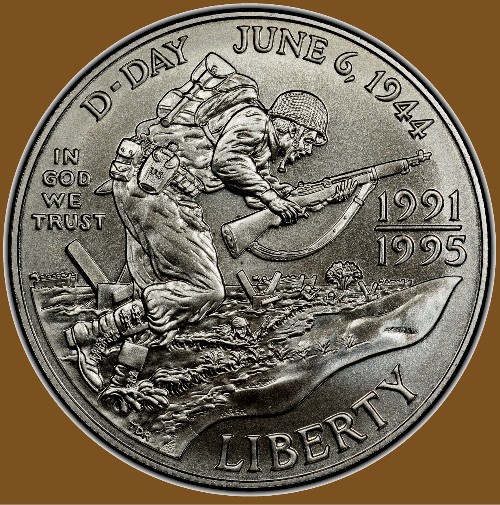
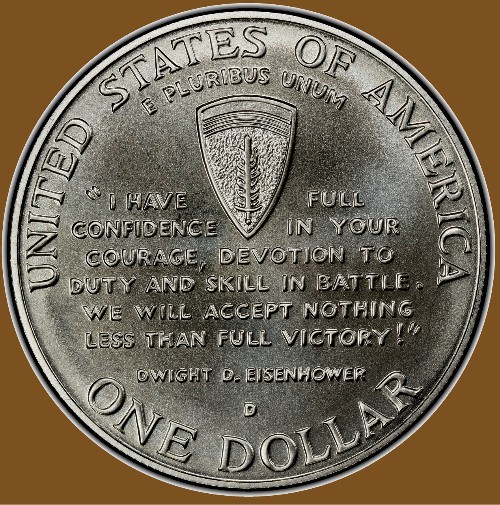
In the end, Representative Yatron's D-Day Silver Dollar bill proved to be redundant and unnecessary in light of the gold, silver and copper-nickel (CuNi) clad WWII commemorative coin program.
For other of my posts about commemorative coins and medals, including other What If? stories, see:
Commems Collection.









 Posted 06/03/2025 06:29 am


