Here are a few quick notes about the 1936 Battle of Gettysburg 75th Anniversary Half Dollar:
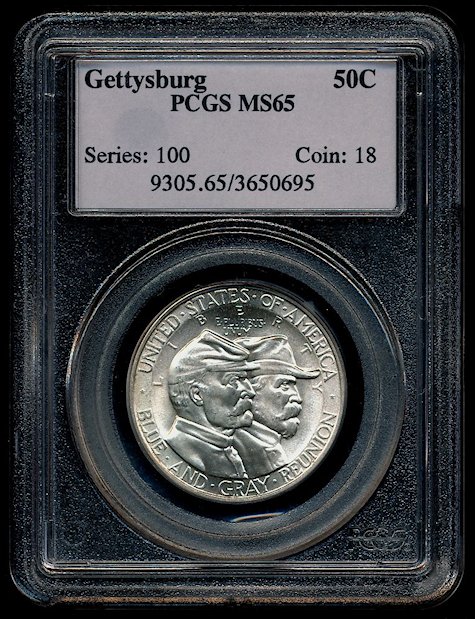
 Tidbit #1
The designer/sculptor of the Gettysburg half dollar, Frank Vittor, put out a call to veteran participants of the United States ("US") Civil War in October 1936. At the time, he stated, "I want to secure as many photographs of Gettysburg veterans as possible. I want recent pictures and also would like to see the soldiers. Both Union and Confederate veterans will figure in my coin design." The pictures were part of his coin design process.
Tidbit #2Prior to James Sankey, a Union soldier who served throughout the War, being announced as the coin's model, Adjutant General Harry Rene Lee, a Confederate officer, was selected/announced by Paul M. Roy, Executive Secretary of the Pennsylvania State Commission (the coin's sponsor). Lee's selection was made in late October/early November 1936 and was apparently in conflict with Vittor's ongoing plans, as, by late November, Vittor was displaying sculpted tablets of the coin's preliminary designs; the obverse was modeled on Sankey.
Note: James Sankey died in November 1938.I've written before about how James Sankey was Frank Vittor's model for the soldier portraits on the obverse of the Gettysburg half dollar (see:
1936 Battle Of Gettysburg 75th Anniversary - Sculptor's Model / Update.
Tidbit #3Residents of Gettysburg and/or Adams County, Pennsylvania - the location of the Battle of Gettysburg - were reported to have been given priority in terms of coin order acceptance/fulfillment. I'm not aware if the special handling was available only for a limited time (e.g, first month of the coin's availability) or how strictly the priority handling was enforced, but it's nice to know the "home town" folks were acknowledged.
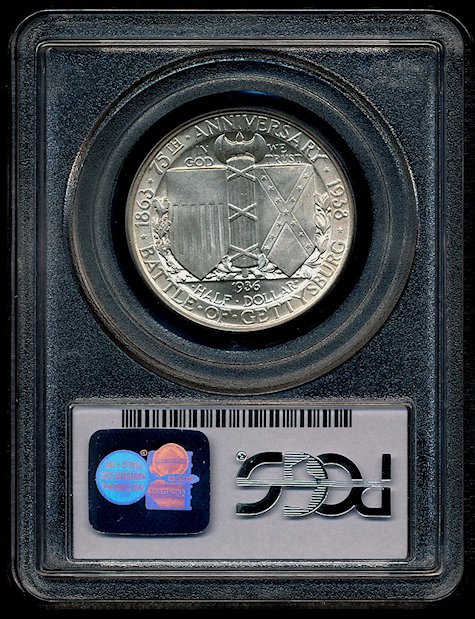
Tidbit #4Some contemporary reports of the 1936 Battle of Gettysburg 75th Anniversary Half Dollar stated that the coin was the first US coin to include the Confederate flag in its design, and that the flag presented was the Confederate "Stars and Bars" design.
Such statements were wrong on both accounts: 1) The
1934 Texas Independence Centennial Half Dollar included a depiction of a Confederate flag on its reverse - years before the Gettysburg coin, and 2) the Confederate "flag" (shield actually) was not of the "Stars and Bars" design (the first National Flag of the Confederacy), but rather a rendering of a Confederate Battle Flag.
ICYWW: the 1925 Stone Mountain Memorial Half Dollar - a coin intended to be a "Memorial to The Valor of the Soldier of the South" - did not include a flag in its design, Confederate or otherwise.
For other of my posts about commemorative coins and medals, including more Gettysburg half dollar stories, see:
Commems Collection.







 Posted 10/20/2025 09:25 am





