Before the Act that authorized the 1993 James Madison/Bill of Rights commemorative coin program, there were separate efforts to secure a standalone coin program for the Bill of Rights and James Madison. Here, I'll explore the bills targeting a coin for the Bill of Rights. (I'll explore the James Madison coin proposals in a follow-up post.)
Companion bills were introduced in the United States ("US") House of Representatives ("House") and US Senate in February and March, 1990, respectively; the 101st Congress was in session. The bills called for a three-coin program - Gold Half Eagle, Silver Dollar and Copper-Nickel (CuNi) Clad Half Dollar.- "in commemoration of the Bill of Rights."
The House bill was introduced by Paul B. Henry (R-MI); the Senate bill by Edward M. Kennedy (D-MA). The bills called for the striking of up to 500,000 Gold Half Eagles, up to 2,000,000 Silver Dollars and up to 3,000,000 Clad Half Dollars..
The same general design parameters were specified for each of the proposed coins, their designs were to "be emblematic of one or more of the first ten Amendments to the Constitution of the United States, known as the Bill of Rights." It seems plausible to envision that each of the coins would have featured different designs and that all ten amendments of the Bill of Rights would have been highlighted between the three coins.
The coin designs were to be selected by the Secretary of the Treasury after consultation with the Trustees of the James Madison Memorial Fellowship Foundation and the Commission of Fine Arts.
Note 1: The US Bill of Rights was primarily drafted by James Madison; he based it on the Virginia Declaration of Rights prepared by George Mason in 1776. The US Bill of Rights guarantees certain civil rights and liberties to the individual that the Government is not to infringe upon.Note 2: The Bill of Rights, as drafted by James Madison, included 19 amendments to the US Constitution. The US Congress debated the proposed amendments and settled upon 12 to present to the States to ratify (a necessary step). The States ratified 10 of the 12 proposed amendments and thus the US' "Bill of Rights" includes 10 amendments. Portrait: James Madison by John Vanderlyn (1816)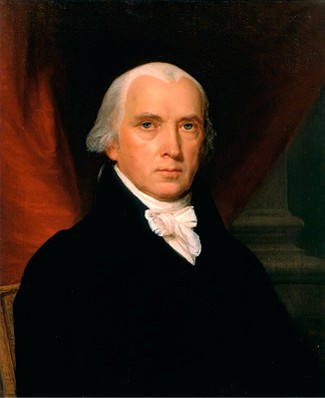 (Image Credit: White House Art Collection, CC BY US 3.0. Public Domain.)Note 3: At the time of sitting for this portrait, Madison was serving as the 4th US President (1809-1817).
(If you'd like to read the US Bill of Rights in its entirety, see:
The United States Bill of Rights.)
Each of the coins was to be struck in Proof and Uncirculated versions, with the authorization window being from January 1, 1991 through June 30, 1992. The US Bill of Rights was officially ratified on December 15, 1791 when Virginia ratified it. Virginia's vote created the needed three-fourths majority among the States (11 of 14; Vermont joined the Union in March 1791). So, the proposed timing for the coin program would have represented the landmark document's actual bicentennial anniversary.
The Issue Price of each coin was to include a surcharge:
- Gold Half Eagle - $35 per coin
- Silver Dollar - $7 per coin
- Clad Half Dollar - $1 per coin
Collected surcharges were to be paid "to the James Madison Fellowship Program established in 1986 by the James Madison Memorial Fellowship Act...to encourage teaching and graduate study of the American Constitution, its roots, its formation, its principles, and its development." A program sell out would have generated $34.5 million in surcharge funds.
Upon its introduction, the House bill was referred to the House Committee on Banking, Finance and Urban Affairs, with a further referral to its Subcommittee on Consumer Affairs and Coinage. The Senate bill was referred to the Senate Committee on Banking. Neither Committee reported on its referred bill. However, with over 130 co-sponsors, the House coin bill laid a solid foundation for future efforts.
For other of my posts about commemorative coins and medals, including more about the James Madison/Bill of Rights coins, see:
Commems Collection









 Posted 11/09/2025 3:13 pm


 Uncirculated American Silver Eagles


