| Author |
 Replies: 12 / Views: 1,088 Replies: 12 / Views: 1,088 |
|
|
Valued Member
United Kingdom
59 Posts |
This might be slightly off topic, but I was just idly browsing GreatCollections and I saw an 1895 shilling with a low bid so far. Click on it, it's in a PCGS slab that says 'XF40' (I believe that's the Sheldon equivalent of EF). Click on the image of the actual coin, it's not even VF to my eyes, looks more like about Fine to me.
So has PCGS lost their marbles when it comes to British coins, or are US grading standards more lax?
|
|
|
|
Valued Member
United States
425 Posts |
 I guess you could say every grading company has their off days. Humans grade the coins and every person doesn't feel the same every day they come to work. I guess I am trying to say graders have their off days as do we. I have submitted coins to a few grading companies and they all give grades we sometimes do not agree with. Just like my 4th grade teacher, she was tough. Sometimes you just have to send the coin back and let them have a look at the coin a second time around. It is extremely tough being a grader at companies. Like umpires in sports there is always someone who doesn't agree. I guess I will conclude and say sometimes I do not see the grade on a coin but if you look hard I think you may see what they see. Hope this helps. Hope I did not confuse you, nice post. |
|
Valued Member
 United Kingdom
59 Posts |
SaturnD51 that makes perfect sense, and I figure as well not everyone is going to grade coins from other countries perfectly. (Case in point, I wouldn't know a Morgan from a Walking Liberty if it bit me, let alone how to grade either one!)
|
|
Pillar of the Community
 United States
2498 Posts |
Quote:
I figure as well not everyone is going to grade coins from other countries perfectly I would agree 100% dgwright, . . but, NGC, a United States-based company, grades coins from ancient Egyptian and other ancient countries; no one seems to be complaining about their grades... .Someone started the hoopla, "PCGS is the greatest", and everyone is now following the dirt road.. |
|
Moderator
Australia
17035 Posts |
Yes, US grading standards, particularly for circulated coins, are "more lax". It's called "gradeflation".
Long long ago - like, back in the Renaissance era, the 1500s and 1600s - the adjectives coin collectors used to grade coins were quite literal. A coin in Good condition actually was pretty good, a coin in Fair condition was pretty fair, and so forth. Everybody only collected ancient and mediaeval coins back then, and such coins rarely come in what we would call "high grade". "Fine" was about as high a grade as anybody would have needed.
As minting technology advanced and coins could come out of the presses looking really nice, we needed to expand the vocabulary to fully describe these new shiny coins. Thus, Very Fine and Extra Fine were added. At some point, the concept of taking a coin straight from the press into the hands of a collector was invented, thus creating the "Uncirculated" grade.
But over time, grading standards slipped, due to much the same natural pressures that cause economic inflation - everybody wants higher graded coins, everybody thinks their own coins are nicer and higher grade than everybody else's, and coin dealers want to extract more money from collectors by claiming the coin is higher grade than it really is. Thus, the meanings and definitions of those adjectives slowly drifted away from their literal meaning and gradeflation crept into the coin market. So today, even in Britain, a coin in Good condition is actually rather awful.
We can see further evidence of gradeflation happening in more modern times by picking up any old "how to collect coins" book, from the 1960s or earlier, and looking at their "how to grade coins" chapter. I have a book from the 1960s that says that only about half of the coins in a mint roll are likely to qualify as "Uncirculated". Half of them, when technically, every single one of them must, by the definition of "mint roll", be "uncirculated".
Gradeflation has affected different coin markets around the world differently. Britain has suffered from gradeflation the least, and thus retains the "toughest" grading. America has suffered it the worst, and their grading standards are the sloppiest. Australia is about halfway between them. There's about one whole grade level between each of them. Thus, a coin that a British collector would call "Fine", an Australian would happily call "Very Fine" and an American would consider "Extremely fine".
All of this is fine and dandy, as long as the markets remain distinct and separate. Unfortunately, in today's modern global marketplace, they do not - and this ends up in confusion, and lots of "Americans can't grade coins properly" comments coming out of Britain and Australia. But they can "grade them properly", in terms of being rigidly defined and consistent - they're just using a different grading standard. The increasing popularity of American TPGs does have the unfortunate side-effect of forcing collectors outside of North America to learn two different grading standards (the American one and their own native one), and how to convert between the two. Fortunately, the Sheldon system widely used in North America makes it easy to discern which of the two grading systems is being used.
TLDR: yes, "XF40" is indeed supposed to mean "extremely fine". But the Americans have redefined "Extremely fine" to mean something different to what it means in Britain.
Don't say "infinitely" when you mean "very"; otherwise, you'll have no word left when you want to talk about something really infinite. - C. S. Lewis
|
|
Valued Member
United Kingdom
59 Posts |
Sap, that actually makes perfect sense that different countries with different numismatic histories would have different grading standards. I've read before that Britain's grading standards are more stringent than those of the US. And it's useful to know that a Sheldon XF-40 is roughly equivalent to a F-NVF in the UK. I live in the US now but I spent the first 30 years of my life in the UK and so the British grading scale is far too deeply ingrained in me to ever let go of it.  I was very guilty in my mis-spent youth of over-inflating coin grades, but these days I'm a lot more diligent... |
|
Pillar of the Community
Canada
5423 Posts |
PCGS IS brutal when it comes to foreign coins .
Especially European , Canadian and Australian circulated
grades coins . Laughable really!
|
|
Pillar of the Community
United States
2498 Posts |
I have been at times studying Older Holders ("Rattlers", Fatty Slabs") I notice that coins in old holders (1986-2004) often show: . . . Stricter grading, Less generous to eye appeal If modern holders show noticeably higher grades for coins in older holders with similar marks, strike, or luster, this is, I guess, what Sap is talking about, " gradeflation". Thank you Sap ! |
|
Bedrock of the Community
United Kingdom
19213 Posts |
dgwright - I agree. I'd grade this coin as Fine. 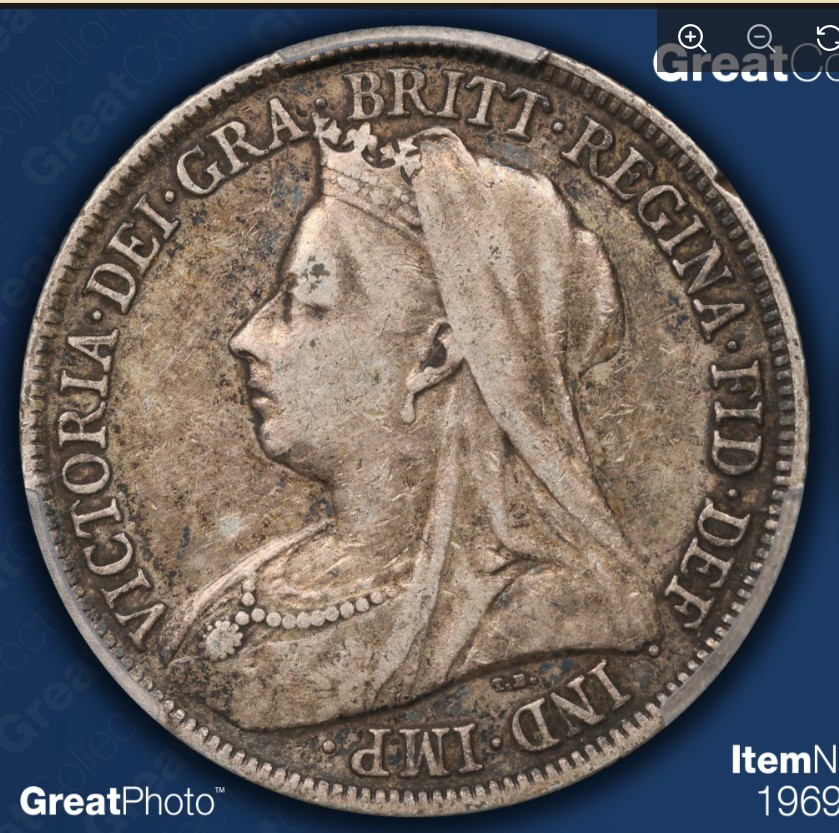 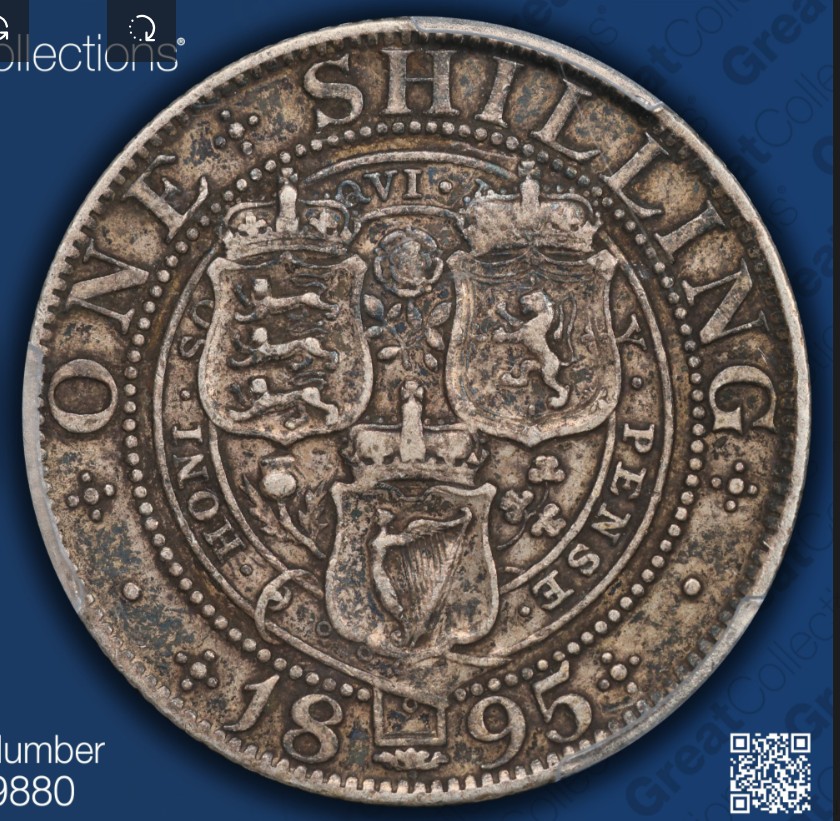 (photos from Great Collections) |
|
Valued Member
United Kingdom
59 Posts |
NumisRob, I would as well. 30 years ago I'd probably have called it VF but I was still in my infancy collecting wise then.
|
|
Valued Member
United States
425 Posts |
There was a member who once posted about AI grading of coins. I agree that they should have AI grade coins therefore we would have grades we could not object to. That might be a possibility in the near future, who knows if it would ever happen. I myself believe CAC is a strong grader of coins.
|
|
Valued Member
Australia
144 Posts |
I have had mainly British and Australian coins graded by PCGS and have found them to be accurate about 80% of the time. The other 20% sees a grade that, in my opinion, is 15, maybe 20 points off what it should be. For NumisRob's coin I would think that's Fine. At best. But then again I live in Australia where the grading standards are quite a lot tighter than what PCGS uses. I had an Australian 2000 $1 mule coin in a PCGS holder with AU50 that was very well worn, so in my opinion should never ever get 'about uncirculated' attached to it. Sometimes, in my opinion, PCGS grades grossly too low. Not to hijack the thread, but here is my example of a banknote I submitted and was shocked to see it only got VF30. I found another PCGS VF30 note to compare it to and the difference is extraordinary. Yet, PCGS says they're the same https://goccf.com/t/485025 |
|
Pillar of the Community
United States
1082 Posts |
Just dropping by to confirm. As a long-time American collector of British/Colonial tokens from the 18th and 19th centuries, most of my acquisitions over the last 4-5 decades have perforce been from the UK, where buying coins (slabbed or not) has always been a culture-shift experience -- sort of analogous to the language adjustment my wife and I go through whenever we spend a long weekend in Quebec City or Montreal (both a short hop from our home).
On the upside, however, the market now seems to be accommodating this built-in transatlantic difference in grading perceptions. For the last two or three years I've begin to notice that a few UK auction houses -- Noonan's comes to mind right now -- have begun to include in their lot descriptions of slabbed tokens their own assigned grades and also an acknowledgment that PCGS or NGC has graded them differently.
In every instance that I can recall, the TPG grade has been at least a half step higher than the auctioneer's grade, and quite often higher than that. Here's an example, pasted in directly from a recent Noonan's lot, a silver Bank of England token: "Good extremely fine, toned [slabbed NGC PF 63]."
Quite the Δ, I'd say!
I believe Baldwin's and Spink and (in the US) Davisson's are among the vendors that will sometimes point out this sort of TPG optimism. I don't believe I've ever encountered such qualifiers at Heritage, CNG, or Great American. Your mileage may vary, of course, as I'm only ever looking at my very tiny sliver of the collecting universe.
As always, it can't hurt to repeat: "Caveat emptor and remember to study the photos closely. You're buying the coin and not the slab."
"If everything seems to be under control, you're just not going fast enough."
--- Mario Andretti
|
| |
Replies: 12 / Views: 1,088 |
|







 Posted 11/20/2025 5:40 pm


