| Author |
 Replies: 10 / Views: 964 Replies: 10 / Views: 964 |
|
|
New Member
United States
28 Posts |
Not sure if it's really a token, or what it would be considered as. I got three of these a while back; brass, uniface, and with different (but close) numbers stamped on them. An online search only really finds a brief wikipedia page on the company, and some old records, of course nothing on these pieces. My initial thought was something like worker's tags (which seems odd for this type of work), or like a bale/barrel tag. Anyone have any information, or possibly some other ideas? 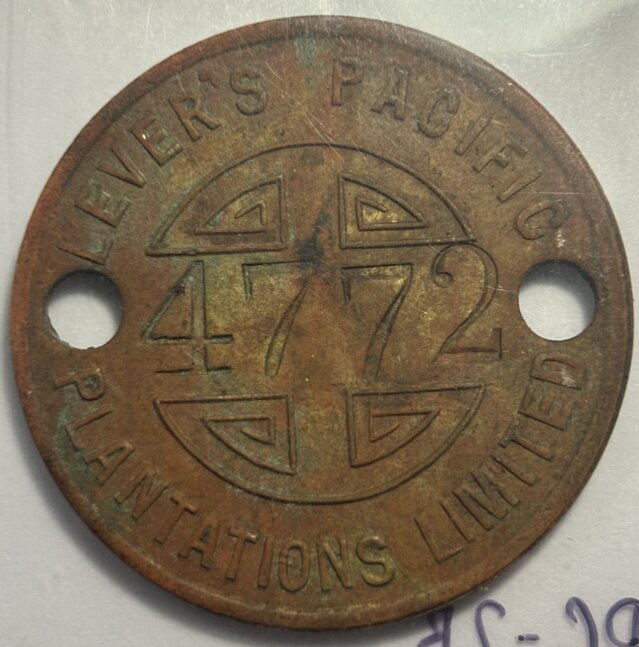 |
|
|
|
Bedrock of the Community
 United States
10601 Posts |
AI description comes up with this: "The object is a Lever's Pacific Plantations Limited brass plantation token, likely from the Solomon Islands. It features the number 4772 within a decorative motif, possibly used for tracking labor or wages on the plantations. Material: Made of brass. Origin: Associated with the Solomon Islands. Function: Used as a form of currency or identification on plantations. Company: Issued by Lever's Pacific Plantations Limited, a subsidiary of the British company Lever Brothers."  |
|
Pillar of the Community
United States
5029 Posts |
This is a great example and a fantastic item for a token collector.. Quick search using Google Lever's Pacific Plantations Ltd. tokens, including those numbered like "4772," were used as private currency (scrip) to pay laborers on the company's coconut and copra plantations in the Solomon Islands during the early 20th century.
Their primary uses included:
Laborer Compensation: Tokens were issued to indigenous workers instead of official government currency. This practice was common in remote colonial areas where hard currency was scarce.
Company Store Purchases: Workers could typically only spend these tokens at "company stores" owned by Lever Brothers (the predecessor to Unilever). This ensured the wages paid out were recycled back into the company's own ecosystem.
Identification: The specific number stamped on a token (such as 4772) often corresponded to a worker's registration or payroll number, acting as a form of physical identification or a way to track work quotas.
Today, these aluminum or brass tokens are highly sought after by numismatists as historical artifacts of the "plantation economy" and the early history of the Solomon Islands. |
|
Moderator
United States
197834 Posts |
Interesting example!  |
|
New Member
 United States
28 Posts |
Thanks for the replies so far, I haven't found anything else out myself. I feel they're probably not scrip, and still think the ID tag seems more likely - whether to ID workers, their payrolls, or their product - would still be the question, I suppose.
|
|
Moderator
United States
109800 Posts |
nice token - what does the other side look like?
|
|
Pillar of the Community
United States
624 Posts |
I'd say its a laborer's Id tag. The term "bango" is also used for these on the pineapple plantation days in Hawaii.
|
|
Pillar of the Community
United States
5029 Posts |
I am continuing to look but this piece is becoming quite the interesting search item.
From google focused search. (If they used this as a labor id or tag there is no record of it.)
In the historical records of Lever's Pacific Plantations Ltd (LPPL) in the Solomon Islands, there is no evidence of specific company-issued metal "tally tags" or wearable ID tags. Labor was managed through contractual and administrative systems rather than proprietary hardware.
While other regions (like Hawaii) used metal "bango tags" (copper tags with numbers) to identify plantation workers by race and pay scale, the LPPL system in the Pacific relied on a paternalistic contract system where the worker's identity was managed through paper registries and village-based recruitment records.
Edited by scopru
01/07/2026 07:51 am
|
|
New Member
United States
28 Posts |
I'm not thinking they're intended to be wearable or the like. I'm more thinking they'd be like the old mining tags - put your number on a board before you went down into a mine so if there was a cave-in the company would know who wasn't accounted for afterwards.
Highly doubtful the plantations had quite the degree of danger like those American mines, but that was my train of thought.
|
|
Pillar of the Community
United States
1147 Posts |
The numbers are punched so likely each piece is unique. The holes could be used to be strung thru creating an id tag. My guess would be it was tied on a bag with the number identifying it or they were used as script as someone suggested and the holes used for keeping them together(on a chain or such). My train of thought is you tied this on a bag, they wrote your number down, and you were paid for that. All guess work here but without someone doing the research it's all I have.
Edited by cointagous
01/17/2026 09:18 am
|
|
New Member
United States
28 Posts |
I had to search a bit for my other two pieces. The one shown above (4772), plus 4771 and 4779. The "4" on each seems to be in the exact same position and orientation, all the other numbers are variable, likely punched manually. Also realised I hadn't mentioned this, but they have a diameter of 39mm.
|
| |
Replies: 10 / Views: 964 |
|







 Posted 01/03/2026 07:25 am


