I previously posted about a potential American Revolution Bicentennial commemorative Silver Coin Set (see it here: What If? 1971 American Revolution Bicentennial), but it was not the only Bicentennial-related commemorative program proposed in Congress in 1971. This time out, I present a proposed program that was far more expansive.In June 1971, James Albertus McClure (R-ID) proposed a bill in the House of Representatives ("House") that called "for the striking of medals and §1 pieces in commemoration of the bicentennial of the American Revolution."
Pennsylvania Statehouse/Independence Hall - Circa 1776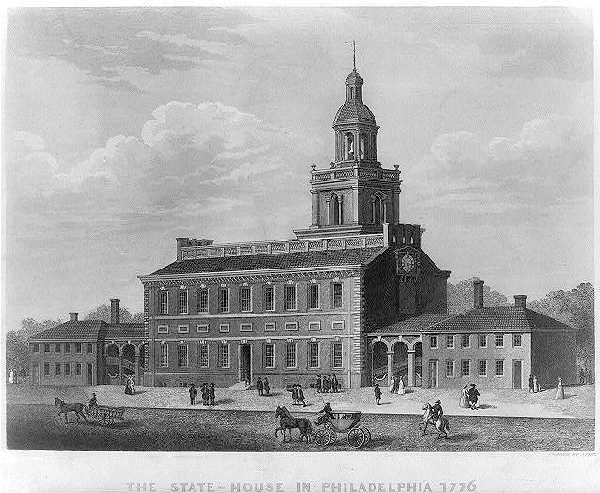 (Image Source: Library of Congress, Prints and Photographs Division. Public Domain. Engraving by John Serz; ~1878.)
The commemorative $1 coin was fairly straightforward in its provisions:
1) It was to be 1.5" in diameter (a United States ("US") coinage standard);
2) It was to be a Clad coin (Silver core) of 80% Silver and 20% Copper;
3) It was to have an overall weight of 24.592 grams.
The Secretary of the Treasury, in consultation with the American Revolution Bicentennial Commission ("ARBC"), was to select the designs for the coin and to determine its mintage.
The proposed medals were a very different matter, however, there were to be National medals, up to 13 commemorative medals and an Award medal. There were to be multiple sizes and metallic compositions of the National and commemorative medals. The bill even included a provision for medals to be struck by each of the US' 50 States under the guidance of the ARBC! A bashful medal proposal it was not!
Let's take it from the top:
First up, an officially designated National Medal was to be authorized "commemorating the year 1776 and its significance to American independence." Medals were to be struck in 0.925 Fine Silver (Sterling) and Bronze in two unspecified sizes (large and small can be inferred from the bill's language).
In addition, up to 13 additional commemorative medals could be struck "to commemorate specific historical events of great importance, recognized nationally as milestones in the continuing progress of the United States of America toward life, liberty, and the pursuit of happiness." The medals, also to be produced in silver and bronze versions - as with the National Medal - were to be struck by the US Mint.
In addition to these medals, each US State was authorized to strike a commemorative medal under the bill, with the ARBC and the Secretary of the Treasury given the authority to approve the designs of such medals before they were struck. The medals were to be struck by a private mint vs. the US Mint.
A gold version of each of the above medals was authorized to be struck upon direction/request of the ARBC, in consultation with the Secretary of the Treasury.
Lastly, the bill authorized an Award Medal to present "in recognition of outstanding service, leadership, or support of bicentennial programs." The Award Medal was to be struck in 0.925 Fine Silver, in one size, as determined by the ARBC; it was to be struck privately.
The medals struck by the US Mint (i.e., the National Medal(s) and the 13 commemorative medals) required a minimum order of 2,000 pieces; no such restrictions were placed on the medals to be struck privately. The bill did not specify maximum mintage figures for any of the medals; they could be struck to meet the level of public demand.
The bill was referred to the House Committee on Banking and Currency, but progressed no further.
Though these particular medals were not struck, the private Franklin Mint produced a variety of US Bicentennial medal sets in Sterling Silver and Bronze, including one that depicted the Official Bicentennial logo design of each State. Many other privately-struck US Bicentennial medals were struck as well!
More numismatic bills followed as the Bicentennial approached. I plan on discussing each in upcoming posts!For other of my posts about commemorative coins and medals, including more "What If?" stories, see:
Commems Collection 









 Posted 03/24/2026 1:31 pm


