I don't typically collect tokens, but the story behind this one intrigued me. I was able to purchase one for less than $2. and so, it's now part of my collection!The "Universal and International Exhibition" - commonly referred to as Expo '67 - was held in Montreal, Canada from April 28 to October 29, 1967. 60+ countries participated in Expo '67 - the "Crown Jewel" of Canada's Centennial celebrations - with more than 90 pavilions constructed (many by participating countries, others by private companies/organizations) and is said to have drawn over 50 million paid visitors.
Expo '67 was organized and received its primary national funding from the Canadian Corporation ("Corporation"), a Crown Company of the Canadian Government. The Corporation was established in December 1962 via the Canadian Parliament.
From a numismatic perspective, th Expo offered an "Official Medallion" (I'll discuss in a separate post), a variety of privately-sponsored souvenir medals and at least one intriguing token.
In 1967, the Canadian Dollar ("CAD") and United States Dollar ("USD") were not at an even exchange rate - one CAD was worth ~$0.93 USD or, alternately, $1 USD was worth ~$1.07 CAD. To compensate for the difference, the Corporation contracted with Wellings Manufacturing Company Limited (which billed itself as "Canada's Private Mint") to produce aluminum "exchange" tokens that were given to those using USD's - they were meant to make up the difference in value per the exchange rate.
Most of the contemporary accounts I've read indicate the exchange was addressed - one token per USD - when attendees paid for parking with USD, but it's possible that other purchases/payments using USDs also generated a token exchange. For example, I've read of their use throughout the Expo '67 grounds for goods and services, and of direct exchanges at Expo '67 on-site banks.
The aluminum tokens have a diameter of 19 mm (slightly larger than the Canadian 10-cent piece at 18.03 mm); it has a smooth edge.
1967 Expo '67 Currency Exchange Token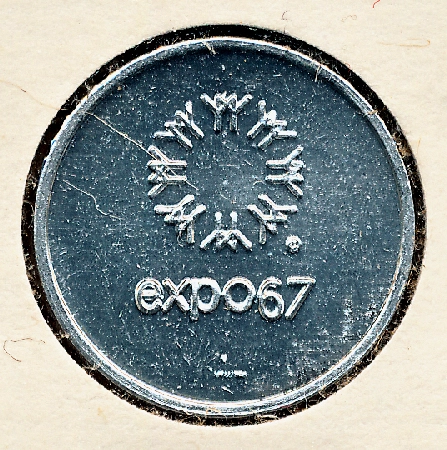
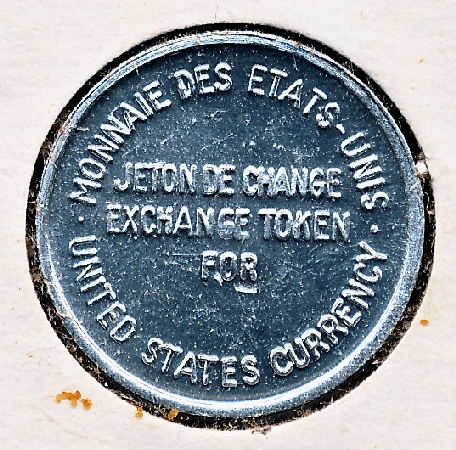
The token's design is simple: the obverse presents the Expo '67 logo with the Wellings Mint mark below; the reverse features the inscriptions: MONNAIE DES ETATS - UNIS / UNITED STATES CURRENCY encircling at the rim, JETON DE CHANGE / EXCHANGE TOKEN FOR at the center.
From the Expo67 Museum web site, an explanation of the Expo '67 logo:
The Logo: A circle made up of stylized human figures holding hands.
Created by: Julien Hebert, a renowned industrial designer from Quebec.
Context: The 1967 World Exposition, held in Montreal, welcomed over 50 million visitors and featured more than 90 pavilions. It remains one of the most significant events of the 20th century in Canadian history.
Meaning: The logo expresses the ideal of friendship and cooperation among nations, perfectly aligned with the exposition's theme, Man and His World. Each figure represents a person, and their circular arrangement symbolizes global unity.
Why it's often confused: Its widespread use in 1967, along with its circular shape and abstract design, can make it difficult to distinguish from the Centennial logo, especially for those who didn't live through that era.Use of the exchange token was short-lived, as reports indicate that banks at the Expo found that exchanging them (at the then-current exchange rate) was too burdensome and stopped participating in the program.
For other of my posts about commemorative coins and medals, including more Canada-related stories, see:
Commems Collection 









 Posted 03/26/2026 11:33 am


