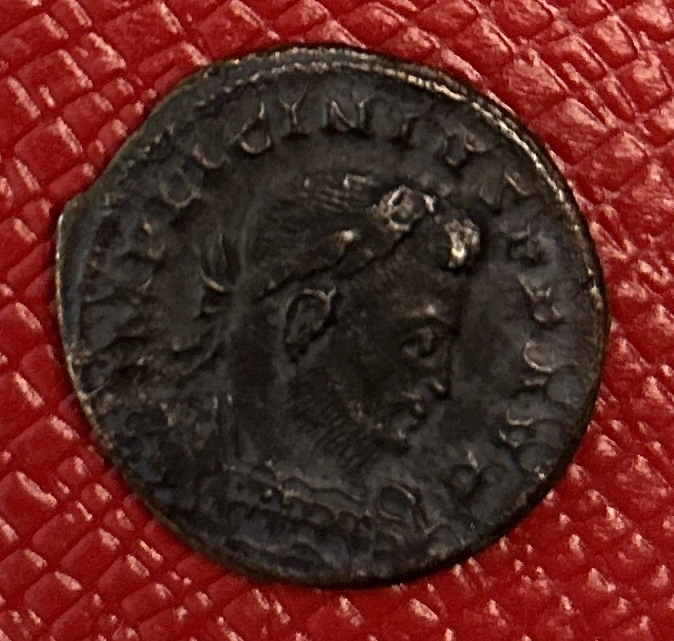
His English-language name is "Licinius", with a U, not a V.
The Latin alphabet does not have separate letters for U and V, they used the letter "V" for both. This usage of V for U carried through to early English and the separation of U/V into two separate letters didn't come about until the late Middle Ages. Likewise, the Romans had no letter "J", but used "I"; the English letter J evolved from writing the initial letter I in a fancy way, and was eventually assigned its own separate pronunciation. The Romans also had no letter "W", but sometimes wrote the letter V twice to create a W-like sound. This is why the name of that letter in English is "double-you", and not "double-vee", despite being written as a double-V.
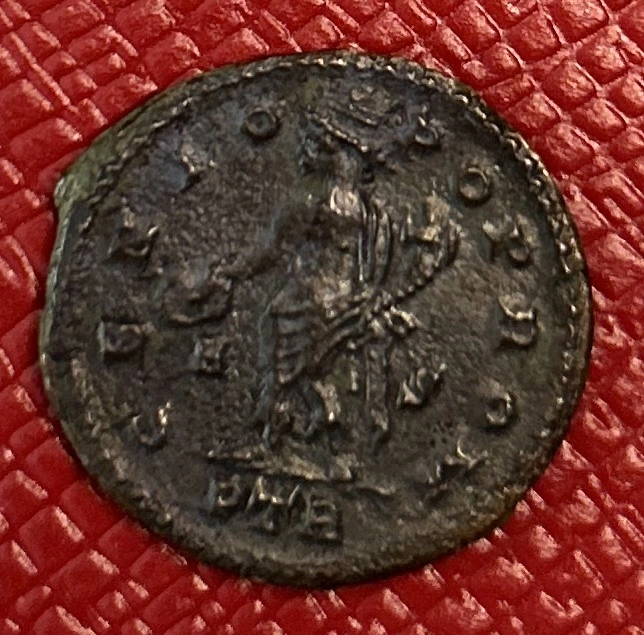
Converting the Latin V into modern English as either a V or U can be somewhat arbitrary; as with the English letter Y, you need to take the surrounding context of the word to figure out whether it's supposed to be a vowel or a consonant. Take the word VNIVERSALIS, which we recognise as the origin of our word "universe"; as with the English word, the first V is a vowel, the second V is a consonant. Or take the word "IVVENTVTIS" appearing on certain coins depicting young Imperial family members and which means "of the youth". This is usually transliterated to "juventutis", though the actual Romans likely pronounced it more like "eyoo-wen-too-tis" rather than the "joo-ven-too-tis" we'd normally mangle it into.
Don't say "infinitely" when you mean "very"; otherwise, you'll have no word left when you want to talk about something really infinite. - C. S. Lewis












 Posted 03/31/2026 6:09 pm


