Presentation of the Draft of the Declaration of Independence in the Continental Congress - June 1776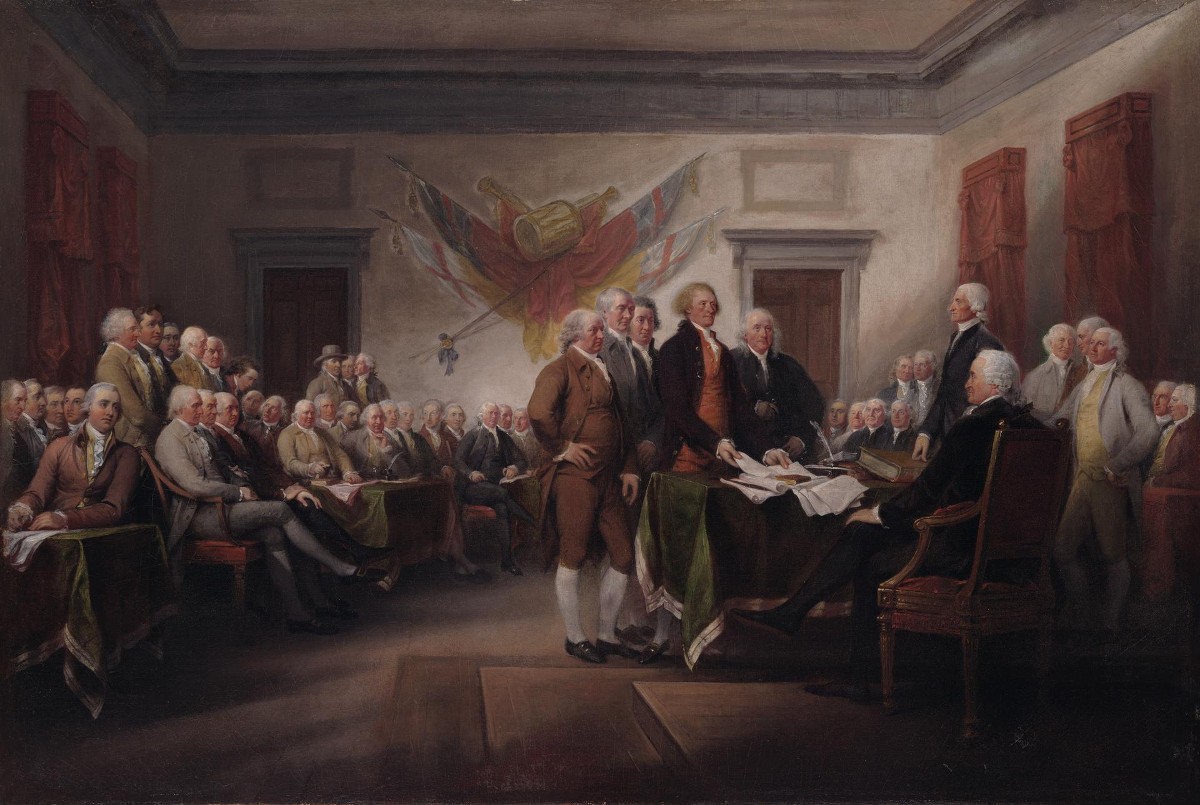 (Image Credit: Yale University Art Gallery, Trumbull Collection. Public Domain.)Note: This famous painting by John Trumbull was painted between 1786 and 1820.
A quick recap...
Representative William Wright Patman (D-TX), on behalf of himself and Leonor Kretzer Sullivan (D-MO), William Beck Widnall (R-NJ) and Chalmers Pangburn Wylie (R-OH), introduced a bill in the House of Representatives ("House") that proposed "a new coinage design and date emblematic of the bicentennial of the American Revolution for dollars and half-dollars, and quarters." The bill was introduced in June 1973, and referred to the House Committee on Banking and Currency.
The bill's proposal of three Bicentennial coins (vs. two) was the result of the US Treasury Department re-evaluating its capacity to produce a redesigned Quarter Dollar in addition to the Dollar and Half Dollar it previously supported. Its exploration of such possibility was based on suggestions made by John J. Pittman, president of the American Numismatic Association ("
ANA") during his testimony before the Subcommittee on Consumer Affairs of the House's Committee on Banking, and Currency in conjunction with the previous Patman, et al. coin bill.
The bill was reported back by the Committee in July 1973. The Report was favorable, with a recommendation to pass. Things took a dramatic turn at this point.
Spark Masayuki Matsunaga (D-HI) introduced a House Resolution that called for the Whole House to consider - for up to one hour - the current House Bicentennial coinage bill (vs. a separate Committee), accept potential amendments to the bill, and, after passing the bill, discharge the House Committee on Banking and Currency from further consideration of the Senate Bicentennial bill before it and substitute the approved House bill in its place.
The Resolution was subsequently passed, and the House took up consideration of the Patman, et al. Bicentennial coinage bill. Co-sponsor Leonor Kretzer Sullivan kicked off the discussion:
"This bill does not go as far as the coin collectors and many other citizens have been urging in utilizing our coinage to commemorate the Bicentennial of the American Revolution, but it represents our best judgment as to what is feasible. We were urged most persuasively by the numismatic hobby to require changes in all of our coins for 1976--a complete change of design on both sides of every coin. This is what Canada did in observance of its Centennial several years ago. And we would have loved to do the same thing for our Bicentennial.
"As a matter of fact, the Advisory Panel on Coins and Medals of the American Revolution Bicentennial Commission recommended to the Commission - and the Commission in turn recommended to the President - that all denominations of coins be changed in 1976 and for the subsequent 25 years to commemorate the Bicentennial. However, the administration was adamantly against any special commemorative coinage for the Bicentennial. Mr. Patman, Mr. Widnall and I subsequently met with the Director of the Mint, the Honorable Mary Brooks, to urge reconsideration of this position and Mrs. Brooks took up the issue further with Secretary Shultz. Eventually the administration relented and sent up a bill early this year proposing Bicentennial designs on the reverse of the dollar and half-dollar coins only. Mr. Patman, Mr. Widnall, Mr. Wylie and I then introduced this administration bill [in March,1973].
"In the hearings of the Subcommittee on Consumer Affairs in May, we went into this issue in depth and learned of the tremendous technical difficulties the Bureau of the Mint would experience in trying to meet the surging demand for more and more coins for daily commerce if the designs of all of the coins were changed. Working around the clock, three shifts a day, they could not meet the projected demand. It is not that the Mint could not produce enough for commerce. But it could not do so and also produce the billions of additional coins which would be diverted from circulation as Bicentennial commemorative collector pieces.
"COMPROMISE NEGOTIATED TO INCLUDE QUARTER
"The reason the administration suggested changes only in the dollar and half dollar coins for the Bicentennial is that these coins do not normally circulate in any large volume. If they all disappeared from circulation as collector pieces and keepsakes in 1976 and subsequent years we would still be able to have enough coinage for necessary purposes - you can use two quarters instead of a half. And the dollar coin is not in very big demand. The coin collectors pointed out that restricting the bicentennial designs to those two coins would not make the bicentennial a daily reminder to the public, and pleaded to have at least the quarter included. We negotiated a compromise with the administration on this issue by persuading the Treasury to agree to include the quarter as well as the dollar and half dollar, and the price of that agreement was that we include in the bill a provision which permits the Mint as a temporary measure to use its bullion depository at West Point, and any of its other non coinage facilities, for both the production and storage of coins. The Mint would then move some of its old coin presses to West Point or other facilities and thus increase its total capacity. And it would be able to begin turning out coms long before the distribution date because it would then have places to stockpile them. However, it does not have this kind of storage capacity at the existing mints according to Mrs. Brooks. [The present bill] is a clean bill carrying out the decisions made."Note: I've included this lengthy excerpt from Representative Sullivan because I believe it provides a very nice summary of the events leading up to the final Bicentennial coinage bills. To review the previous discussions referenced by Ms. Sullivan, see: What If? 1973 American Revolution Bicentennial - The Evolution Continues.One thing of note between the House bill and the Senate's, the House bill
did not include a provision for gold coins for the Bicentennial - a provision the Federal Reserve System did not support due to its potential impact on gold's market price.
Philip Miller Crane (R-IL) offered an amendment to the House bill that would have restored the Senate bill's provision for a special Gold coin. Debate followed, with those against arguing that it was not an appropriate amendment as it was proposing the creation of an entirely new collector coin vs. simply changing the designs on existing ciruclating coins, and therefore not germane.
The amendment was not allowed.
Representative Crane then offered an amendment that called for 150 million circulating 40% Silver (Clad) circulating dollar coins.
After much debate, the amendment was not allowed on the grounds it was proposing a change in metal composition vs. a design change - it was ruled not germane.
Steven Douglas Symms (R-ID) then offered an amendment that was essentially a duplicate of Representative Crane's second proposed amendment (Silver Clad coins). It called for 150 million, or more, 40% Silver (Clad) Dollar coins for circulation.
It was quickly challenged on the same grounds as the previous amendment and was thus not allowed.
With no further amendments proposed, the House voted on its Bicentennial coinage bill and passed it easily. Next stop, the Senate for concurrence. But, oh, if it were only as easy as it sounds!
See
We Have Coin! - P 2 to read about the Senate's reaction to having its Bicentennial coinage bill substituted!
For other of my posts about commemorative coins and medals, including more "What If?" stories, see:
Commems Collection 






 Posted 04/08/2026 09:18 am





