The 1927 Battle of Bennington - Vermont Independence Sesquicentennial Half Dollar was considered at a time when the United States ("US") Treasury was finding its voice regarding its opposition to the issue of commemorative coins, but it had no objections to striking commemorative medals for the same events.
At the start of the Hearing, Committee Chairman, Albert Henry Vestal (R-IN), read the letter he had received from Andrew William Mellon, Secretary of the Treasury. Here's an excerpt:
"In my judgement, the coinage should not be utilized for profit to finance any project or commemorate any other events than those of great national importance to all of the people. The policy of issuing special coins opens the way to counterfeiting and makes the protection of the integrity of our coinage most difficult. The issue of special coins is not in the interest of the general public and usually satisfies a very limited demand. The practice introduces confusion into our system of coinage , is an unnecessary expense, and as actual results have shown special coins are not liked by the public."Mellon also included a table that illustrated the general poor performance of the Maine Statehood Centennial, Landing of the Pilgrims Tercentenary, Missouri Statehood Centennial, Alabama Statehood Centennial, Ulysses S. Grant Centenary,
Monroe Doctrine Centennial and Huguenot-Walloon Tercentenary half dollars.
The floor was then turned over to the Treasury Department representatives. In attendance were several members of the Treasury/Mint leadership team: Garrad B. Winston, Assistant Undersecretary of the Treasury, Robert J. Grant, Director of the Mint and Mary M. O'Reilly, Assistant Director of the Mint.
Winston and Grant deferred to O'Reilly for questions in consideration of her longer term at the Treasury/Mint and her deeper familiarity with past US commemorative coin issues. O'Reilly made it clear from the start that the Treasury's objection to the proposed coin was not specific to the Bennington-Vermont coin bill, but rather "to the practice of organizations asking for coins for every celebration that comes up."
She also discussed the typical scenario with the "special" commemorative coins that are authorized - many remain unsold by their sponsor and are returned to the Mint.
Q&A followed regarding the Mint's procedures for handling unsold coins that are returned to the Mint by their sponsor. In short, the Mint takes them back at face value, melts them and recoin them as needed and appropriate across denominations. The Mint does not pay for the shipping costs - to or from the Mint - such costs are borne by the coin's sponsor.
O'Reilly then summarized the bills then-currently pending before Congress.
Representative Frederick Gleed Fleetwood (R-VT) was the next to testify. Fleetwood was present to support the Battle of Bennington-Vermont Independence Sesquicentennial Half Dollar coin bill and quickly made known the "tremendous national importance" of the Battle of Bennington and Vermont's early contributions, including the role of the Green Mountain Boys in the American Revolution. He believed such significance justified a commemorative coin to celebrate it.
Randolph Perkins (R-NJ) joined Representative Fleetwood in supporting the coin bill, and engaged in the following with Assistant Undersecretary Garrad Winston:
"MR. PERKINS: Do you not think it is a bad time to start the policy on old Vermont, which is now 150 years old?
MR. WINSTON: I do not know when you are going to stop it!
MR. PERKINS: You are trying to stop it now; there is only one Vermont and one Bennington.
WINSTON: What will I say when the next man comes along?"Representative Robert Milton Leach (R-MA) then joined in to support the bill:
"MR. LEACH: Do you not think that the President, being a native of Vermont, we ought to consider that fact?
MR. WINSTON: I can not see where you draw the line, if you do not draw it and be through with it."No one wanted the line drawn at their bill!
Committee Chairman Vestal then moved the discussion along, and invited Morton D. Hull (R-IL) to speak. Hull let his long-time connection to Bennington be known, and voiced his acknowledgement of the importance placed on commemorating certain events by the local population. He stated that such events offered "a real historical occasion and inspiration for the people of that neighborhood."
Chairman Vestal then questioned Hull on whether "a commemorative medal of some kind would carry out the same idea as the coinage of a 50-cent piece?" Hull questioned whether a medal would be accepted as readily by the public, who might prefer a coin with a stated face value.
Winston was then asked by Vestal if the Treasury Department would object to striking a commemorative medal for the events - Winston stated that it would not.
Committee member James Zacharie Spearing (D-LA) then asked about the striking of a medal with an inscription indicating its origin from the US Government vs. the local anniversary committee. Winston had no issue with including such an inscription. Representative Hull argued in favor of a coin, stating "the coin has a sentimental value with the consuming public, much more than the medal."
The medal vs. coin discussion continued, but Representative Fleetwood eventually made his position clear: "I do not think a medal would be at all satisfactory."
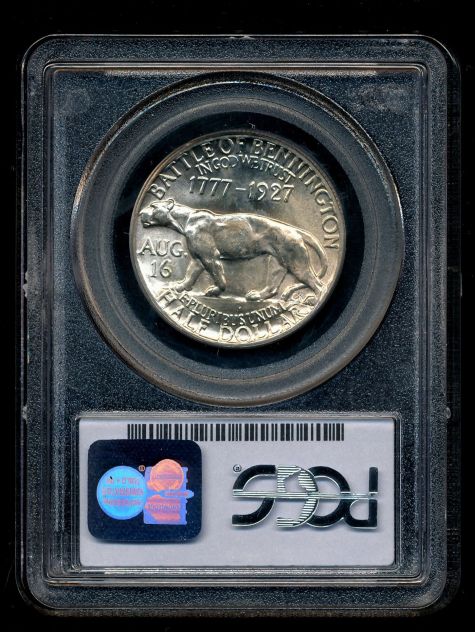
Ultimately, the idea of striking a medal instead of a coin was pushed aside and collectors have the 1927 Battle of Bennington - Vermont Independence Sesquicentennial
Half Dollar to add to their collections.
1927 Battle of Bennington - Vermont Independence Sesquicentennial Half Dollar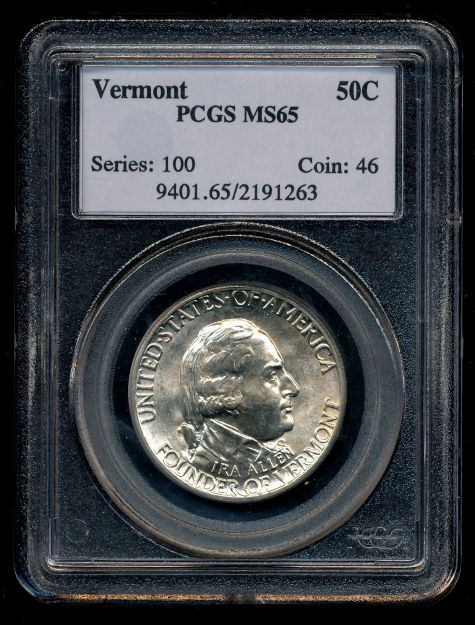
For a read of some of my thoughts regarding the US Treasury's position regarding commemorative coins, see
1927 Battle of Bennington - Vermont Independence Sesquicentennial - Thoughts.
For other of my posts about commemorative coins and medals, including more Bennington-Vermont half dollae stories, see:
Commems Collection





 Posted 04/20/2026 12:16 pm





