| Author |
 Replies: 12 / Views: 590 Replies: 12 / Views: 590 |
|
|
Pillar of the Community
United States
792 Posts |
Hi. Pictured here is a straight graded 1734 Mexican Pillar Dollar (8 Reales). Zooming in, there are some very small green spots. Is this verdigris? Active corrosion? What would you do if this was your coin (it is not my coin)? 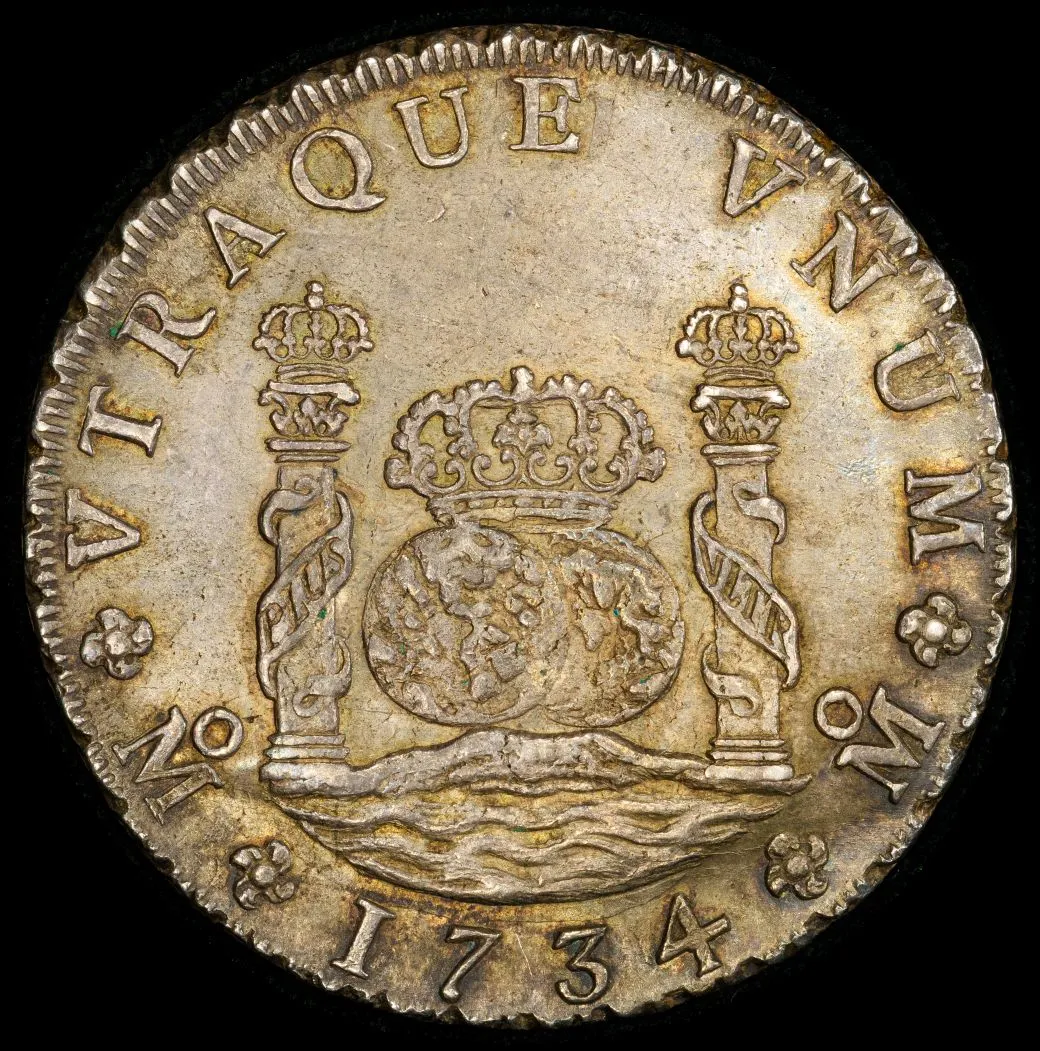 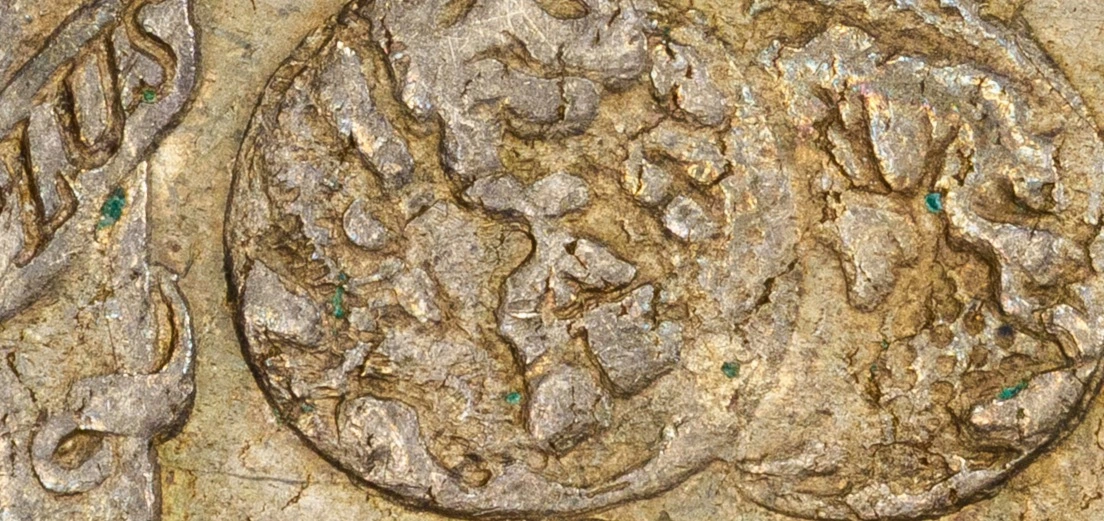 Edited by Adam590
05/09/2026 02:15 am
|
|
|
|
Bedrock of the Community
United States
80349 Posts |
Looks like Verdigris spots to me. If it was my coin, I'd use Verdi-Care to remove the spots.
Errers and Varietys.
Edited by Errers and Varietys
05/09/2026 10:05 pm
|
|
Bedrock of the Community
Australia
21794 Posts |
To get the droplet of Verdicare small enough, drop it off the end of a needle point.
|
|
Pillar of the Community
United States
1918 Posts |
Sharp wooden toothpick works well too.
|
|
Pillar of the Community
 United States
8075 Posts |
I would leave it alone.
The "large" one (I suspect the only one visible to the unaided eye, or at least mine) is what, a quarter of a mm?
Edited by tdziemia
05/10/2026 12:55 pm
|
|
Pillar of the Community
Canada
9911 Posts |
Verdigris is a copper compound.
This coin is about 92% silver.
Very unlikely this is verdigris, as verdigris only affects copper in the alloy.
Much more likely this is PVC damage, it is not stable and should be removed with acetone to prevent further damage.
"Dipping" is not considered cleaning...
-from PCGS website
|
|
Pillar of the Community
United States
1918 Posts |
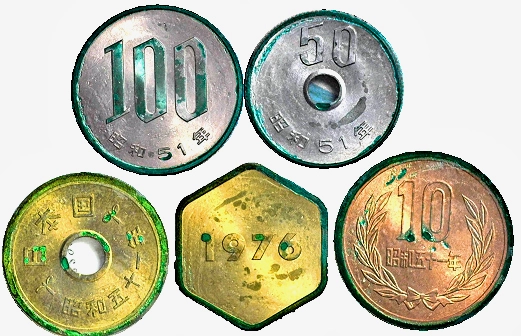 This is PVC "green slime". |
|
Pillar of the Community
United States
8075 Posts |
Edited by tdziemia
05/10/2026 6:17 pm
|
|
Moderator
 Australia
17031 Posts |
Silver does not turn green when it corrodes. Green on a silver-alloy coin is a sign that it is the alloyed copper, rather than silver, that is corroding. High-silver-content coins do not usually form green deposits; when they do form, it is a sign that the coins have been buried or submerged in a corrosive environment for a significant period of time. Salty or acidic soil is the usual suspect. The green deposits are usually somewhat soluble in seawater so shipwreck coins usually do not display this, unless they turn green after improper conservation. Nor do coins that have been "above ground" i.e. in circulation or hidden in collections for most of their existence.
Is it "Active"? No. The coin has been removed from that corrosive environment; any damage has already been done. The green coloration is quite dark and "solid" looking rather than powdery, so bronze disease can be ruled out (not that bronze disease is likely to occur on high-silver-alloy coins). In that sense, it is not "urgent" that this be treated. The coin almost certainly had those exact same green spots on it when it was slabbed, and I have trouble believing that NGC simply didn't notice them, so NGC clearly had no issues with the spots being present.
That the green stuff is stuck way down in the dips and depressions on the coin indicate to me that the coin has already been cleaned; it almost certainly was covered in a lot more green than this when it was freshly dug up out of the ground, and all the easy-to-reach green stuff was removed.
Don't say "infinitely" when you mean "very"; otherwise, you'll have no word left when you want to talk about something really infinite. - C. S. Lewis
|
|
Pillar of the Community
United States
8075 Posts |
Quote:
High-silver-content coins do not usually form green deposits; when they do form, it is a sign that the coins have been buried or submerged in a corrosive environment for a significant period of time. I think the links in my earlier post indicate that coins not subjected to burial or seawater are also prone. Impossible to say qualitatively whether more or less because of selection bias in coins that are likely to show up in acsearch. Suffice to say plenty of silver coins that were never buried exhibit verdigris. |
|
Pillar of the Community
 United States
792 Posts |
...and the plot thickens. I have an update. It turns out this coin was once in a PCGS MS(62) holder with larger spots. It seems someone took out the bigger, left the smaller ones, and then allowed the coin to get resubmitted for an MS(62)+ grade. 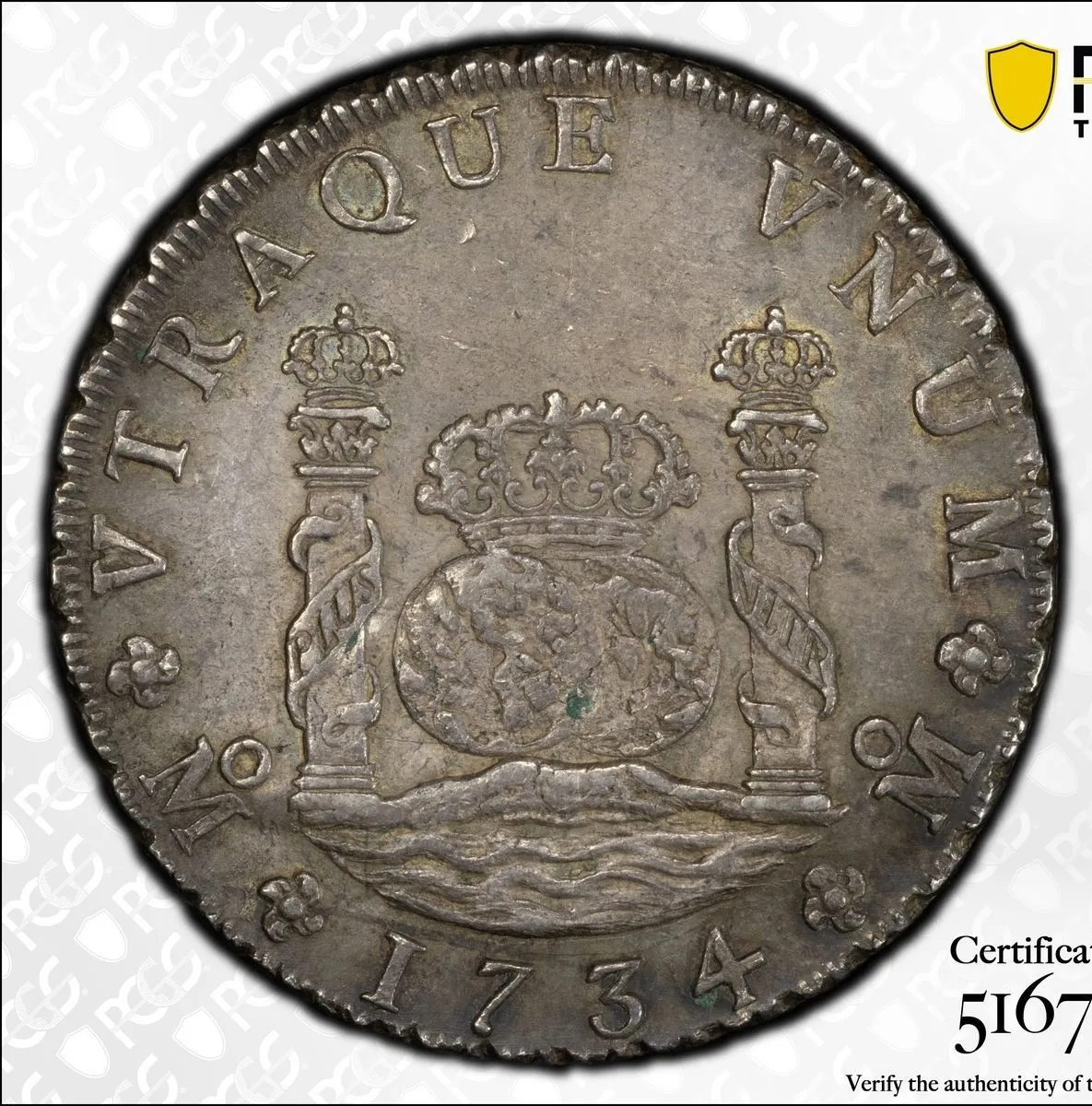 Obviously PCGS is well aware of this, and it very well may have been PCGS themselves. Would these spots still be "active" and eating away the coin in the slab? |
|
Moderator
Australia
17031 Posts |
Quote:
Would these spots still be "active" and eating away the coin in the slab? No, it shouldn't be. As I said earlier, dark green corrosion is fine and stable; it's the powdery pale-green or whitish stuff you've got to look out for. Thanks to these before-and-after shots, we can even test this hypothesis: are there any green spots in the current (new) picture, that aren't present in the older picture? All of the green spots I can see were there on the original - nothing "new" has popped up, and none of the old spots have grown bigger. Some of the green spots in the older photo are hard to see; I'm not sure if that's because of different lighting, photoshop tweaking, or if the spots were made brighter-green by whatever chemicals might have been used to remove the larger spots. There's other evidence of treatment or cleaning besides the removal of the large obvious green patches. In the old photo, there's a fuzzy dark grey patch just inside the first upright stroke of the M in VNVM. This has turned into a bright patch on the newer photo, with some odd scouring or etching apparent inside it. That's harder to explain than just by a change in lighting. My assumption here would be that it was a small patch of horn silver (silver chloride), which is notoriously difficult to remove but can be treated with thiosulfate and physical removal (scraping or scrubbing). And horn silver definitely doesn't form under normal circumstances, but forms after prolonged burial in salty soil or submersion in salt water. Don't say "infinitely" when you mean "very"; otherwise, you'll have no word left when you want to talk about something really infinite. - C. S. Lewis
|
|
Moderator
United States
197800 Posts |
Quote:
I have an update... Interesting.  |
| |
Replies: 12 / Views: 590 |
|




 Posted 05/09/2026 11:16 pm





