It is fair to say that Akron, Ohio rose to significance as a result of the building of the Ohio Erie Canal; the Canal linked Cleveland (via the Cuyahoga River near Lake Erie) and Akron. The Canal enabled Akron to grow into a busy trade center and manufacturing site.
Note: The Ohio Erie Canal was constructed between 1825 and 1832.Simon Perkins (b. 1771; d. 1844) was a businessman, land agent and surveyor (by training). Perkins worked for the Erie Land Company in Ohio, which was owned by the Connecticut Land Company (of Moses Cleaveland fame); he worked for the company from 1797 to 1813. Later, Perkins was a member of the Ohio Board of Canal Commissioners (1826 to 1838) and was responsible for raising money for the Canal's construction and maintenance.
Perkins was also a land speculator who had become the largest land owner in Ohio circa 1815. Learning of the Erie Ohio Canal's construction, Perkins bought land along the Canal's planned route in the area that would become Akron. In 1825, Perkins, along with Paul Williams, donated 100 acres of land to Ohio - it was to be the future site of Akron. (Some sources indicate the donation was Williams') idea.) The site was along the Canal, but on a elevated spot.
Note: 'Akron' is derived from the Greek word 'akros' meaning elevation or summit.In 1975, Akron, OH celebrated 150 years of history with a year-long sesquicentennial celebration and a commemorative medal. The Akron Sesquicentennial, Inc. was established by the Akron City Council in 1973. It was to be the "official agency" to plan and prepare for the city's sesquicentennial anniversary. A community exposition was staged in July and historical dramas were presented in December.
An official 1-1/2" bronze commemorative medal was issued by the agency; silver and silver-plated versions were also available.
The obverse of the medal presents a head-and-shoulders, three-quarters (right-facing) portrait of Simon Perkins, with a Canal Boat navigating the Canal positioned in front of him. The inscription found below the central portrait scene (near the medal's rim), identifies Perkins as the founder of Akron.
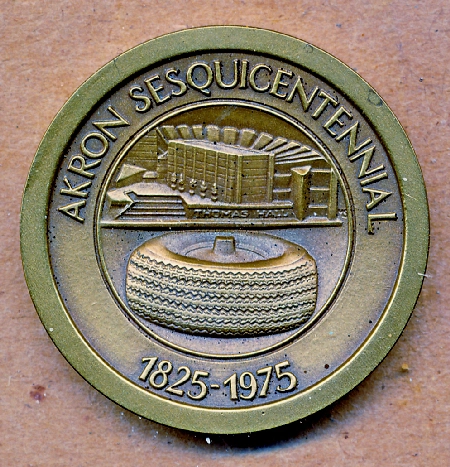
The top portion of the medal's reverse depicts E. J. Thomas Hall. The performing arts center was opened in 1973; it is part of the University of Akron. The Hall was named in honor of Edwin Joel Thomas, the former chairman and CEO of The Goodyear Tire & Rubber Co. (headquartered in Akron).
Below Thomas Hall is a tire, symbolic of the city's robust rubber industry that earned it the nickname "Rubber Capital of the World." Akron was/is home to Goodyear Tire & Rubber Company, Firestone Tire & Rubber Co.(now part of Bridgestone ), B.F. Goodrich (now part of Michelin) and General Tire & Rubber Co. (now part of Continental).
10,000 of the Bronze medals were struck; they sold for $4.00 each at local banks/financial institutions and stores. 500 Bronze medals were "quadruple silver-plated" and were sold for $8.00 each. A limited number of fine silver medals (150) were also struck and were sold for $25.00 each.
1975 Akon, Ohio Sesquicentennial Medal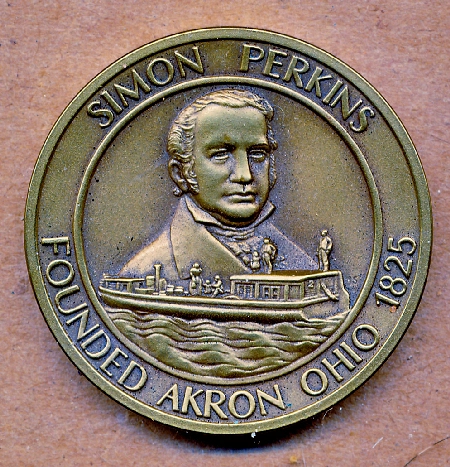
For other of my posts about commemorative coins and medals, see:
Commems Collection






 Posted 05/14/2026 08:03 am


