In a previous post -
1876 Centennial Exposition - I discussed the United States Centennial Exposition and presented a couple of the commemorative souvenir medals struck by the United States ("US") Mint for it. This time out, I'm circling back to the Exposition for a quick look at the US Congress' actions regarding the Centennial Exposition and its authorized medals.
A bit of chronological background:
In March 1871, the US Congress authorized the US Centennial Commission to plan and organize "an exhibition of American and foreign products and manufactures under the auspices of the Government of the United States."
In June 1872, Congress created the Centennial Board of Finance to serve as a fund raiser and fund manager for the planned Centennial Exposition.
The Coinage Act of 1873 - signed into law in February 1873 - included language that authorized the striking of medals by the US Mint only if they were of
national character.
In February 1874, Congress began formal discussions of a medal program to commemorate the 100th Anniversary of American Independence and help mark the Centennial Exposition that was to be held in Philadelphia in 1876. Samuel Hooper (R-MA) got things started when he introduced a bill "To authorize medals commemorating the one hundredth anniversary of the first meeting of the Continental Congress and of the Declaration of Independence."
Upon its introduction, the bill was referred to the House Committee on Coinage, Weights and Measures ("Committee"). The Committee reported the bill back favorably; it was then considered in the House. The brief, ensuing discussion was not about whether the bill should be passed, but rather to clarify its intent and scope.
The bill's language was constructed to support the production/availability of Mint-struck Award medals vs. commemorative souvenir medals. It was amended to ensure that those contacting the Mint for a medal would be liable for the full cost of its production.
The House passed the bill and sent it to the Senate for concurrence; the bill was referred to the Senate Committee on Finance. Senator John Scott (R-PA) announced that the Committee had reported the bill with an amendment. The amendment was one of substitution, and broadened the scope of the bill's medal program and named the Centennial Exposition's Board of Finance as the financial sponsor/beneficiary of the medals.
Note: Both the original House bill and the amended Senate bill included language indicating that the medals stuck were "subject to the provisions of the fifty-second section of the coinage act of eighteen hundred and seventy-three" which limited the Mint's involvement with medals to those of national character - i.e., no more "personal request" medals could be struck by the Mint.The amended bill was passed in the Senate and returned to the House for its concurrence. The House concurred in the Senate's substitution/amendment, and the bill was sent on to the President. It was signed into law on June 16, 1874 by US President Ulysses S. Grant.
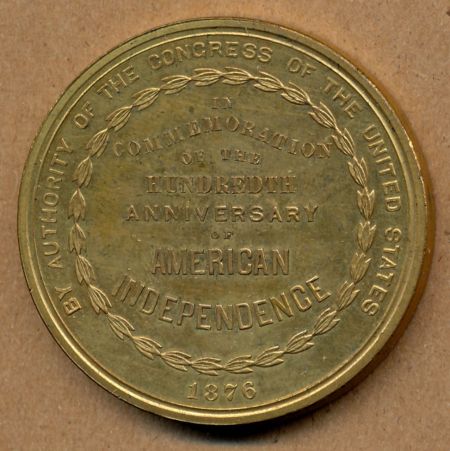
Overall, there was little debate/objection in Congress regarding the striking of Centennial Exposition medals by the US Mint. As a result, the Mint struck Commemorative/Souvenir medals and Award medals for the Centennial Board of Finance beginning in 1874 and continuing through 1876.
I plan on circling back to dive into the medals themselves, and discuss their designs, sizes, mintages and initial sales prices. Stay tuned!
Centennial Exposition Commemorative/Souvenire Medal (Small)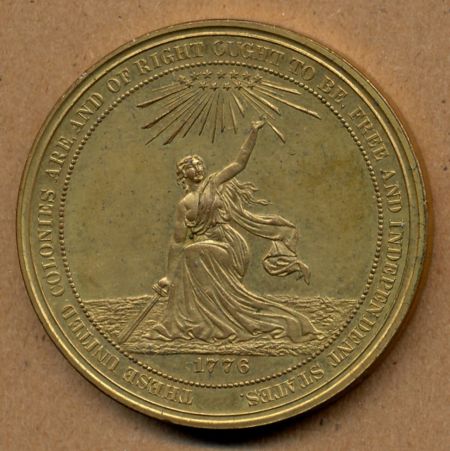
For other of my posts about commemorative coins and medals, including more classical-era stories, see:
Commems Collection






 Posted 05/31/2026 07:15 am


