Coin Community Family of Web Sites Join Thousands of Coin, Bullion, & Money Collectors
Coin, Banknote and Medal Collectors's Online Mall Vancouvers #1 Coin and Paper Money Dealer 300,000 items to help build your collection! Royal Estate Auctions - $1 Coin AuctionsJoin Thousands of Coin, Bullion, & Money Collectors Specializing in Modern Numismatics Royal Canadian Mint products, Canadian, Polish, American, and world coins and banknotes.


Username:
Password:
Save Password
Forgot your Password?


This page may contain links that result in small commissions to keep this free site up and running.

Welcome Guest! Registering and/or logging in will remove the anchor (bottom) ads. It's Free!

Can You Help ?

To participate in the forum you must log in or register.
Author Previous TopicReplies: 13 / Views: 1,449Next Topic  
New Member

United States
4 Posts
 Posted 07/27/2006  5:54 pm Show Profile   Bookmark this topic Add wmurph to your friends list Get a Link to this Message Number of Subscribers
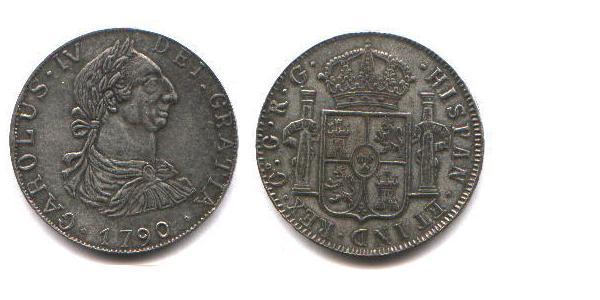
I am not a "Collector" just interested in old coins. A friend who lightly dabbles in coins, asked me help identify a coin and its markings. I started looking thru coin references. I have been unable to locate the marking in references and on web sites.

I found a coin very simular coin on the web, but "close only counts in horse-shoes".

Any assistance would be appreciated. I hope I am using the correct terminology in my description of the coin.

Am told coin is "Spanish Reales". Some references use the terms
"Portrait", "Modified Pillar" or "Milled Bust" design.

{the * = dot}
Obverse: CAROLUS (Bust facing Right) III * DEI * G * 1778 *

Interp. as: [ Charles III by the Grace of God 1778 ] ?

The biggest noticeable difference is the "III" over the bridge
of the nose instead of behind the crown of the head as shown in
most references of 1778 coins. I have also read some about the
importance of the "C" in Carolus and where the printing starts
in relation to it's position of the shoulder and hair/pony/tail.
( I presume to help id a forgery ? )

Reverse: *HISPAN*ET IND*REX*Cº[* dot under the little o]G*R*G*

Interp as: [King of Spain and the Indies * mint mark *
denomination * and the assayer initials ] ?

Unable to identify the mint mark {Co} in any references;
determine the coin denomination {G}, and the assayer
marks {R*G}.

The "Pillars of Hercules" with the Spanish Shield and
Crown are also on reverse. Motto on the banners on the
pillars bear PLUS VLTR [abbrev for Plus Ultra (More Beyond)].

Also the outer edge around the coin has the alternating
O and rectangle design.

Well....all this is what I THINK I KNOW...

Any information or references,would be appreciated... Thanks...wm

( Coin was Scanned on computer, pictures attached )

Can-You-Help-?
Can-You-Help-?

>Edited by bobby131313 to show pictures in post<


Edited by wmurph
07/27/2006 5:59 pm
Valued Member
kuhli's Avatar
United States
230 Posts
 Posted 07/27/2006  6:17 pm  Show Profile   Bookmark this reply Add kuhli to your friends list Get a Link to this Reply
quote:
Originally posted by wmurph
Unable to identify the mint mark {Co} in any references;


Cº is the mintmark for Cuzco, Peru.
Pillar of the Community
dsking's Avatar
United States
2365 Posts
 Posted 07/27/2006  6:19 pm  Show Profile   Bookmark this reply Add dsking to your friends list Get a Link to this Reply
I would say that it is a 2 Reales, "Spanish Milled". Whether it is genuine, another member more knowledgeable will have to chime in on that one. In the meantime, try a Google search for Carolus III - you'll find info. And yes, the Mint is Peru. (I wasn't quick enough).
Edited by dsking
07/27/2006 6:21 pm
Forum Dad
Learn More...
bobby131313's Avatar
United States
24163 Posts
 Posted 07/27/2006  6:51 pm  Show Profile   Bookmark this reply Add bobby131313 to your friends list Get a Link to this Reply

I'm sure Swamperbob will see this soon, then you will probably have enough info to make you and your friend's heads explode. [:0]

Pillar of the Community
swamperbob's Avatar
United States
5362 Posts
 Posted 07/27/2006  7:42 pm  Show Profile   Bookmark this reply Add swamperbob to your friends list Get a Link to this Reply
Thanks to bobby131313 for pointing this out.

The very brief answer is that what you have is a Fantasy issue. A coin that never actually existed.

The reverse die with the King's portrait has Spanish not Colonial legend placement, but the obverse die is clearly a "copy" modeled on the Colonial standard obverse. Spanish convention calls the side with the name of the country the Obverse and the date/portrait side the reverse. That seems backwards to a collector from the US.

The letter fonts are incorrect for either Spanish or Spanish colonial. For example the 7 in the date is a numeral with serifs at the tail. That is NEVER seen on Spanish coins or Peruvian for that matter.

The mint is an attempt at Cuzco, Peru except that the mint was always shown as a monogram. Peru did not use the First letter capital with a superscript format. That standard is seen most often in Mexico.

There is no denomination at all - the "G" is meaningless.

The assayer initials "R.G." are neither Peruvian nor Spanish. They were seen on Mexican issues from Zacatecas which is a very commonly copied coin.

The coin itself appears to be white metal and is either an injection molded piece or was struck in a collar. The rim is too high and the dentils are wrong for the period. The Portrait of King Charles is clearly the same one seen on the Chinese copies of the 1776 Mexican 8R.

If the coin is the size of a silver dollar, I would bet it weighs roughly 21 grams and that the edge is reeded ||||||||. The correct edge is the circle square colonila edge.

I would appreciate knowing more about this coin as it is NOT one that I already own.
Pillar of the Community
swamperbob's Avatar
United States
5362 Posts
 Posted 07/27/2006  7:47 pm  Show Profile   Bookmark this reply Add swamperbob to your friends list Get a Link to this Reply
I just located the obverse of this coin in my files. It is mated with a 1790 Colonial reverse die but my notes indicate that the coin is a Modern Chinese product. My copy has a lotus edge which is also wrong. I picked up my copy in 2005.

If I can find a scan of my copy I will post it.
New Member
United States
4 Posts
 Posted 07/27/2006  7:50 pm  Show Profile   Bookmark this reply Add wmurph to your friends list Get a Link to this Reply
Thanks to everyone....

Swamperbob--the edge of the coin is alternating
O and rectangles.


So, is your thinking that this is a counterfit?

wm

Edit: a gentleman that used to travel mexico, spain, portugal,
and europe obtained coins many years ago. When he returned, he
just locked them in a safe. While watching a friend e-bay for
birth year coins, the gentleman's family said "look at these"
dug out the safe and said what are they?

thats how it all started....
Edited by wmurph
07/27/2006 7:55 pm
Pillar of the Community
swamperbob's Avatar
United States
5362 Posts
 Posted 07/27/2006  7:59 pm  Show Profile   Bookmark this reply Add swamperbob to your friends list Get a Link to this Reply
Here is the one I own.

Image: Can-You-Help-? 1790 Co G RG Fantasy Chinese.jpg
28.32 KB

My copy is a lightweight white metal fantasy made by injection molding in China within the past couple decades.
Pillar of the Community
swamperbob's Avatar
United States
5362 Posts
 Posted 07/27/2006  8:06 pm  Show Profile   Bookmark this reply Add swamperbob to your friends list Get a Link to this Reply
Technically you call these things "Fantasies" but they do fall within the general category of Modern Counterfeit.

They are collectable items but for minimal amounts because the molds may still exist in China. I have a very large collection of counterfeit 8R coins and am always looking for new material.

The edge on your coin has been corrected to at least show the correct pattern which was in fact the circle square design. Are there any traces of the seam from the molds?
Pillar of the Community
dsking's Avatar
United States
2365 Posts
 Posted 07/27/2006  8:50 pm  Show Profile   Bookmark this reply Add dsking to your friends list Get a Link to this Reply
Yup, Swamperbob strikes again with his expertise!
New Member
United States
4 Posts
 Posted 07/27/2006  9:52 pm  Show Profile   Bookmark this reply Add wmurph to your friends list Get a Link to this Reply
OK Swamperbob...

You just cleared my frazzled brain...

I will get the coin again and look at it closer look
under magnification.

I will keep you posted....thanks....wm
Pillar of the Community
Australia
3831 Posts
 Posted 07/28/2006  11:35 am  Show Profile   Bookmark this reply Add gxseries to your friends list Get a Link to this Reply
Counterfeits exist from the time such designs were made, so it doesn't matter when your coin was possibly obtained and such - unfortnately counterfeits still exist in present days so it's pointless to debate whether your grandfather collected it or not, as counterfeits did exist at that time.
My partial coin collection http://www.omnicoin.com/collection/gxseries
My numismatics articles and collection: http://www.gxseries.com/numis/numis_index.htm
Regularly updated at least once a month.
New Member
United States
4 Posts
 Posted 08/01/2006  09:43 am  Show Profile   Bookmark this reply Add wmurph to your friends list Get a Link to this Reply
Swamperbob,

I got a look at the coin again.

I see what could/would appear to be molded lines/marks,
especially around the outer edge/rim of the coin on the
pattern of O's and squares design.

I also read that the modling process can transfer markings
that appear as scratches on the flat surfaces, ie. around the
area of the portrait/bust of the coin. This coin also appears
to have these types of marking also.

Should a TRUE Carolus III coid be magnetic?
This one is highly magnetic...

This research/learning has been highly informative and
interesting. I guess most common folk, like myself, only
thought of counterfits as being on paper. I never
considered of it being in coins...let alone the "recarving"
to try and increase value and the "moving of the metal" to
change dates, etc... wm
Edited by wmurph
08/01/2006 09:44 am
Pillar of the Community
swamperbob's Avatar
United States
5362 Posts
 Posted 08/01/2006  10:17 am  Show Profile   Bookmark this reply Add swamperbob to your friends list Get a Link to this Reply
If the coin is magnetic - it can not be real. I always keep a small coated magnet handy to check coins. Very few real coins made before 1900 will be magnetic.

The ferro-magnetic metals normally encountered are Iron (or steel) and nickel. Most people don't remember from their school science class that nickel is magnetic. I suspect that your coin is a nickel alloy because iron counterfeits are rough on the dies and cause rapid Die Deterioration. An alloy of copper and nickel can be magnetic and it makes a very good substitute for silver.

Most starting collectors do not realize that coins are counterfeited as well as paper money. I found out when I was about 10 years old when I got a copy of the 1944 no P "Henning Nickel" while hunting through change for silver nickels. The idea that someone would forge a 5 cent piece was remarkable to me and it got me started learning about counterfeits.

The subject is complex and also involves alterations as you noted. I have been hunting for forgeries for about 48 years now and I am still learning. It can become a lifelong passion.

  Previous TopicReplies: 13 / Views: 1,449Next Topic  

To participate in the forum you must log in or register.


Disclaimer: While a tremendous amount of effort goes into ensuring the accuracy of the information contained in this site, Coin Community assumes no liability for errors. Copyright 2005 - 2026 Coin Community Family- all rights reserved worldwide. Use of any images or content on this website without prior written permission of Coin Community or the original lender is strictly prohibited.
Contact Us  |  Advertise Here  |  Privacy Policy / Terms of Use

Coin Community Forum © 2005 - 2026 Coin Community Forums
It took 0.31 seconds to rattle this change. Forums