| Author |
 Replies: 45 / Views: 9,393 Replies: 45 / Views: 9,393 |
|
|
|
Valued Member
United States
426 Posts |
Hey swamperbob,
Is that 1827 8R Do one of those "debased originals" made with genuine mint dies? I ask because it looks just like the original. In fact if it wasnt for the "weird" color I wouldn't suspect nothing at all, what is the weight on that piece?
|
|
New Member
 United States
25 Posts |
To: TwoKopeiki: A neat 1836 Durango! I like the large dot on the cap and heavy die crack on the eagle die. I have (4) 1836 Durangos and they all have dots on the cap. (3) of them are very small and could be missed without decent magnification or worn off if the coin graded VF or lower.
My fourth example has a large dot similar to yours. I do not think they are the same die though. Mine has a clearly doubled o in Do and a short diagonal line through what I term Ray 1 (the ray that emerges from the lower left corner of the cap). It also has a diagonal line between Rays 3 and 4 (counting right from ray 1).
I do not see these points on your scan. I am looking at a small laptop screen now though since my main computer appears to have crashed earlier today.
I am not sure if the dots are centering dots (which doesn't seem to make sense on a hubbed die?) or intentional marks to identify the die as genuine. Or?
My reverse shows no sign of the die cracks on the Eagle die and there appears to be minor differences in the cactus spines. I will have to check the Eagle dies on other dates around 1836 because the crack looks familiar.
Thanks for posting the pictures.
To swamperbob: You guys are starting to scare me with all of the counterfeits. You had mentioned Riddell and I Googled it and found it in digital form online. I later ordered a copy from Abe books. I hope the resolution is of high quality? I was not aware of so many bogo's, especially transfers or those actually struck from dies that have quasi mint relationships. I really appreciate the pictures that are being posted.
My background in Capped Bust halves, where all dies have been extensively studied in depth and published with decent plates in Overton, may have caused me to underestimate the need to scrutinize the 8 Reales beyond the obvious crude counterfeits that don't match the proper die styles.
I will be getting the digital scale out and doing more weight measurements. What do you do to check specific gravity? I can't help but wonder if there is a tool that can check silver purity similar to that used at scrap yards to measure the composition of metals there.
|
|
Pillar of the Community
United States
5362 Posts |
RealPeso The 1827 Do is not classified as a "Debased" issue by Riddell or anyone else I know of. If you notice the angle of the superior rays - they are more oblique than the originals. The dies are very well executed and the eagle can be readily confused with a version of the original. The differences are subtle so many collectors with high grade copies with INTACT plates can be fooled into thinking they have an original. It is a deceptive forgery.
Riddell lists two 1826 and by reference only an 1827 dated variety of this type (numbers 350 and 351) and I have discovered them to be fairly common as a general type. The 1827 coins are made from re-dated dies. However, there are numerous small die varieties. The number of actual dies is unclear. There appear to be mules and more than one die pair HOWEVER, the engraver was very good and it is my opinion that the dies were repaired/improved on more than one occasion making several very minor sub-varieties. Some of these alterations can NOT be seen on low grade examples. More study of this group of coins is needed to see if it was produced with only die pair.
Weights listed for the two examples in Riddell are 25.2 and 26.8 grams. I record a range of weights from 24.4 to 26.5 grams for my copies. Most copies are executed in a thin Sheffield plate that is the correct color on the surface. The cores were of different base metals. There are some that use a silver color core that can be difficult to distinguish. I posted one of the darker cores to make the forgery obvious.
So if you own an 1827 Durango with the obliques superior rays - I would suggest you do a Specific Gravity test to see if it contains the correct amount of silver. I do not know of an original that uses these dies.
You didn't ask but the edges are applied using a correct technique. You will find TWO overlaps on opposite sides but the edge designs are slightly irregular.
BE VERY CAUTIOUS WITH THIS DATE.
Macro122 When dealing with the Mexican 8R coins you will find many minor tweaks. Some were done when the dies were made but many others when the dies were REPAIRED. Mexican screw press operators seem to have clashed their dies more often than their US counterparts. As a result, there are more lapped 8R dies than Bust Halves. At times the lapping removed enough detail that a touch-up was done. I encountered this for the first time when I ran into an 1832 Go 8R with the final superscript s on the wrong side of the ray. I suspected a forgery BUT it turned out to be an original with a repunched superscript. Since that discovery I have located at least a dozen similar repairs that resulted in new die varieties.
There is a spectacular 1834 Go where the rays on the left side of the cap have an ANGLE point about 1/2 inch from the cap. That die may have been the result a weak original HUBBING. When the hubs were pressed into the steel die faces - weak impressions were common - usually a second or third pressing took care of the problem BUT if the die was removed from the press before the weakness was noted - how exactly would it be re-aligned? So I suspect that in some cases these weaknesses in low relief details were actually corrected by engraving the missing details.
The need to look at details closely is something not really done before. Counterfeits were not seen as a problem because the coins were of low value. But NOW it is getting costly to miss a fake.
I posted some of the really CRUDE fakes because I was trying to show a range. If I can dig out pictures of one of the debased 1830's Go coins I will post them. Durango did not lose dies - but did have an operator or two hung from switching planchets. The French dies were heavily forged in France and New England. The examples I posted are NOT mint dies. They are outside fakes nothing more.
By the way the French die copy 365 and 371 are by far the MOST COMMON Counterfeit in the Durangos series I am aware of.
|
|
New Member
United States
25 Posts |
To: swamperbob: That is a lot of info to digest! It sounds like the 8 Reales were more similar to the Capped Bust Half Dimes with frequent clashing and lapping etc. compared to the half dollars. I have a few Go mint 8 Reales. I have not studied them that much though. I have sort of overlooked the hubbed dies from there. I will have to check them out more closely and report anything of interest. I recall a coin I believe was a Go that had a very sharp N over inverted N in MEXICANA. I will look that coin up as I haven't looked at the other mints in a while. I will dig out my 1827 Durangos to compare to the counterfeit you posted as well as reference Riddell online as best I can (until the printed copy arrives). I have tried to stick with higher grade coins for the most part. Most of my coins are XF or better. I mention this only because I am curious as to the number of XF or higher graded coins that turn out to be counterfeit as compared to those of a lesser grade? I am also curious as to how you measure specific gravity? Do you use a liquid displacement method of some type to find the coin's volume? |
|
New Member
United States
25 Posts |
To: swamperbob: I took a real quick look at my 1827 Durangos. I have (5) and happy to say none match the Cap die of the #350A you posted. What I call Ray 1 (the ray that extends from the lower left corner of the cap)points to various locations on the D, all significantly left of the location of Ray 1 on the #350A.
I have 22 Go mint Resplandores between 1826 and 1852. The neat one with sharply inverted N over N in MEXICANA turned out to be an 1849 GoPF. A neat coin where the N stands right out.
I have (2) 1832's. Both appear to be of the same die marriage at a quick glance. On the Cap die the 0 in 10 D and the subscript s in Gs are sharply recut. On the Eagle die LIBERTAD is sharply clashed above the cactus.
I do not have any 1834's.
|
|
Pillar of the Community
United States
5362 Posts |
For anyone interested in a Riddell forgery - a good friend Bill Hussey of Florida ( ebay Flacoin) has posted a nice example of the Riddell #365 for sale. This is the version with the eagle without the crest on his head. This is a forgery most likely made in France (or at least the dies were). http://cgi.ebay.com/ws/eBayISAPI.dl...TRK:MEWAX:ITThis is an auction that ebay SHOULD NOT STOP. The Riddell counterfeits are all perfectly legal to own possess and sell under US law. There is no fraud because Bill has indicated the weight and "likely" nature of the origin. Too bad ebay makes us have to use less precise terminology but that is just how it is. Macro122 I will respond to your questions when I return home. Right now I am away and do not have access to my own PC or files. |
|
Valued Member
United States
426 Posts |
Quote:
RealPeso The 1827 Do is not classified as a "Debased" issue by Riddell or anyone else I know of. If you notice the angle of the superior rays - they are more oblique than the originals. The dies are very well executed and the eagle can be readily confused with a version of the original. The differences are subtle so many collectors with high grade copies with INTACT plates can be fooled into thinking they have an original. It is a deceptive forgery.
Riddell lists two 1826 and by reference only an 1827 dated variety of this type (numbers 350 and 351) and I have discovered them to be fairly common as a general type. The 1827 coins are made from re-dated dies. However, there are numerous small die varieties. The number of actual dies is unclear. There appear to be mules and more than one die pair HOWEVER, the engraver was very good and it is my opinion that the dies were repaired/improved on more than one occasion making several very minor sub-varieties. Some of these alterations can NOT be seen on low grade examples. More study of this group of coins is needed to see if it was produced with only die pair.
Weights listed for the two examples in Riddell are 25.2 and 26.8 grams. I record a range of weights from 24.4 to 26.5 grams for my copies. Most copies are executed in a thin Sheffield plate that is the correct color on the surface. The cores were of different base metals. There are some that use a silver color core that can be difficult to distinguish. I posted one of the darker cores to make the forgery obvious.
So if you own an 1827 Durango with the obliques superior rays - I would suggest you do a Specific Gravity test to see if it contains the correct amount of silver. I do not know of an original that uses these dies.
You didn't ask but the edges are applied using a correct technique. You will find TWO overlaps on opposite sides but the edge designs are slightly irregular.
BE VERY CAUTIOUS WITH THIS DATE.
I do have a 1827 Do in my collection but thanks to your help we successfully identified it as a original 8R in a thread I posted last year. https://goccf.com/t/73544But I must say that the 350A looks extremely similar and I was literally staring at my computer screen and pictures of my coin for a long time before I started noticing the very small differences. Whoever was behind that counterfeit did a splendid job. Currently I am on the lookout for another 1827 8R Do but with the die style of 1827-1829 to complement the one I have that is why I pay special attention to any talk regarding the 1827 Durangos. Thank You! |
|
Pillar of the Community
United States
5362 Posts |
RealPeso You say; Quote:
Whoever was behind that counterfeit did a splendid job. I agree that until you get really familiar with the real thing this forgery is VERY DECEPTIVE. But place the two pictures side by side any you can pick out the differences. Once you know what to look for you will not be fooled again. Remember a successful forgery needed only to pass one time BUT if you wanted to pass hundreds or thousands of fakes - the copies had to be VERY WELL DONE. As soon as word got out the forgers had to re tool the dies or change locations for passing them.
|
|
Pillar of the Community
United States
5362 Posts |
Macro122 I am back at home now so I can tackle your questions a bit better. Like you I also collected Cape Bust Half Dollars for a period of time in between my periods of concentrating on forgeries. I never studied the dimes so I can not comment on clashing frequency. But the Mexican dies were VERY frequently clashed. Even the counterfeits often show clashes. (The ones made on screw presses that is.) The Guanajuato 8Rs made with hubs do appear with various minor varieties. This is a result of several factors mostly involving the crude methods of die preparation. A weakly set hub design was often heavily recut to supply missing detail. The clashed dies were also repaired resulting in multiple related variations. You speak of a Go coin with a N over a reversed N - since 1849 was a date that used king punches and not full hubs it could be a real punching error. I would like to see it. The forgeries of Go coins are second in number only to Zacatecas. These two mints were the most prolific so they were the targets of forgery most often. Mexico City is third and Durango 4th. The other branch mints all have period fakes but the numbers are far fewer. You also ask if higher grade coins exist as forgeries. The answer is both yes and no. There are a few Riddell varieties that I have seen in XF, but many were intentionally made to look worn to VF or so. Most of what appears on ebay are the low end coins. The XF coins are often considered REAL when the top layer is intact so I suspect many reside in older collections undetected. Specific Gravity is easily measured by weighing the coin in air and in water. The difference in the two weights in grams is the Volume of the coin in Cubic centimeters. SG is weight divided by volume. So technically you do not directly measure the displacement you measure the change in weight caused by immersion. Here are pictures of three 1833 Go coins - a real one and then two counterfeits. Dies are once again VERY close. 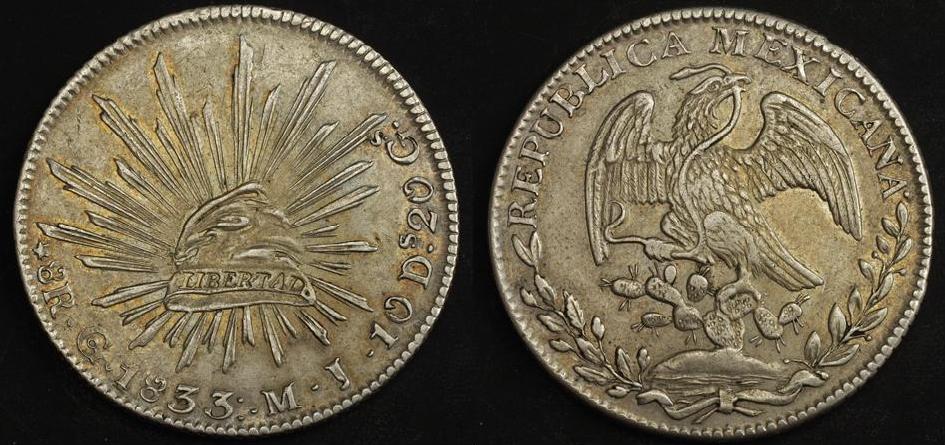 This second coin is counterfeit - but in my opinion it is one of the coins made using the stolen Go hub reported in US mint records and alluded to by Riddell. Note the three missing elements of the hub are all ODD - the final digit of the date is tilted and the two assayer initials are crude and the wrong font. The edge is done using two mismated dies. Perhaps older salvaged edge dies. 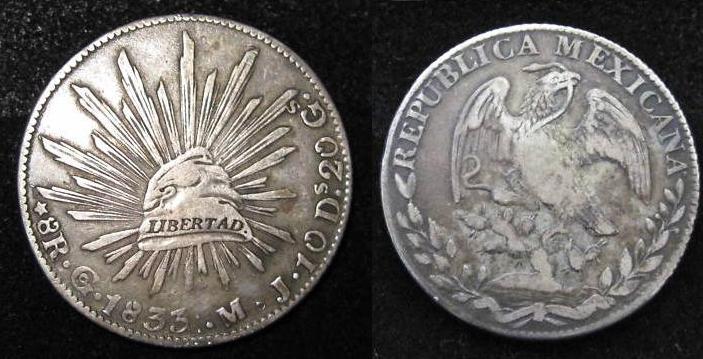 This final forgery has a much better pair of assayer initials but note the very small 3 at the end of the date and of course the coin is plated base metal. 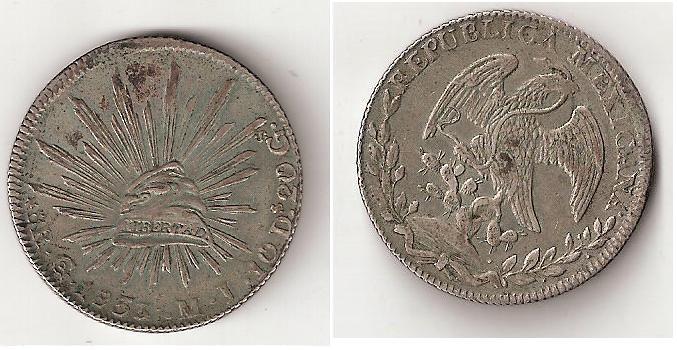
|
|
New Member
United States
25 Posts |
swamperbob: Thanks for the info. I am going to have to make a rig for immersing the coin in water. I have a 100 gram digital scale that is relatively small.
I can send you the 1849 Go for study. My email address is macro122@aol.com. I don't know if my email address is available to you through my profile here. I submitted it, but I apparently can't view anyone else's without 100 posts?
I will check my Go's again to see if any look suspicious. Not sure if I have any 1833's?
I weighed all of my 1825 through 1831 Do's:
1825 25.37 to 26.85 range in grams
1826 26.25 to 27.27 " "
1827 25.94 to 27.14 " "
1828 26.99 to 27.39 " "
1829 26.42 to 27.91 " "
1830 26.53 to 26.70 " "
1831 26.39 to 27.79 " "
I'm not sure if you can tell anything from weights alone? Or if specific gravity is necessary?
|
|
Valued Member
United States
426 Posts |
Nice counterfeit coins swamperbob they are practically a spittin image of the original, kind of scary. What are the weights on the last two? (the two counterfeits) Do they have the correct edge? Speaking of counterfeit Go 8R's check this one out and how much it sold for: It's real just different die style. http://cgi.ebay.com/ws/eBayISAPI.dl...3D&viewitem=Marcro: Most of the weights look legit, the only ones I would be a little wary of are the 1825 that weighs 25.37 (seems too low even for heavy wear) and the heavy ones 27.91 , 27.79 seems too heavy but then again the Durango mint did have some bad quality control in the early years and wasn't consistent. as far as SG I believe this is the true and best way to determine if a coin is legit but I haven't mastered the process yet. Edited by RealPeso
02/12/2011 5:17 pm
|
|
Pillar of the Community
United States
5362 Posts |
Macro122 The weights alone for very early Durango coins do not provide as conclusive evidence of forgery as those of later dates. In "Hooknecks" there is a table of weights of known examples of the 1824 Do coins. The range of weights and the relative number of examples provides a very interesting way to check what "NORMAL" is for coins of the 1820s in particular.
There are only TWO coins that weigh below 26.2 grams listed. One weighs 25.6 and the other 25.7 grams.
So on that basis, the 25.37 gram 1825 coin you list draws my attention. While possibly it would set a new low for an original, I am more concerned that it may be a forgery. Couple this with your earlier position about looking for only high grade coins and I and I am even more suspicious.
On the high end, the table records 4 coins at or above 27.40 grams. These are 27.4, 27.6, 27.7 and 28.0 grams. Coins in the 27.4 gram and higher range would deserve extra attention.
So even though we think of Durango coins as being exceptionally variable in weight - the range is still much closer than many collectors think. You have to recall that when silver weight equalled monetary value it was VERY IMPORTANT. A coin could not be too heavy or the government was GIVING AWAY money or too light because then it was fraud. The legal range was 2/10s of a gram. The practical range for Durango was 7/10ths and that is considered the WIDEST known average. So I am concerned about the range you have.
As you know, I am a great proponent of SG. I believe every collector should do it every-time they evaluate a coin - NO EXCEPTIONS. But SG only tells you if the coin was FRAUDULENT. The real issue is who did it. Some (but in fact VERY FEW) debased coins were made in the mint - the vast majority of debased coins were COUNTERFEITS made outside the mint. If a large percentage of mint output was "debased" or fraudulent - that fact would have been documented by the US government which relied on Mexican coinage for the larger part of it's circulating currency (specie). I have found no such general cautions in the record. So I do not believe it was a huge problem at all. Forgery was the real problem - unofficial and done outside the mint. But it was a BIG problem.
RealPeso The auction you pointed out appears to be for a real 8R, why do you believe it is a counterfeit?
|
|
New Member
United States
25 Posts |
Thanks Real Peso and swamperbob:
I am suspicious of the 1825 that weighs in at 25.37 grams after a closer look at it. It only grades about VF. Additionally, a couple of others of the proper weight too. I have two 1825's that weigh 26.67 and 26.75 that look a bit questionable too.
I did not see any counterfeits listed in Riddell for Durango in 1825. So, Do you guys have pictures or descriptions of any 1825 DO bogo's?
|
|
Valued Member
United States
426 Posts |
Quote:
RealPeso The auction you pointed out appears to be for a real 8R, why do you believe it is a counterfeit? Swamperbob: Woops! My mistake, I was focused on the die style of 1830-1843 and did not realize this year had two die styles. (1829-1830) I checked my copy of "Resplandores" and true enough the coin I pointed out is the 1829-1830 die style so this coin is real. Edited by RealPeso
02/12/2011 5:15 pm
|
|
Pillar of the Community
United States
5362 Posts |
Macro122 I have one counterfeit 1825 Do RL that weighs 26.2 grams but I do not have a photo of the coin only my computer record indicating that I bought it in 2007.
I also record that I have two originals that you might find interesting. They were created with the wrong number of rays. (The cap should have 32 rays). But in 1825 the number still varied - at least at Durango. One copy which I still keep in the suspect category has only 28 rays while the other has a far more believable 31. I originally bought both as counterfeits but after extensive testing the second one has proven to be real (beyond any doubt in my mind). The reservations I still have about the coin with 28 rays are very subjective in nature. The error just seems too significant to have never been noticed before. Neither is noted in Resplandores.
I will have to dig these out and take pictures.
|
| |
Replies: 45 / Views: 9,393 |








 First Page


 Posted 02/07/2011 8:23 pm


