| Author |
 Replies: 45 / Views: 9,387 Replies: 45 / Views: 9,387 |
|
|
|
New Member
 United States
25 Posts |
swamperbob:
I have encountered three different ray counts for the 1825 Do's. I have seen or own 29, 28 and 32 ray count Cap die examples. There also appear to be three different (legitimate) Eagle die variations. (1) Periods both between and after REPUBLICA.MEXICANA. (CA.NA.) (2) A period between but not after REPUBLICA.MEXICANA (CA.NA) (3) No periods between or after REPUBLICA MEXICANA) (CA NA)
I have purposely listed the above types in what I believe to have been their basic emission sequence.
The 'Hookneck' Durango's of 1824 all have (CA.NA.) Eagle dies. Therefore, logic would follow, as Dunigan/Parker suggests, this was likely the first type struck in 1825. I can only confirm two examples of (CA.NA.) Eagle dies. One is the first Eagle plate in Dunigan/Parker. The other is in Ponterio Auction #143-1298. The Ponterio example is definitely paired with a 29 ray Cap die. The Dunigan/Parker Cap die plate coin also has 29 rays. I can't verify that this 29 ray Cap die was paired with the (CA.NA) plate coin pictured next to it, but the toning on both is remarkably similar. I can verify that it is not paired with the middle (CA.NA) plate because I now own that coin. Both of these examples are of the same die types, but all are different dies. Time and searching by die variety collectors will determine if all 29 ray Cap dies were paired with only (CA.NA.) Eagle dies?
The majority of 1825 Cap dies that I have seen have had 28 rays. I have encountered five different 28 ray Cap dies. Four of the five were paired with (CA.NA) Eagle dies and one with a (CA NA) Eagle die. It appears that the 28 ray and (CA.NA) die types came next in emission. I do not know of any 1826's with (CA.NA) Eagle dies, but there are (CA NA) examples. Additionally, I do not know of any 28 ray Cap dies in 1826 either. Therefore, logically the 28 ray Cap dies fit in here.
Lastly, there are the 32 ray Cap dies. Again, logically they seem to fit in here at the end, as all 1826 and later Cap dies have 32 rays. As stated before, (CA NA) Eagle dies also appear in 1826.
I have never encountered a 31 ray Cap die. VERY INTERESTING!
Appearing for the first time in 1826 is the Eagle die with no period between but with period after REPUBLICA MEXICANA. (CA NA.) I know of no LEGITIMATE 1825's with this type of Eagle die. I have only seen two examples and I own them both. I believe both to be likely counterfeits, but have not done any SG tests. They both weigh in correctly, but look quite suspicious. They both have 32 ray Cap dies which would likely be correct if legitimate examples exist.
My underweight example is a 32 ray/(CA.NA) model. It looks better than the other two suspects, but? It has a heavy vertical die break along the right curve of the o in Do. The field on the left of the break is raised. There is a long diagonal die crack from the lower part of the break up across the date. If it is bogo, then kudos to its originator! If he didn't work for the mint, he should have!
|
|
New Member
United States
25 Posts |
swamperbob and others:
After my last post I viewed a demonstration of a Specific Gravity (SG) test on YouTube and followed it as described here. I tested the three suspect 1825 Do's from that posting. The first coin tested was the underweight coin that looks fairly good, but is below the acceptable weight level. The coin is a decent VF, so not worn enough to justify the low weight.
I first weighed the coin dry on my 100 gram digital scale. It weighed 25.37 grams. I filled a small plastic cup about three quarters full with water. The cup with water weighed 94.82 grams.
I then attached the coin to a thin nylon thread with a small piece of scotch tape. I then suspended the coin in the water while still on the scale. Being careful to not touch the sides or bottom of the cup, with the coin completely immersed in the water, I got a reading of 97.37 grams.
Subtracting the weight of the cup and water (94.82 grams) from the total weight with the coin immersed (97.37 grams), gave me the weight of the coin in water of 2.55 grams.
Dividing the dry weight of 25.37 grams by the immersed weight of 2.55 grams resulted in a Specific Gravity (SG) of 9.95 for this coin.
I followed this procedure for the other two suspect coins and got SG readings of 10.20 and 10.11.
So my questions for swamperbob and others: Does this appear to be a legitimate SG test for these coins? Are these readings in line with what they should be for legitimate coins?
|
|
Pillar of the Community
United States
5362 Posts |
Macro122 Interesting SG results. If the readings are correct, then you have a definite counterfeit at 70% silver and two suspicious coins at 84% and 78.5% silver. Those 2 readings are lower than I would normally expect for real coins and I wonder if the conditions of your test are providing accurate results.
Please try testing something like a US silver dollar. See if you get 10.3.
|
|
New Member
United States
25 Posts |
swamperbob:
I also tested a generic 1827 bust half dollar and got a reading of 10.15. I will get some distilled water and try more coins later today.
How do you suspend your coins for testing? Do I need to calculate the weight of the tape and the portion of the thread that is submerged and subtract that from the total weight of the coin in water? That would slightly reduce the calculated weight of the coin in water and increase the SG number.
Edited by Macro122
02/14/2011 04:51 am
|
|
New Member
United States
25 Posts |
I just realized that there was a typo in the third paragraph of my post from yesterday (2-13-11 at 9:20 am). Quote:
I can't verify that this 29 ray Cap die was paired with the (CA.NA) plate coin pictured next to it, The Eagle die type in parentheses should have read (CA.NA.) not (CA.NA) |
|
Pillar of the Community
United States
5362 Posts |
Macro122 If you use tape and string that are submerged - that is likely the cause for the readings being low. While SG is easy to do it requires PRECISION. Most of the digital scales on the market that read to 0.001 levels are accurate only to 0.01g read the fine print that comes with the scale. Most accuracy levels are expressed in terms of % of the item being weighed. Because we are really measuring the VOLUME of the coin - small differences are very meaningful.
For example if your 8R weighs 27.03 grams and the volume is 2.62 cc (weight difference 2.62 grams) the SG is 10.31 perfect. But if your scale is accurate to only the nearest 0.01 gram - you really have a range of results that are equally possible. 27.03/2.61 is 10.35 but 27.03/2.63 is 10.27. I would guess that a piece of tape attached and immersed would have a buoyant effect several times as great.
I use a stainless steel wire that I make into a loop so that the coin stands on edge. Using a digital scale I zero the scale with the hangar alone in the water at the point of balance - that way the effect of the loop being immersed is deducted in that way.
With my analytical balance (which is mechanical) I use a silver wire for the loop and deduct the effect by weighing the loop in air and in water before I start.
Also remember for a half dollar your scale needs to be even more accurate than for a dollar coin. I personally feel the analytical balance (accurate to 0.001 gram) is needed for 1/2 and 1/4 dollar sizes. I do not have the capability at present to do SG accurately on a dime sized coin. That would require an extremely accurate scale.
|
|
New Member
United States
25 Posts |
swamperbob:
I did not realize that a small nearly weightless piece of tape would have any affect on the process. The nylon thread that I used was also a bit stretchy too.
Are you using stainless steel or silver wire because they have similar SG's as the .903 silver coin? Or to avoid any buoyancy affects with lighter SG materials?
I had thought about fitting a rubber o-ring around the edge of the coin and attaching it to a thread. Would this have similar problems as the tape, even if its weight was accounted for?
How did you keep the coin from falling out of the loop? Do you have pliable wire that bends to snugly wrap around the edge of the coin?
I also bought a gallon of distilled water to use once I get the suspension issue corrected. Will that make any difference as opposed to tap water?
|
|
Pillar of the Community
United States
5362 Posts |
Macro122 The loop I make is simple - I take a straight length of wire (the type that does not spring back at all) and form a triangle at the end with the base wider than the coin in question. The end of the wire I bend around the top of the triangle one or two times leaving a LONG tail of wire. The bottom of the triangle I bend to allow the coin to fit into the pocket. Then I bend the wire from the top loop over the coin making sure there is no contact with the end. Here is a sketch of the loop. 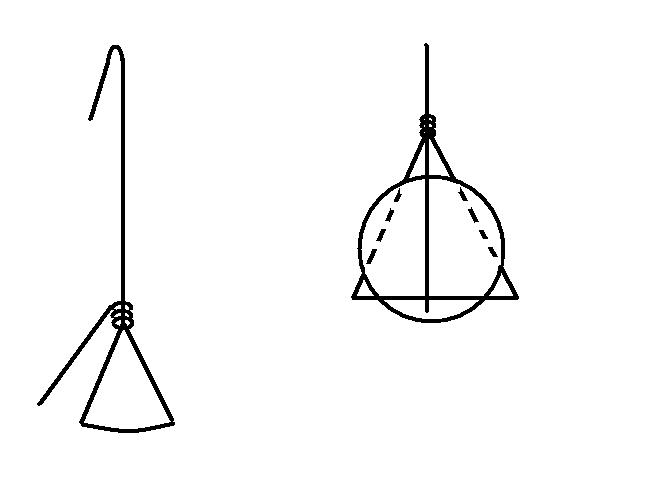 I use stainless steel because it does not rust. I have loops pre made for all sizes of coins. Steel has a LOWER SG than silver so that must be adjusted for if the scale can not be pre-zeroed with the loop immersed. I use silver wire when the SG is very critical for smaller silver coins and I have to use the 4 beam balance scale. The wire is 900 fine silver so the difference in SG is not critical provided the coin being tested is near 900 fine itself.
|
|
New Member
United States
25 Posts |
swamperbob:
Thanks for the additional info and the diagram. That helps a lot! I have a 100 gram digital scale. I hope I can get a sufficent amount of water, the coin and apparatus all to total less than 100 grams? I think I can for sure by setting the scale to zero with water and apparatus submerged.
I am hoping to make up the apparatus tonight or tomorrow and see what I come up with. I need to find a 100 gram weight (if possible) in order to calibrate my scale also (just to be sure). This scale was a replacement for a defective one and they didn't send the calibration weight with it.
|
|
Pillar of the Community
United States
5362 Posts |
You do not need to weigh the water - only the coin hanging IN water. Every time you dip a coin into the water you remove enough water to make the result inaccurate.
Weigh the loop hanging in the water and ZERO the scale with the loop immersed.
Then weigh the coin hanging in the water (the fact the scale was zeroed with the loop already means you have the weight of the coin hanging in water alone.) The weight of the coin in water can be directly subtracted from the coin's weight in air to arrive at the displacement of the coin - the volume.
|
|
New Member
United States
25 Posts |
swamperbob:
I think I may have finally gotten the SG testing to work properly.
I made an apparatus to hold the coin similar to the one you diagrammed. The weight of the apparatus submerged was 0.17 grams. I filled the cup about 3/4 full of distilled water. With the cup and water on the scale, I zeroed the scale. Then I submerged the coin while contained in the apparatus and recorded the weight. I subtracted 0.17 from each reading to obtain the submerged weight of the coin.
I tested 11 Durango 8 Reales pieces as follows:
1825 Dry Weight = 25.37g In Water = 2.46g SG = 10.31
1825 Dry Weight = 26.77g In Water = 2.60g SG = 10.30
1825 Dry Weight = 26.69g In Water = 2.60g SG = 10.27
Those are the three that I tested previously and got readings of 9.95, 10.20 and 10.11 with the scotch tape and nylon thread used to hold the coin.
I tested several 1834's for two reasons. (1) I have several varieties including a couple that had crestless eagles. (2) I have run across one odd Cap die and one odd Eagle die that are significantly different than all of the others that I have found of that era. They are both found in 1834, but are not paired together. Each is from a different hub than any others that I have encountered. The Eagle die ironically is the one on the plate coin in Dunigan/Parker. I wanted to test those and several others to be certain of their authenticity.
a 1834 Dry Weight = 26.83g In Water = 2.60g SG = 10.32
b 1834 Dry Weight = 26.93g In Water = 2.62g SG = 10.28
c 1834 Dry Weight = 27.10g In Water = 2.64g SG = 10.27
d 1834 Dry Weight = 26.36g In Water = 2.54g SG = 10.38
e 1834 Dry Weight = 26.81g In Water = 2.60g SG = 10.31
f 1834 Dry Weight = 27.14g In Water = 2.66g SG = 10.20
g 1834 Dry Weight = 26.11g In Water = 2.52g SG = 10.36
h 1834 Dry Weight = 24.56g In Water = 2.66g SG = 9.23
a,e and h have crestless eagles. a and e look good and pass the SG test. h is no doubt a bogo. This coin grades AU and has semi-prooflike surfaces! It is virtually mark free except for some significant pits from a rusty Eagle die. The rust is most noticeable below the I in REPUBLICA, between A M, around the period at the end of MEXICANA and to the right of the snake at the top edge of the wing to the right. This is an excellent counterfeit.
b,f and g all have the odd Eagle die mentioned previously. They all have the same Cap die as well - so all are the same die marriage. f is a little off I believe due to what appears to be lacquer on the surface of the coin. This coin was purchased from Mike Dunigan mainly because it was of the odd reverse type. I pointed out this odd Eagle die to him at that time. g was from the Ponterio auction of a well known collection.
The odd Eagle die (b,f and g) has a die crack that runs through the X in MEXICANA similar to that on Riddell's counterfeit #370. It is definitely not from that die though. To make things even more interesting, c and d also have die cracks running through the X in MEXICANA! They are distictly different dies from each other, different than (b,f and g) as well as the counterfeit. And all these pieces check out in appearance and SG.
d also has the odd Cap die previously mentioned.
Let me know what you think of this analysis.
Edited by Macro122
02/16/2011 9:10 pm
|
|
Pillar of the Community
United States
5362 Posts |
Macro122 I think you have gotten the trick to doing an accurate SG. The results are FAR better. They are all close enough to 10.3 to satisfy me that the coins are all real.
A small coating of lacquer is adequate to reduce the SG by 0.1.
I agree with your analysis - the h coin sounds like a great forgery. I would like to see it to see if the rust patterns match mine.
|
|
New Member
United States
25 Posts |
swamperbob:
Contact me at my email address and I can send you the bogo 1834 and the Go with inverted N to study. Also, I can try and dig up the edge mirror and send that along as well.
|
|
Pillar of the Community
United States
5362 Posts |
That would be great thanks
Edited by swamperbob
02/17/2011 9:17 pm
|
|
Pillar of the Community
United States
5362 Posts |
I tried to locate your email address and could not locate it. I may have opened your earlier letter on my daughter's PC/ Could you write again - swamperbob22 @aol.com
|
| |
Replies: 45 / Views: 9,387 |








 First Page
 Previous Page

 Posted 02/13/2011 11:05 am


