| Author |
 Replies: 92 / Views: 16,727 Replies: 92 / Views: 16,727 |
|
|
|
Bedrock of the Community
United States
12437 Posts |
If it is bubbling, it is still working. You will want to refresh the H2O2 once it begins to look turbid or you see a precipitate. Let me preface this by saying I have absolutely no experience cleaning ancients but IMO, slow is the best way to go. Not only would stronger H2O2 be dangerous for the user but it could also harm the patina of the coin, leaving the metal looking completely stripped. A 30% solution will not react only 10x as fast as 3%, the reaction kinetics would be exponentially greater and possibly 100x as fast.
|
|
Pillar of the Community
United States
514 Posts |
On another coin forum, there's a fellow who advocated heated H2O2 for cleaning ancients. I believe he used a lightbulb close to the container as a heat source, while other members heated the H2O2 in the microwave. I don't recall the results.
I'm no chemist, but I think of H2O2 as unstable and 'wanting to be' water. It reacts with organic components (ie dirt). It's also great for cleaning blood, but hopefully there's not much of that on your coins! H2O2 would be an addition to the cleaning arsenal as it reacts with different types of molecules than acetone or distilled H2O.
As a scientist I'd wonder about more 'control' groups. I don't suggest that you perform an elaborate experiment, but just wonder about how many groups of coins you'd have to use to get some clear answers.
On my current batches of coins I'm using distilled H2O and a toothbrush. In the past I've used washing soda and hot H2O2, but didn't keep clear records or pictures and honestly don't know if they helped at all or if so, how much. I can at least say it wasn't remarkable enough for me to remember and continue using.
I guess the ultimate question is: Even if the peroxide is bubbling and changing colors of the dirt -- is that important? Is there a measurable benefit compared to using plain water?
Stronger peroxide is available at salon supply stores as hair bleach or at pool supply stores as a sanitizer. I have never used it for any purpose and do not recommend anyone use it in a casual manner.
-wheatiefan
|
|
Pillar of the Community
 United States
3499 Posts |
biokemist6 & wheatiefan- Thanks for the advice and input! I am rather happy with this method so far. In just 3 days of this my two uncleaned coins were difficult to read with cemented dirt covering many of the devices and letters. But I now can read both fairly well and the fields are looking better too. I am proud to report that one has officially revealed its place of production: Constantinople (The CONS mint mark was totally unreadable as recently as last Thursday). What is interesting about this, is that it is from a lot of uncleaned coins which was said to have come from France. But I do suppose that coins from Constantinople did make their way to France at times.
|
|
Pillar of the Community
United States
842 Posts |
I wonder how it will affect the patina. If I were you I would take it out as soon as it is fully attributable. This eliminates any danger of over-cleaning. There are many coins in my showcase that are no where near fully cleaned but can be 100% identified. Besides, I kind of like having some crud left on there. Gives it more character...  |
|
Pillar of the Community
United States
3499 Posts |
ancientcoinguy- Yeah, I know what you mean by liking ancients with character. But I don't think that these coins are in danger of over-cleaning. The Peroxide supposedly does not really react with the metal in such a low concentration, but still goes after the encrusted dirt. So I might let them soak for a while longer and lose some more stuck-on crud.
|
|
Pillar of the Community
United States
842 Posts |
This 3% solution, where did you find it? I want to get my hands on some...
|
|
Pillar of the Community
United States
3499 Posts |
ancientcoinguy- Oh it is standard drugstore hydrogen peroxide. I got my bottle for $1 at a local CVS. I'm sure that Walgreens, other major drugstore chains, and many grocery stores carry it. I actually only got the idea after reading a number of posts on other websites about using 20-40% concentrations. Supposedly that concentration turns a lump of encrusted dirt into a coin in a couple of hours. But as you can see from the posts in this thread that does not appear to really be the case, and it can harm the coin as well as harm you if you touch it. |
|
Pillar of the Community
United States
842 Posts |
Wow silly me!  I forgot all about my medical cabinet! I found a bottle of it in there (expired 2009). Hopefully it still has some oompf to it. I put three of my dirty coins in there.  We shall see.... |
|
Pillar of the Community
United States
3499 Posts |
ancientcoinguy- Great to hear that you are joining in on this experiment. I guess that makes three of us now. Please do keep us posted as to what happens to your uncleaned coins. Do you already have some idea of what they are? Or will this cleaning reveal much (we hope)?
|
|
Pillar of the Community
United States
842 Posts |
The three are in various stages of cleaning. One is fresh from mother Earth, one is about 40% finished, and the third is already about 85% complete. I wanted to see how each would react to this experiment. I must say I like the look of how bubbly they have become!
I have a large AE 1 that is covered in small pebbles and sand (concretion) that will NOT come off even after a year in olive oil and several passes through my electrolysis machine. If this works I am going to give it a good soak in the H2O2.
Edited by ancientcoinguy
10/03/2011 9:04 pm
|
|
Pillar of the Community
United States
3499 Posts |
ancientcoinguy- Awesome! I'd love to see some pics of those before and after if possible.
|
|
Pillar of the Community
United States
3499 Posts |
So I am VERY happy to report that after only 5 days in hydrogen peroxide with a daily scrubbing off of loosened dirt the reverse of this one Constantius II coin looks great. (Seriously, I could barely detect the reverse design only a couple of weeks ago). But I am having a bit of trouble IDing the mint. I heard that this was from an uncleaned lot from France. So any ideas? Thanks! 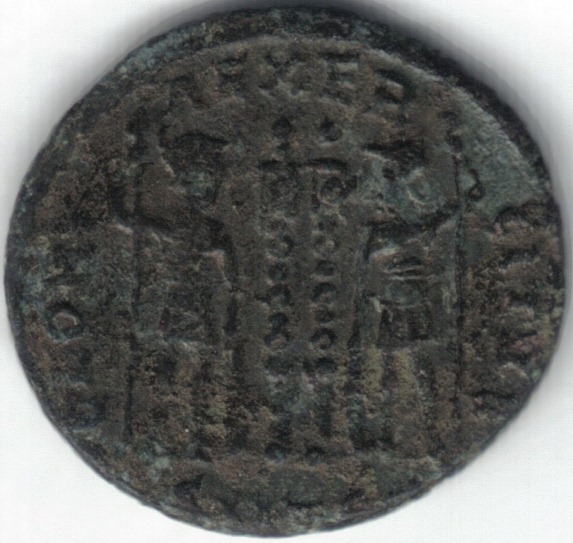 Edited by Archraz
10/05/2011 11:22 pm
|
|
Pillar of the Community
United States
1549 Posts |
SMTS Sacra Moneta TheSsalonica followed by a letter to ID the workshop but it is off flan here.
|
|
Pillar of the Community
United States
3499 Posts |
dougsmit- Thanks for the help and input! So it is from Thessalonica, Greece?
|
|
Moderator
 United States
23731 Posts |
I'm also getting some good results with the ones I'm soaking.
|
| |
Replies: 92 / Views: 16,727 |





 First Page


 Posted 10/03/2011 2:08 pm


