|
This page may contain links that result in small commissions to keep this free site up and running.

Welcome Guest! Registering and/or logging in will remove the anchor (bottom) ads and the security checks. It's Free!
To participate in the forum you must log in or register. | Author |
 Replies: 148 / Views: 20,006 Replies: 148 / Views: 20,006 |
|
|
|
Moderator
  United States
34564 Posts |
@joe2007--you are right about the rarity. With only a few exceptions, the vast majority of these have fewer than a hundred examples existing. I would point out, though, that for the budding collector of early dated coins, there are four or five possibilities for sale right now on vcoins. Ok on to Switzerland--Region V for Levinson. I will start off straight away with the confession that I do not have a single example from this region. In lieu of posting coins from my collection, I plan to provide some information that I find interesting about the early dated coins of Switzerland. Again, sorry no pics.  In total, there are only 27 Swiss coin types in Levinson's book (cf. the listing of German types, which numbers a little less than 500 types). Virtually all of them are prohibitively rare to collect, with fewer than 10 examples in private hands. The most common (a Guldliner of Bern dated 1494) is estimated to have fewer than 50 examples of available for collecting. Another impediment to collecting region V coins is the fact that nearly all types (20/27) were made in gold rather than the typically less costly silver. In looking at Levinson's Price Supplement, I only see one coin listed for less than $2K. The median estimated price is more like $8K. While several coins have five figure prices listed, the really scary types are so rare that Levinson wasn't even able to estimate a price. This is generally reserved for unique pieces or coin types for which every example is currently residing in a museum and therefore no longer collectible. For collectors who want an example of a Region V coin on the cheap, there were restrikes made of the 1499-dated Turnosgroshens of Basel. They were struck in 1901 to celebrate the 400th anniversary of Basel joining the Swiss coinage federation. I have seen these "coins" pop up for sale on rare occasions. "If you climb a good tree, you get a push."
-----Ghanaian proverb
"The danger we all now face is distinguishing between what is authentic and what is performed."
-----King Adz
|
|
Moderator
United States
34564 Posts |
Here is some additional information about region V coins from Levinson:
Nine varieties each come to us from the cities of Basel and Bern. This represents two-thirds of all Swiss early dated coin varieties and comprise both gold and silver coins. Other, less prolific mints were located in Chur, Lausaunne, Lucerne, Sitten, and St. Gallen. As I mentioned previously, virtually all of these coins are quite rare. Interestingly, as they tended to not be used in regular commerce, the available examples are typically preserved in "hot off the press" condition.
The coinage of the St. Gallen mint is the most interesting to me. The first Swiss dated coin was produced there--a 1424 Plappart. This is also the first coin struck using Arabic style numerals. Recall that earlier dated coins used Roman numerals (such as on my avatar). But after St. Gallen struck the Plapparts, it ceased minting operations until 1500, when three denominations of coins were struck.
"If you climb a good tree, you get a push."
-----Ghanaian proverb
"The danger we all now face is distinguishing between what is authentic and what is performed."
-----King Adz
|
|
Moderator
United States
34564 Posts |
A new week and so a new region for early dated European coinage on this thread.
This week is your opportunity to post coins from Region VI (Scandanavia) listed in Levinson. Unfortunately, as with the previous region, my collection is completely lacking in examples. I do note that there are only a total of 12 varieties, most of which are either uncollectable or merely wicked hard to find. As I have time this week, I plan to share some information about the coins from this region and the three mints (two in Denmark and one in Sweden). I'm also planning to put together a little information about the very first European dated coin: the Danish Denier dated 1234 AD.
"If you climb a good tree, you get a push."
-----Ghanaian proverb
"The danger we all now face is distinguishing between what is authentic and what is performed."
-----King Adz
|
|
Moderator
United States
196572 Posts |
Hopefully someone will provide.  |
|
Moderator
United States
34564 Posts |
Quote:
Hopefully someone will provide. That would be wicked awesome, but don't hold your breath... There are only three dates of Region VI coins: 1234, 1478, and 1496 AD. Of these, only the 1478-dated coins are actually collectible (it seems that all seven of the 1234-dated coins and all three of the 1496-dated coins are in museums). Interestingly, the 1478s were minted with a frozen date and so accumulated a bunch of inscription variations as dies wore out and then were re-cut by a largely illiterate mint staff. In particular the variations in the date have caused some problems for correct attribution. The 1478 is inscribed in various ways as: 1&^8, 8o, 1&^, ^8o°, 1^^8, 1&, 8, and ^8. In some cases, these are errors in manufacturing the dies, while in others, single or stacked annulets look like the number 0 or 8, respectively. Three of these Ortug or Half-Ortug variations are listed as merely "Rare", which corresponds to an estimated 21-50 collectible pieces extant. All the others are prohibitively rare or unique. With patience, you might find a fairly beat-down coin listed for a little under $500, but most of the others that are actually collectible will set you back $1000-$3000 in that same condition. There are only three mints of Scandinavian early dated coinage: Roskilde Denmark for the 1234-dated coins, Stockholm Sweden for the 1478-dated coins, and Copenhagen Denmark for the 1496-dated coins. "If you climb a good tree, you get a push."
-----Ghanaian proverb
"The danger we all now face is distinguishing between what is authentic and what is performed."
-----King Adz
|
|
Moderator
United States
196572 Posts |
Not holding my breath. Just having a snack while reading your analysis.  |
|
Moderator
United States
34564 Posts |
Over the course of the past several years, the question as to the first dated coin has come up multiple times: http://goccf.com/t/126499http://goccf.com/t/261976http://goccf.com/t/30087I thought that I might share some more information about these coins, as they fit very nicely into Levinson's Region VI. There is plenty of information available on the web for those with some basic Google skills, but below I have summarized some of what Levinson has to say. I also note that numismatist with more advanced interest should check out a 1963 article written by F. Lindahl in the journal Nordisk Numismatsk Arsskrift. There are seven of these pieces known, but all seven are in museum collections (more on that later) and none have ever been offered for sale (more on that later). These were struck on behalf of Niels Stigsen, the bishop of Roskilde Denmark. They seem to have been struck to commemorate the bishop's success at being given the right to take a portion of the mint revenue. To be super-specific about their claim to fame, these deniers are the "first dated coins to be struck in Europe with a Latin inscription". On the obv is a bishop's mitre surrounded by the inscription ANNO DOMINI. The rev has a crown surrounded by the inscription M CC XXX IIII. My compliments to The size of these deniers is about 15 mm and the mass is a little less than 1 g. Oddly, two different dies appear to have been used, one with lower case letters and one with upper case letters. Levinson is quite clear that all seven examples are locked away in Scandinavian museums. However, look here: http://www.bruun-rasmussen.dk/sold-...&mode=detailMaybe this auction house had one to sell back in 2008? Before I spent $40K on a coin that isn't supposed to be available for sale, I would want some strong assurance that it was real.  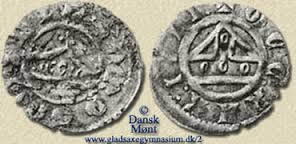 "If you climb a good tree, you get a push."
-----Ghanaian proverb
"The danger we all now face is distinguishing between what is authentic and what is performed."
-----King Adz
|
|
Moderator
United States
196572 Posts |
Very interesting. Thank you for sharing. |
|
Moderator
United States
34564 Posts |
Welcome to week 7! I'm planning to discuss the next region outlined by Levinson: Italy. Perhaps you have noticed a steep drop-off in pictures from my collection since we left the Habsburgs (Region 4). Well, somehow Italy is even harder to collect than some of the other difficult regions previously described. I count a total of only 11 varieties of early dated coins from Italy, with ten out of the 11 being essentially noncollectable due to their scarcity. For today's post, I'd like to focus on the only one of these guys that you might actually see outside of a museum. In Bologna, several 1494 AD-dated denominations were minted--all cast from the same dies. I'm not aware of any other region in this time frame issuing dated cast coins (all others are struck). Evidently, a few more bronzes (pattern testones) were made than either the gold (4 ducats) or silver (double testone). On the obv of all of these coins is a right facing, high-relief portrait of Duke Giovanni II Bentivoglio with the inscription IOANNES BENTIVO LVS II BONOIENSIS. The rev contains the date (in Roman numerals) as a series of horizontal lines: MA XIMILLIANI IMPERATORIS MVNVS MCCCCLXXXX IIII. The coins are quite heavy--nearly 13 g. In a quick web search, I can only find two instances of this coin being sold: http://www.cNGCoins.com/Coin.aspx?CoinID=216440https://www.cNGCoins.com/Coin.aspx?CoinID=184931At a hammer price of $900, the "cheap" one hardly qualifies as a bargain, but such is the rarefied air that you are breathing when you collect early dated Italian coins. Levinson estimates that there are between 11 and 20 of these pieces currently available for private collectors. "If you climb a good tree, you get a push."
-----Ghanaian proverb
"The danger we all now face is distinguishing between what is authentic and what is performed."
-----King Adz
|
|
Moderator
United States
34564 Posts |
Here is a little more information about the early dated coins of Italy.
There were a total of four active mints: Bologna, Forli, Milan, and Rome. Of these, Forli was the least prolific, producing a single dated coin (1480 AD) of which only a single example exists. In this same timeframe, a small number of undated coins were also issued by the Lord of Forli (Girolamo Riaria). However, these issues ended by the end of the 15th century as he was hacked to death by sword-wielding assassins avenging his part in a partially-successful murder plot against the Medici family in Florence. Clearly, being a ringleader of murder scheme that is not entirely successful is not a longevity-extending achievement.
There were a couple variations of a pattern Bronze Testones minted in Milan. Levinson cites the most recent sale as being in 1998--I'm not sure if either of these coins has subsequently spent time on the open market. Finally, in 1500 AD, Pope Alexander VI had a Triple Florin minted. This piece is remarkable for two reasons. First, it is the only coin with the date expressed as "MD" (all other 1500-dated coins used other variations of Roman numerals such as MCCCCC). Second, the use of an AD date on Papal States coins was highly unusual, with the vast majority being either undated or else dated with the Pope's regnal date.
Finally, if I add up all the known and estimated numbers of potentially collectible pieces of all the Italian early dated coins, the grand sum of all 11 varieties is only 30-50 pieces. Yikes!
"If you climb a good tree, you get a push."
-----Ghanaian proverb
"The danger we all now face is distinguishing between what is authentic and what is performed."
-----King Adz
|
|
Moderator
United States
196572 Posts |
Wow, good analysis. |
|
Moderator
United States
34564 Posts |
And so week 8 begins now. This is the story of the eighth region of early dated European coins: France. Not only do I have no examples of these coins, I can virtually guarantee that you don't have them either. Only three varieties were produced, with one variety existing only as a single specimen in a museum and the other two varieties with no more than three collectible in existence. That said, if you are one of the handful of souls with one of these babies in your collection, please post some pics of that eye candy for us. According to Levinson, of these three varieties, two are unknown in recent auctions, while the other was "claimed by right" by the French government in 1997. Within France, there were two duchies for early dated coins: Lorraine and Nantes. Interestingly, Lorraine is represented by mints at both Nancy and St. Die. Three different mints, and yet only the tiniest output of these gems for us to add to our collections. I cannot find any images on-line of these coins to post for your inspection. However, here is a link to the museum which holds the only 1491 Double Gros minted by Nancy: http://museu.ms/museum/details/5735...emporary-artMaybe the next time one of our members is visiting Eastern France (specifically Epinal) could check it out and post pics here? "If you climb a good tree, you get a push."
-----Ghanaian proverb
"The danger we all now face is distinguishing between what is authentic and what is performed."
-----King Adz
|
|
Moderator
United States
34564 Posts |
Hi. I've been thinking a bit about the best way to handle this thread when our eighth week ends on 11/12/16. I can envision a couple different pathways: I can have the mods lock it and the currently posted coins stand on their own. Alternatively, I could keep it open for future posts as folks stumble on this thread (or go out an purchase their own early dated coinage). I'm leaning toward this second option as it would allow an entire body of work to be stored all in one convenient thread. Plus I still have a bunch more coins I could post from regions I, II, and III... What do all y'all think about the best path to take? Lock it or keep it open for future contributions?  "If you climb a good tree, you get a push."
-----Ghanaian proverb
"The danger we all now face is distinguishing between what is authentic and what is performed."
-----King Adz
|
|
Pillar of the Community
United States
7067 Posts |
I'm with you on voting for the second option, Dave. Truly outstanding work on this thread, btw...lots of info and obvious enthusiasm for the subject matter.
|
|
Pillar of the Community
Russian Federation
5186 Posts |
We should probably add a ninth week for early AD dated coinage not covered in Levinson (such as the Acre dirhams).
I agree about having it open for any early AD dated coins past that ninth week, however.
|
| |
Replies: 148 / Views: 20,006 |
To participate in the forum you must log in or register.
 
- Definitive Test For Black Beauty Nickels
- My Last Purchase: A Bronze Greek Coin Representing The Poetess Sappho
- How Many Countries Do You Have Coins From?
- Post Your Coins With Coats Of Arms, Shields, Crests, Crowns, Etc.
- How Far Back Can We Go? Ninth Edition!
- 1966 Nickel Die Adjustment Strike?
- Post Your Stories & Pix Of Found Money
- 1885-Zs Mexico - 25 Centavos W/Arcing Die Crack, Tilted & Re-Punched Reverse Die
- 1934 Peace Dollar NGC MS-67+ At Auction
- Will Our Coins Ever Be Valuable?
- G L B 49's MS-70 Perfect Silver Coins
- ID Help - Roman Provincial Coin
- 1894 Fifty Cents - Grade This Coin. It May Or May Not Be TPG.
- 1847 Undecimo Edge Great Britain Gothic Crown, Gothic Type, NGC PF61
- Error Opinions, 1971-D DDO, 1955-D/S, 1996-P Quarter
- Post Your Coins Representing The Animal Kingdom.
- Post Your Bird Coins
- Post Your Coin Or Medal With Flora
- Continuing List To Show Everyones Latest Acquisitions
- Post Your Coins Of Steel (And Iron)!
Disclaimer: While a tremendous amount of effort goes into ensuring the accuracy of the information contained in this site, Coin Community assumes no liability for errors. Copyright 2005 - 2026 Coin Community Family- all rights reserved worldwide. Use of any images or content on this website without prior written permission of Coin Community or the original lender is strictly prohibited.
Contact Us | Advertise Here | Privacy Policy / Terms of Use
|
| Coin Community Forum |
© 2005 - 2026 Coin Community Forums |
| It took 0.56 seconds to rattle this change. |
 |
|
| |
| |







 First Page
 Previous Page


 Posted 10/18/2016 06:03 am


