| Author |
 Replies: 20 / Views: 767 Replies: 20 / Views: 767 |
Page 2 of 2
|
|
|
|
Bedrock of the Community
 United States
27233 Posts |
Inordinately fascinated by bits of metal with strange markings and figures
|
|
Pillar of the Community
  United States
6879 Posts |
Glad I asked the question. =)
For now, I will hold off on removing the coin from the slab. Honestly, it's a well made plastic case. I will try to take some reasonable pictures of the nickel itself tomorrow, so folks can give some opinions on grade. It's not a particularly high grade specimen, and it does have a few blemishes like that dark mark on the head, and what might be evidence of cleaning on the reverse.
|
|
Pillar of the Community
United States
3456 Posts |
I agree with your choice. It will at least protect the coin.
|
|
Moderator
United States
194504 Posts |
Good points, all. I agree, leave it as is for now.
|
|
Pillar of the Community
United States
6879 Posts |
Some images for grading. Unfortunately, the obverse is right near the top surface of the slab, but the reverse is sunken pretty far down from the plastic window. 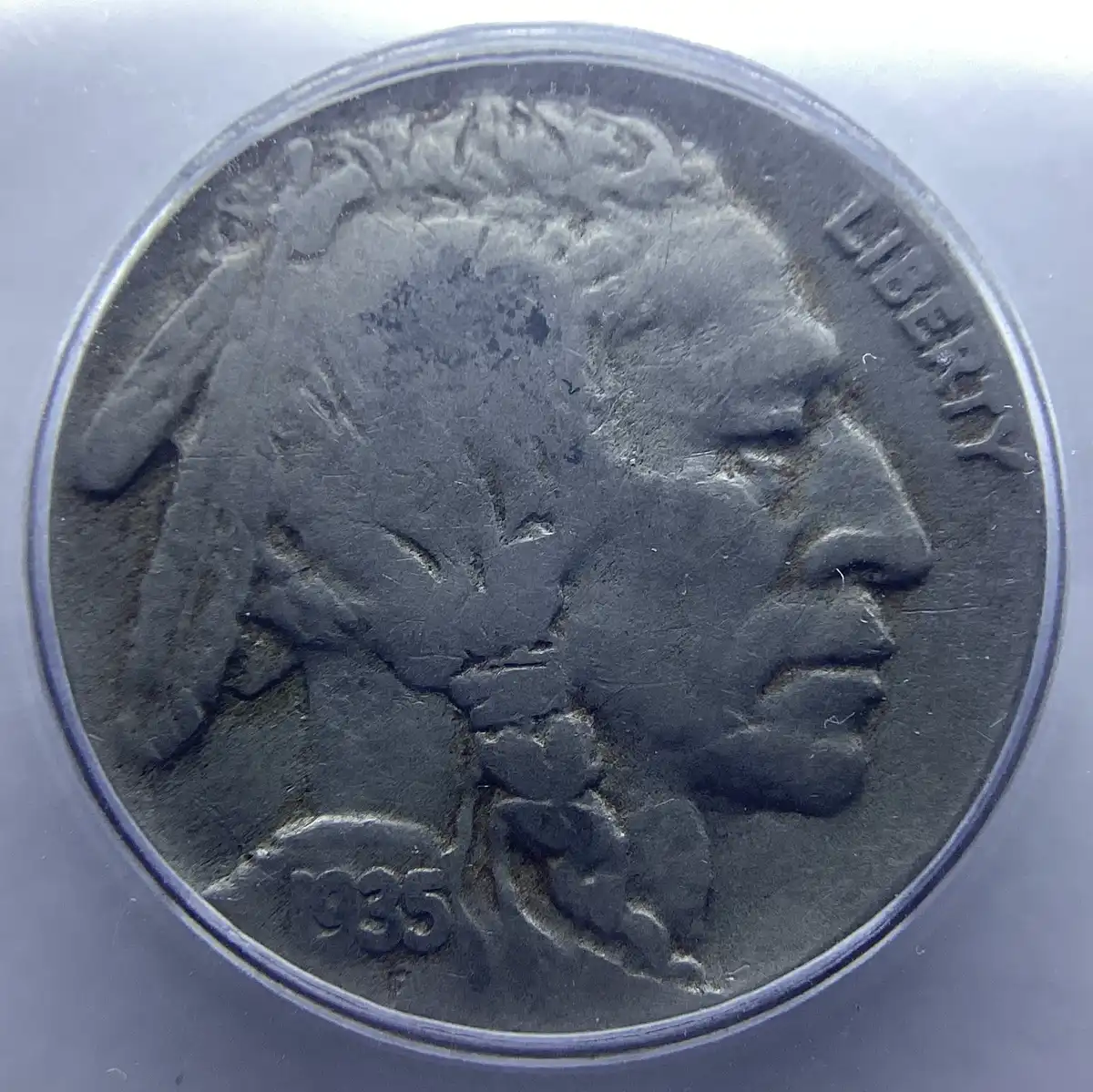 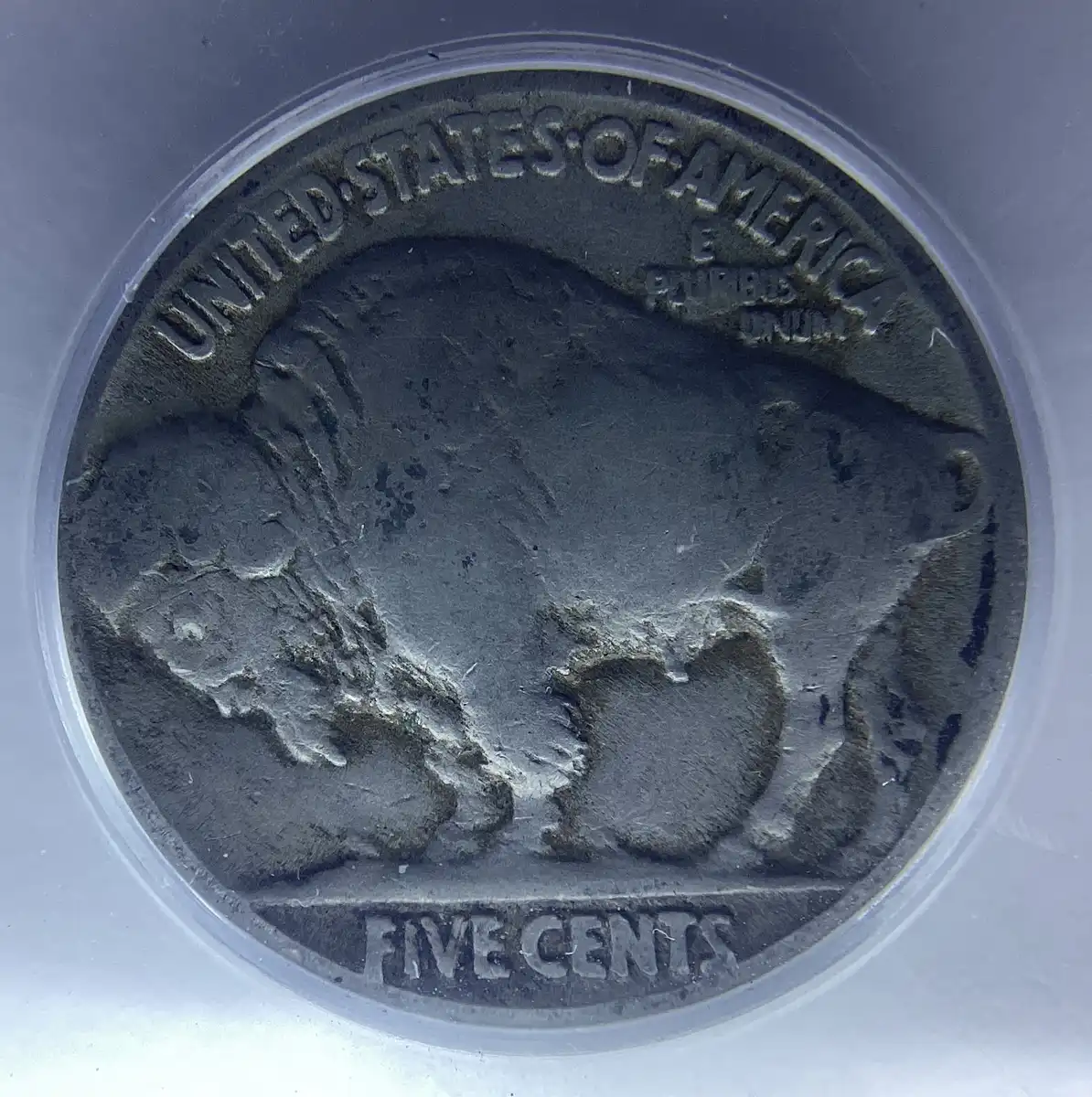 |
|
Pillar of the Community
United States
6879 Posts |
I am thinking it falls somewhere along the line between VG to F, but I am not that proficient at grading Buffalo nickels yet. |
|
Pillar of the Community
United States
3722 Posts |
I agree, any grading will be a bit iffy because of the slab. First things first, your coin is 1935 FS-801, DDR-001, WDDR-001. The notching on the "E"s of FIVE and CENTS and the clear doubling on the "V" of FIVE are dead giveaways. It is either late Stage B or early Stage C. The Stage C marker is the obverse die crack from the braid to the shoulder just east of the "5." It is visible, but not quite complete. Second, the coin will be detailed. There is a corrosion spot removed on the Indian's head and the coin has been cleaned (wiped). Third, clash polishing makes the coin appear more worn than it is. The later stages of this DDR show extensive clash polishing, and this is apparent on your coin. The heavy die polishing lines in the fields NE-SW on the obverse and NW-SE on the reverse are typical for this die pair. Ironically, they polished the buffalo's head quite well, but didn't polish the second feather / "U" of UNITED clash well enough to remove it. The LIBERTY / right rear hoof clash also isn't polished well enough to remove it. On some examples, parts of EPU can be seen beneath the chin. I can't quite make out the lettering beneath the chin on your coin. The buffalo's head and horn have been affected by the die polishing. The rear portion of the buffalo's back (beneath UNUM) has also been affected by the die polishing. The lower second and third feather and chin are affected by the polishing. Putting all this together, on the obverse, your coin has a complete rachis and calamus on the second feather, some detail on the knot, some separation on the braids, decent detail in the eye, lips, chin, and hair, and weak but discernable separation of the hair and forehead. These are consistent with low VF. On the reverse, the buffalo's tail, "F" of FIVE, and "S" of CENTS are merging with the rim. Everywhere except at PCGS, this would cap the grade at VF. Disregarding the die-polished areas, the reverse detail on the buffalo's eye, beard, foreleg, and hump are consistent with low to mid VF. Based on what I can make out, this coin looks like VF-20 Details, maybe VF-25 Details. It's a great catch, regardless of details or technical grade. You have a keeper.  |
|
Moderator
United States
194504 Posts |
Quote:
First things first, your coin is 1935 FS-801, DDR-001, WDDR-001.  Quote:
Second, the coin will be detailed. There is a corrosion spot removed on the Indian's head and the coin has been cleaned (wiped). I did not notice that in the first images, but I can see it in the second set. Quote:
It's a great catch, regardless of details or technical grade. You have a keeper. Thank you for sharing your always appreciated analysis.  |
|
Pillar of the Community
United States
6879 Posts |
Fortcollins, as always, thanks for the outstanding analysis! Quote:
Second, the coin will be detailed. There is a corrosion spot removed on the Indian's head and the coin has been cleaned (wiped). Yeah, I kinda thought you guys were going to say that. Initially, I had some hope that the dark gray spots were just crud that could be dissolved with acetone, but the more I looked at it under magnification, the more places I could see where corrosion and environmental damage had been stripped away. Quote:
Based on what I can make out, this coin looks like VF-20 Details, maybe VF-25 Details. I think that's great news! Certainly a considerably higher grade than the 10-15 that I would have given the coin. Quote:
It's a great catch, regardless of details or technical grade. You have a keeper. Thanks! I was fortunate to come across that one in my feed. The coin was picked for $8, although the seller tried to ship it with an ESUS label, so that cost me another $6.42 at the post office in postage due. Still a great bargain for an iconic variety. Given that the coin is Details regardless, I am going to keep it in the ICG slab. Clearly I have a lot left to learn about die polishing vs. die wear, and about the completeness of ribbons and rachis! =P |
|
Pillar of the Community
United States
3722 Posts |
Quote:
Thanks! I was fortunate to come across that one in my feed. The coin was picked for $8, although the seller tried to ship it with an ESUS label, so that cost me another $6.42 at the post office in postage due. Still a great bargain for an iconic variety. Wow. You did VERY well on this purchase. It's one of the most spectacular doubled dies in the entire series (obviously the two major DDOs steal the top billing). The technical grade won't be much of a price driver here. The variety is in demand and it's not an easy one to find. As details coins go, this one is definitely collectible. The spot doesn't distract from the DDR, and the cleaning isn't harsh. Nice coin! |
|
Pillar of the Community
United States
6879 Posts |
You can take a healthy slice of the credit for my Buffalo nickel cherry-picks. While I have grown familiar with some variety catalogs—namely Wexler, Variety Vista, and PCGS—all of the knowledge on hunting these varieties was learned 100% on CCF. Quote:
obviously the two major DDOs steal the top billing Hopefully this isn't a daft question. The 1916 doubled die obverse is obviously king. Is the second coin the 1918/7? I know the dates on Buffalo nickels were hubbed, not hand punched, so the FS-101 designation leads me to believe it's considered a DDO (similar to the 1943/2 Jefferson nickel). |
|
Moderator
United States
105202 Posts |
so did you crack it out yet?
|
|
Pillar of the Community
United States
3722 Posts |
Quote:Hopefully this isn't a daft question. The 1916 doubled die obverse is obviously king. Is the second coin the 1918/7? I know the dates on Buffalo nickels were hubbed, not hand punched, so the FS-101 designation leads me to believe it's considered a DDO (similar to the 1943/2 Jefferson nickel). It's a very good question! The 1918/7-D is a DDO, like the other wartime varieties during both World Wars. It's more common than the price would suggest, but the demand is high. Yes, the 1916 DDO and 1918/7-D are the top two Buffalo doubled dies. |
|
Pillar of the Community
United States
6879 Posts |
Thanks, I will file that away in the memory bank. =) Quote:
so did you crack it out yet? I decided against a crack out. Those areas of removed corrosion mean that there is really nothing that I can do to conserve the coin. If I take nice photos at some future point, I might change my mind about the keeping the slab. |
|
Moderator
United States
194504 Posts |
Sounds like the correct choice for now. |
|
Page 2 of 2
|
Replies: 20 / Views: 767 |
Page 2 of 2
|








 First Page


 Posted 06/18/2026 11:46 pm


