|
This page may contain links that result in small commissions to keep this free site up and running.

Welcome Guest! Registering and/or logging in will remove the anchor (bottom) ads and the security checks. It's Free!
To participate in the forum you must log in or register. | Author |
 Replies: 5,980 / Views: 455,843 Replies: 5,980 / Views: 455,843 |
|
|
|
Moderator
 United States
195559 Posts |
Excellent addition to your set.  |
|
Bedrock of the Community
 United States
10284 Posts |
I think you can see how I am trying to connect the medals together with history jbuck.
It will make the Grandkids learn something I hope about American and other famous art, American history and some of the famous people involved.
I know I am learning a lot myself and it will also put a bit more interesting color to my coin collection.
My coin collection and the medal kick are complementing each other as I move along here.
I do think I am coming near the end of a rampage and will probably have to slow down soon on chasing these things.
I have nabbed a lot of my favorite characters. I'd still like to get a few more American folklore items.
Annie Oakley, Paul Bunyan, Moby Dick, Wyatt Earp, and Doc Holiday. Stuff like that.
|
|
Moderator
United States
195559 Posts |
You are doing a fine job. Best of luck on the continuing search. |
|
Bedrock of the Community
United States
10284 Posts |
Two tougher issues from the bronze Statehood Medallic Art Co Set Jefferson Davis
Confederate States President Kentucky born Jefferson Davis was an American politician who served as the only President of the Confederate States from 1861 to 1865. He was a member of the Democratic Party who represented Mississippi in the United States Senate and the House of Representatives prior to becoming president of the Confederacy. He was the 23rd United States Secretary of War, serving under U.S. President Franklin Pierce from 1853 to 1857. Jefferson Davis served six years as a lieutenant in the United States Army. He fought in the Mexican-American War (1846-1848), as the colonel of a volunteer regiment. Davis raised a volunteer regiment, the 155th Infantry Regiment, becoming its colonel under the command of his former father-in-law, General Zachary Taylor. After Davis was captured by Union forces on May 10 1865 at Irwinville in Irwin County, Georgia, he was accused of treason and imprisoned on May 19, 1865 in a casemate at Fortress Monroe on the coast of Virginia. Irons were riveted to his ankles at the order of General Nelson Miles who was in charge of the fort. Davis was allowed no visitors, and no books except the Bible. He was never tried and was released after two years. Before the American Civil War, he operated a large cotton plantation in Mississippi and owned as many as 74 slaves. After the Civil War most historians sharply criticize Davis for his flawed military strategy, his selection of friends for military commands, and his neglect of homefront crises. After his release from prison and pardon, Davis faced continued financial pressures, as well as an unsettled family life, he lost about everything he owned. He was a proud man and would not accept charity but most of his financial ventures were dismal. Davis had poor health for most of his life, including repeated bouts of malaria, battle wounds from fighting in the Mexican-American War and a chronic eye infection that made bright light painful. He also had a nerve disorder that caused severe pain in his face. After the war, he contributed to reconciliation of the South with the North, but remained a symbol for Southern pride.  and Sitting Bull Before the Battle of the Little Bighorn, Sitting Bull had a vision in which he saw many soldiers, "as thick as grasshoppers," falling upside down into the Lakota camp, which his people took as a foreshadowing of a major victory in which a large number of soldiers would be killed. About three weeks later, the confederated Lakota tribes with the Northern Cheyenne defeated the 7th Cavalry under Lt. Col. George Armstrong Custer on June 25, 1876, annihilating Custer's battalion and seeming to bear out Sitting Bull's prophetic vision. Annie Oakley was Sitting Bull's symbolically "adopted" daughter. Sitting Bull felt that she was "gifted" by supernatural means in order to shoot so accurately with both hands. He named her "Little Sure Shot" - a name that Oakley used throughout her career. After working as a performer with Buffalo Bill's Wild West show, Sitting Bull returned to the Standing Rock Agency in South Dakota. Because of fears that he would use his influence to support the Ghost Dance movement, Indian Service agent James McLaughlin at Fort Yates ordered his arrest. During an ensuing struggle between Sitting Bull's followers and the agency police, Sitting Bull was shot in the side and head by Standing Rock policemen.  |
|
Bedrock of the Community
United States
10284 Posts |
Three Franklin Mint National Commemorative Society Medals Mintage each 5292
39 mm diameter
Weight 0.83 oz
.925 Sterling SilverOne for the President when I was born, I like Ike! Eisenhower Memorial 1969  His VP Richard Nixon remembered this pose!  Dwight David "Ike" Eisenhower was an American Army general and statesman who served as the 34th President of the United States from 1953 to 1961. During World War II, he was a five-star general in the United States Army and served as Supreme Commander of the Allied Expeditionary Forces in Europe. He was responsible for planning and supervising the invasion of North Africa in Operation Torch in 1942-43 and the successful invasion of France and Germany in 1944-45 from the Western Front. He was also the first American President to be bound by the 22nd Amendment, which limits the number of times one can be elected to the office of President of the United States.  One for President Thomas Jefferson, who had some to do with the Louisiana Purchase 1971Westward Ho!   ... but a history lesson on this complicated deal is too lengthy for this thread. Not a bad deal for 3 cents an acre though!   and One for American Folklore, Babe Ruth 1969 "The Bambino"   The Curse of the Bambino was a superstition evolving from the failure of the Boston Red Sox baseball team to win the World Series in the 86-year period from 1918 to 2004. This misfortune began after the Red Sox sold star player Babe Ruth, sometimes nicknamed as "The Bambino", to the New York Yankees in the off-season of 1919-1920. Before that point, the Red Sox had been one of the most successful professional baseball franchises, winning the first World Series and amassing five World Series titles. After the sale, they went without a title for decades, even while the Red Sox won four American League championships from 1946 to 1986, as the previously lackluster Yankees became one of the most successful franchises in North American professional sports. The curse became a focal point of the Yankees-Red Sox rivalry over the years. Talk of the curse as an ongoing phenomenon ended in 2004, when the Red Sox came back from a 0-3 best-of-seven deficit to beat the Yankees in the 2004 American League Championship Series and then went on to sweep the St. Louis Cardinals to win the 2004 World Series.  |
|
Moderator
United States
195559 Posts |
Nice additions, but you know I think the Ike is the best.  The profile is not too different from the US Mint medal. They make for a nice pair... 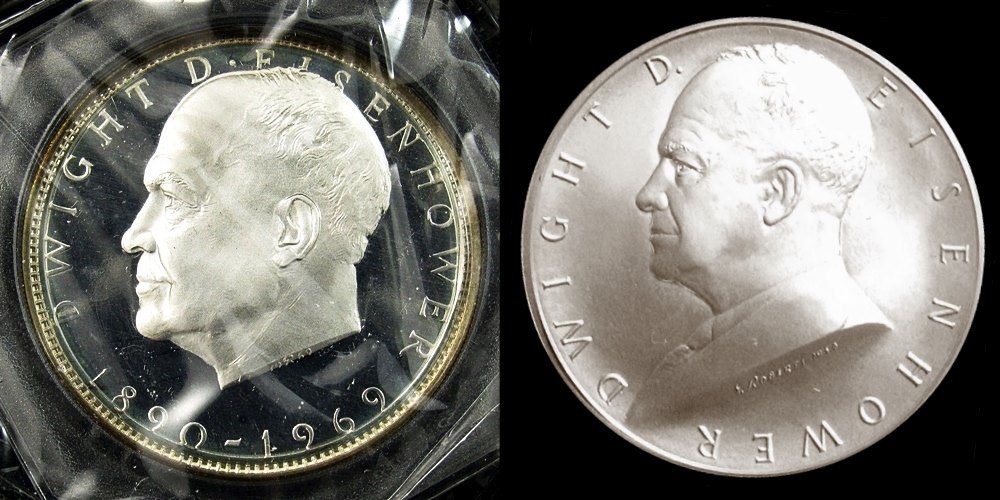 |
|
Valued Member
United States
110 Posts |
The 1978 Coinarama medal commemorated the 100th Anniversary of the Morgan dollar, and has the Morgan head as the main design element. The Morgan dollar was designed by Asst. Engraver George T. Morgan. The obverse of the dollar shows Liberty in profile. This was the first silver dollar minted after the end of free coining of silver. This allowed for people possessing of bullion or mined silver to be able to deposit it in a bank who would refine it and turn it in to US silver coins. This ended the monetized bullion rate of 16 ounces of silver equaling 1 ounce of gold, helping to protect the gold standard of our money at the time. An extremely popular coin, there are many varieties of each date, making this an exciting and difficult coinage to collect in full. Mintage: Silver - 100 (haven't seen one for sale) Bronze - 500 Oxidized Bronze - 535 Less than 10 other medals struck (Aluminum is pictured below - unsure if this is from this line, or the amount was not reported)    |
|
Bedrock of the Community
United States
10284 Posts |
Griffin, I think I figured it out and found your listings LOL Quite a bit to look at there! I grabbed a reverse for your Morgan Coinarama medal above that you listed and will post it here for you. 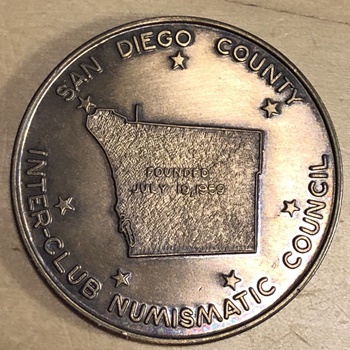 |
|
Valued Member
United States
110 Posts |
Yeah, thats the reverse for all but the first two official medals
|
|
Valued Member
United States
110 Posts |
The 1979 Coinarama medal honored the 110th Anniversary of the completion of the Transcontinental Railroad. In continuing the early United States' desire of Manifest Destiny, a nation that stretches from sea to sea, it was determined that a cross country railroad would be needed to connect the two sides of the country. This would be much faster and more efficient than having to send cargo and migrants by ship around the horn of South America. It was originally brought up in 1832, but construction did not begin until 1863. It's final spike was struck in 1869 at Promontory Summit in Utah. 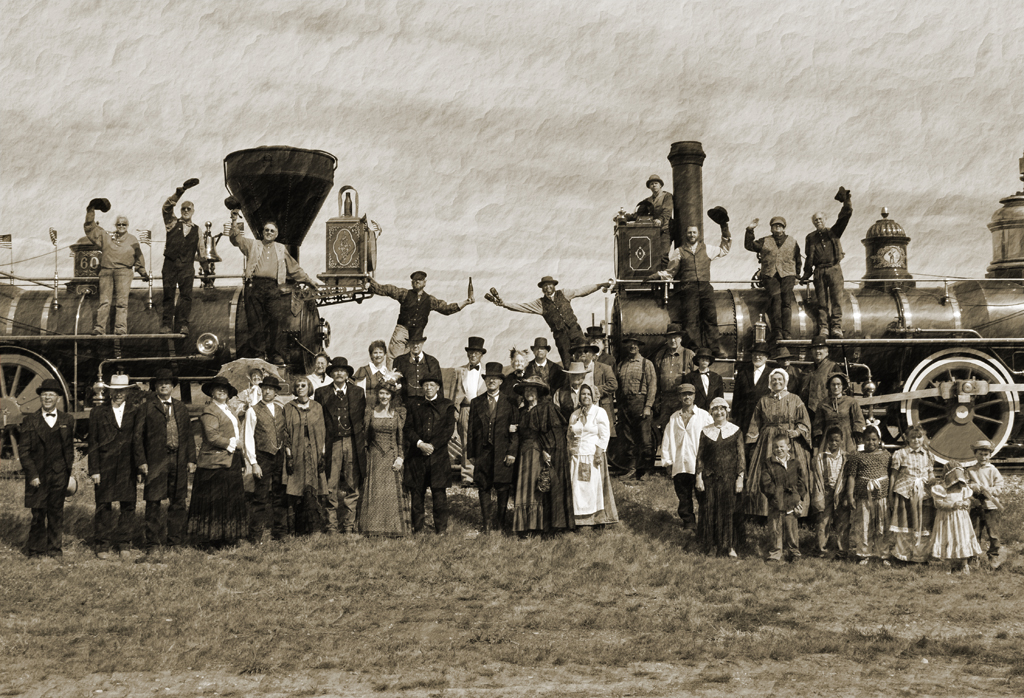 The medal commemorates this ceremony, and shows two trains facing each other. Mintage: Silver - 100 (haven't seen one) Bronze - 1000 Less than 10 in other metals.  |
|
Bedrock of the Community
United States
10284 Posts |
Nice Golden Spike medal Griffin. Nice write up too. Guys like this cannot be written up in such short description. This is a TEXAS medal, the great state and certainly one of my very favorites. I do on occasion fly the Texas Lone Star Flag at my PA house. Last time was during and after Hurricane Harvey. I have been there a few times. Sam Houston - Texas Medallic Art Co Bronze 1.5 in medal  Fought in the War of 1812 Fought in the War of 1812, wounded twice and favored by Andrew Jackson. In 1822, Houston was elected to the U.S. House of Representatives for Tennessee. He won the race for Governor of Tennessee in 1827 but scandals of infidelity caused him to lose Eliza, his first of three wives and the chance for re-election. Houston also was blamed for giving Indian tribes supplies which caused him a lot of grief. He beat William Stanbery with a cane, was arrested and left for Mexico without paying a $500.00 judgement. He left for Texas in December 1832 and was immediately swept up in the politics of what was still a part of the Mexican state of Coahuila, attending the Convention of 1833 as representative for Nacogdoches. Houston emerged as a supporter of William Harris Wharton and his brother, who promoted independence from Mexico. The Texas Army commissioned Houston as Major General in November 1835. After the Alamo, Houston's army defeated Santa Anna who was forced to sign the Treaty of Velasco, granting Texas its independence. Houston was injured by a stray bullet which shattered his ankle. Houston was twice elected President of the Republic of Texas.
After the annexation of Texas by the United States in 1845, Houston was elected to the U.S. Senate by the Texas state legislature. He was sworn in as Governor of Texas on December 21, 1859. Upon election, he became the only person elected to serve as governor of two U.S. states, Texas and Tennessee, by popular vote. Although Houston was a slave owner and opposed abolition, he opposed the secession of Texas from the Union. An elected convention voted to secede from the United States on February 1, 1861, and Texas joined the Confederate States of America on March 2, 1861. Houston refused to recognize its legality, but the Texas legislature upheld the legitimacy of secession. The political forces that brought about Texas's secession were powerful enough to replace the state's Unionist governor. Houston chose not to resist, stating, Quote:
"I love Texas too well to bring civil strife and bloodshed upon her. To avert this calamity, I shall make no endeavor to maintain my authority as Chief Executive of this State, except by the peaceful exercise of my functions ... " He was evicted from his office on March 16, 1861, for refusing to take an oath of loyalty to the Confederacy.  |
|
Bedrock of the Community
United States
10284 Posts |
I didn't realize that I had posted a bunch of other medals in other threads before we got this one going. One of my other Robert E. Lee medals http://goccf.com/t/32990&whichpage=204#2560780This one is for VirginiaRobert E. LeeMedallic Art Co. bronze 1.5 in.  Robert Edward Lee was an American and Confederate soldier, best known as a commander of the Confederate States Army. He commanded the Army of Northern Virginia in the American Civil War from 1862 until his surrender in 1865. A son of Revolutionary War officer Henry "Light Horse Harry" Lee III, Lee was a top graduate of the United States Military Academy and an exceptional officer and military engineer in the United States Army for 32 years. During this time, he served throughout the United States, distinguished himself during the Mexican-American War, and served as Superintendent of the United States Military Academy. When Virginia declared its secession from the Union in April 1861, Lee chose to follow his home state, despite his desire for the country to remain intact and an offer of a senior Union command. During the first year of the Civil War, Lee served as a senior military adviser to Confederate President Jefferson Davis. In the summer of 1863, Lee invaded the North again, marching through western Maryland and into south central Pennsylvania. He encountered Union forces under George G. Meade at the three-day Battle of Gettysburg in Pennsylvania in July. That battle would produce the largest number of casualties in the American Civil War.  Edited by TNG
02/19/2018 12:26 am
|
|
Pillar of the Community
United States
5029 Posts |
|
|
Moderator
United States
195559 Posts |
More nice additions. |
|
Valued Member
United States
110 Posts |
The 1980 San Diego Coinarama medal was the first in a series of "California's Protected Species" animal medals. The Desert Tortoise is the state reptile of both California and Nevada, and can be found in the Mojave and Sonoran Deserts in the American Southwest and Mexican Northwest. Because of the tough hot or cold conditions found consistently in the desert, these tortoise's live about 95% of their life in rock shelters or underground in burrows to protect themselves from the elements. They grow to about a foot long, and live for about 50-80 years. They are classified as vulnerable to extinction. They can go up to a year without drinking water, and most of their water intake is through the plants and fruits they eat. If they happen upon a large enough puddle after a rain, desert tortoise's can add up to 40% of their weight in water.  Another error, all medals were struck with "Desert Tortorise." This is one of the most sought after of the Coinarama medals as it has the lowest silver mintage, and a handful were melted before they could be sold. A few also may have been stolen before they could be sold. Mintage: Silver - 50 (7-15 melted) Bronze - 500 Oxidized Bronze - 515 Less than 10 in other metals  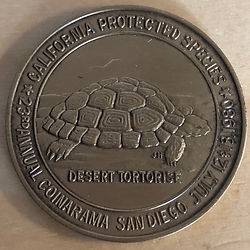 |
| |
Replies: 5,980 / Views: 455,843 |
To participate in the forum you must log in or register.
Disclaimer: While a tremendous amount of effort goes into ensuring the accuracy of the information contained in this site, Coin Community assumes no liability for errors. Copyright 2005 - 2026 Coin Community Family- all rights reserved worldwide. Use of any images or content on this website without prior written permission of Coin Community or the original lender is strictly prohibited.
Contact Us | Advertise Here | Privacy Policy / Terms of Use
|
| Coin Community Forum |
© 2005 - 2026 Coin Community Forums |
| It took 0.66 seconds to rattle this change. |
 |
|
| |
| |







 First Page
 Previous Page


 Posted 02/15/2018 2:50 pm


