Three new additions
40 mm .925 Silver medals .87 troy oz
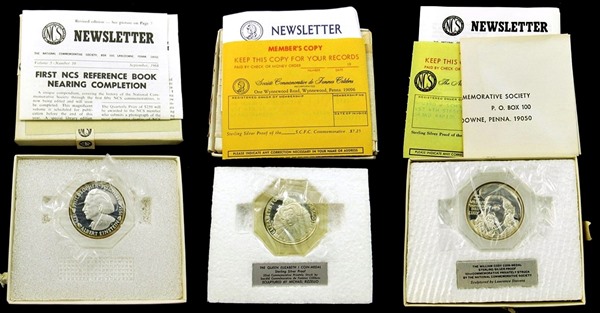 Albert Einstein
 Sterling Silver Proof Medal
1968 National Commemorative Society Franklin Mint
Honestly, everything this man knew is way beyond me.

A German-born theoretical physicist who developed the general theory of relativity, one of the two pillars of modern physics.
He received the Nobel Prize in Physics in 1921.
Einstein is well known for his theories about light, matter, gravity, space, and time. His most well known equation is E = mc2
It means that energy and mass are different forms of the same thing.
Einstein published more than 301 scientific papers and over 150 non-scientific works. He received honorary doctorate degrees in science, medicine and philosophy from many European and American universities.
Near the beginning of World War II, he warned President Franklin D. Roosevelt that Germany might be developing an atomic weapon, and recommended that the U.S. begin nuclear weapons research.
That research, begun by a newly established Manhattan Project, resulted in the U.S. becoming the first and only country to have nuclear weapons during the war.

 Queen Elizabeth IGood Queen Bess
1971 Societe Commemorative Femmes Celebres

Elizabeth was the daughter of Henry VIII and Anne Boleyn, his second wife, who was executed two-and-a-half years after Elizabeth's birth. Anne's marriage to Henry VIII was annulled, and Elizabeth was declared illegitimate. Her half-brother, Edward VI, ruled until his death in 1553, bequeathing the crown to Lady Jane Grey and ignoring the claims of his two half-sisters, Elizabeth a Protestant and the Roman Catholic Mary, in spite of statute law to the contrary.
Edward's will was set aside and Mary became queen, deposing Lady Jane Grey who was eventually beheaded. During Mary's reign, Elizabeth was imprisoned for nearly a year on suspicion of supporting Protestant rebels.
Mary had over 280 religious dissenters ( Protestants ) burned at the stake in the Marian persecutions. After Mary's death in 1558, her re-establishment of Roman Catholicism was reversed by her younger half-sister and successor Elizabeth became queen.
Elizabeth's reign is known as the Elizabethan era. The period is famous for the flourishing of English drama, led by playwrights such as William Shakespeare and for the seafaring prowess of English adventurers such as Francis Drake. Some historians depict Elizabeth as a short-tempered, sometimes indecisive ruler, who enjoyed more than her share of luck.
Mary, Queen of Scots, was imprisoned in 1568 and executed by order of Elizabeth as the focus of Catholic plotting against the English Crown.

Mary's death may have been the final trigger for the launching on 12 July 1588, of the Spanish Armada.
A great fleet of Spanish ships set sail for the English Channel, planning to ferry an invasion force under the Duke of Parma to the coast of southeast England from the Netherlands.
A combination of miscalculation, misfortune, and an attack of English fire ships dispersed the Spanish ships to the northeast and defeated the Armada.
The Armada straggled home to Spain in shattered remnants.
Though Elizabeth followed a largely defensive foreign policy, her reign raised England's status abroad.
Pope Sixtus V marvelled ...
"She is only a woman, only mistress of half an island, and yet she makes herself feared by Spain, by France, by the Empire, by all".

 William Cody
1968 National Commemorative Society Franklin Mint

William F. "Buffalo Bill" Cody opened Buffalo Bill's Wild West show on May 19, 1883 at Omaha, Nebraska. His partner that first season was a dentist and exhibition shooter, Dr. W.F. Carver. Cody and Carver took the show, subtitled "Rocky Mountain and Prairie Exhibition," across the country to popular acclaim and favorable reviews, launching a genre of outdoor entertainment that thrived for three decades and survived, in fits and starts, for almost three more.
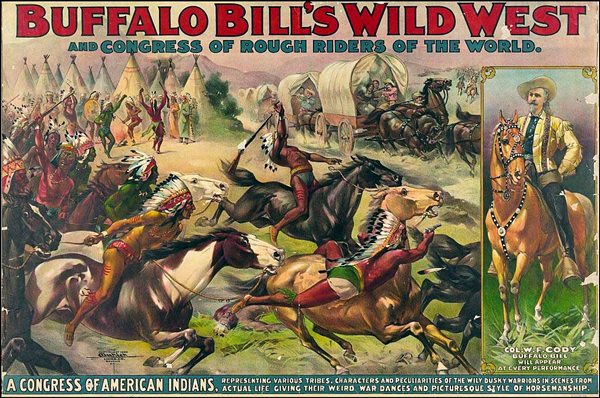
The logistics of the show were formidable. The biggest of them all, Buffalo Bill's Wild West, in the late 1890s carried as many as five hundred cast and staff members, including twenty-five cowboys, a dozen cowgirls, and one hundred Indian men, women, and children. They all were fed three hot meals a day, cooked on twenty-foot-long ranges. The show generated its own electricity and staffed its own fire department. Performers lived in wall tents during long stands or slept in railroad sleeping cars when the show moved daily. Business on the back lot was carried on in what one reporter called "a Babel of languages." Expenses were as high as $4,000 per day.








 First Page
 Previous Page


 Posted 02/22/2018 09:08 am