By early 1915, a new threat, submarines, began to materialize. At first, they were used by the Germans only to attack naval vessels, and they achieved only occasional - but sometimes spectacular - successes. Then the U-boats as they were called, began to attack merchant vessels at times. Desperate to gain an advantage on the Atlantic, the German government decided to step up their submarine campaign. On 4 February 1915 Germany declared the seas around the British Isles a war zone and from 18 February allied ships in the area would be sunk without warning. Efforts would be taken to avoid sinking neutral ships. The sinking of the Cunard ocean liner RMS Lusitania occurred on Friday, 7 May 1915 during the First World War, as Germany waged submarine warfare against the United Kingdom which had implemented a naval blockade of Germany. The ship was identified and torpedoed by the German U-boat U-20 and Lusitania sank in 18 minutes.
On board the Lusitania, Leslie Morton, an eighteen-year-old lookout at the bow, had spotted thin lines of foam racing toward the ship. He shouted, "Torpedoes coming on the starboard side!" through a megaphone, thinking the bubbles came from two projectiles. The torpedo struck Lusitania under the bridge, sending a plume of debris, steel plating and water upward and knocking lifeboat number five off its davits. "It sounded like a million-ton hammer hitting a steam boiler a hundred feet high." one passenger said. A second, more powerful explosion followed, sending a geyser of water, coal, dust and debris high above the deck.
The vessel went down 11 miles off the Old Head of Kinsale, Ireland, killing 1,198 and leaving 761 survivors. The sinking turned public opinion in many countries against Germany, contributed to the American entry into World War I and became an iconic symbol in military recruiting campaigns of why the war was being fought.
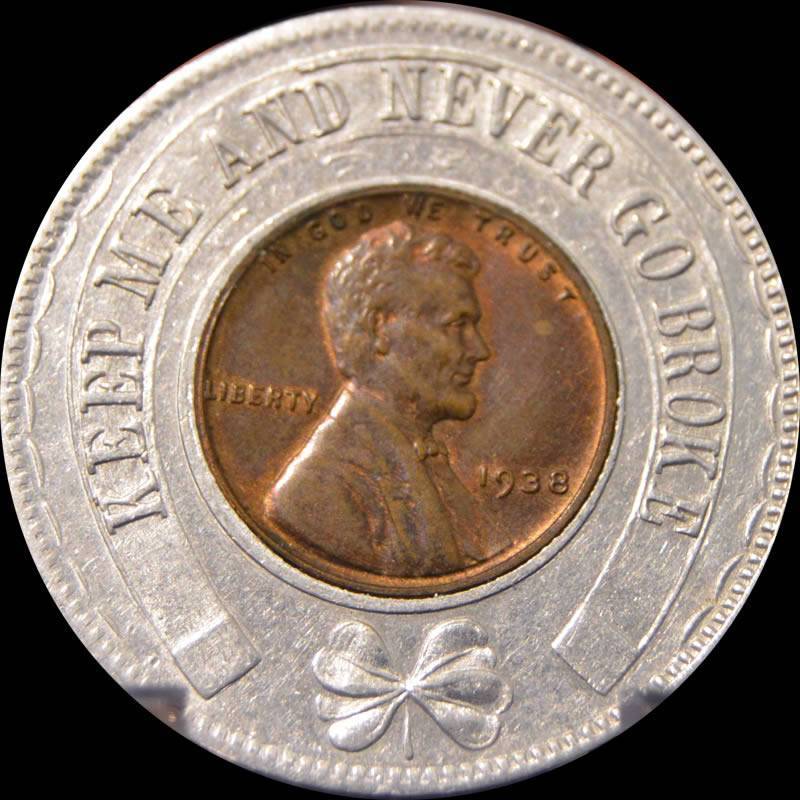
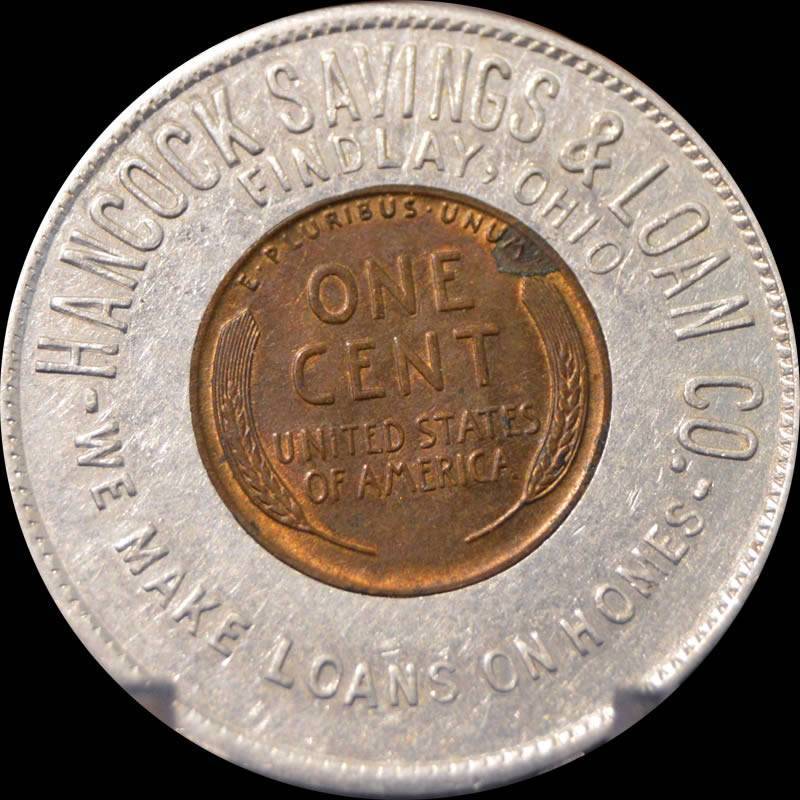
A nice 1938 Wheat cent is the center of attention for this lucky penny holder from Findlay, Ohio.
Nowadays, the Hancock S&L does business as the Hancock FCU. The bank was founded in .. 1938. After a merger in 1981, they survived the S&L scandal and are still in the banking business 80 years later.
Thanks for the lucky penny paralyse. Not many banks or S&L and credit unions lasted that long. I only have one Encased Cent. At the coin club meeting last month somebody brought in a whole bunch in a zipper bag and an album of them and some really odd ones were in his collection. Facinating niche of the hobby.
Quote: A nice 1938 Wheat cent is the center of attention for this lucky penny holder from Findlay, Ohio.
Nowadays, the Hancock S&L does business as the Hancock FCU. The bank was founded in .. 1938. After a merger in 1981, they survived the S&L scandal and are still in the banking business 80 years later.
I was about 10 years old, fascinated by the Gemini missions. Apollo was to be the 3 man capsule. I vaguely remember it some. I remember Super Bowl 1, the Vietnam War on the news every day. I remember Hippies and anti war protests. 1967 was a pretty wild year but I was just a kid. On 27 January 1967 Apollo 1 was sitting on the launch pad atop a Saturn 1B rocket at Cape Canaveral. The Apollo 1 crew commander, Virgil "Gus" Grissom, was an Air Force veteran of the Korean War. He was among NASA's first group of seven astronauts, the Mercury Seven. Grissom was America's second person in space in 1961.
Fellow spaceflight veteran Ed White, an Air Force lieutenant colonel, was the first American to make a spacewalk, on Gemini 4 in 1965.
Roger Chaffee was a seasoned Navy lieutenant commander who joined the program in 1963. Although a rookie in space, he had spent years supporting the Gemini program, most publicly as CapCom on Gemini 4. Now getting a chance to fly after five years in the program, he said, "I think it will be a lot of fun."
This patch was designed by the crew but never took flight.
The crew was practicing the Launch procedure for the actual flight the following month. The morning of the test, the crew suited up and detected a foul odor in the breathing oxygen, which took about an hour to fix. Then the communications system acted up. Grissom vented at 6:30 p.m. "How are we going to get to the moon if we can't talk between three buildings?" With communications problems dragging on, the practice countdown was held. Suddenly, at 6:30:54, an unidentified electrical arc ignited the Command Module's pure, high-pressure pure oxygen atmosphere that was being used to replicate conditions in orbit. Then at 6:31 p.m. came a frightening word from the spacecraft: "Fire." The fire engulfed the interior capsule and the astronauts' efforts to open the hatch and escape were in vain. Less than a minute later all three had perished.
A 5 minute news clip from the next day at Cape Canaveral.
Disclaimer: While a tremendous amount of effort goes into ensuring the accuracy of the information contained in this site, Coin Community assumes no liability for errors. Copyright 2005 - 2026 Coin Community Family- all rights reserved worldwide. Use of any images or content on this website without prior written permission of Coin Community or the original lender is strictly prohibited. Contact Us | Advertise Here | Privacy Policy / Terms of Use







 First Page
 Previous Page


 Posted 03/12/2018 2:13 pm