I've previously posted about the 1987 United States ("US") Constitution Bicentennial Gold Half Eagle and Silver Dollar; you can review the post at:
- 1987 US Constitution BicentennialThis time out, I'm adding to the commemorative coin program's background with a bit of its history in Congress.
The bill proposing the coins was introduced in the House of Representatives ("House") during the First Session of the 99th Congress by Frank Annunzio (D-IL); Annunzio was the Chairman of the Subcommittee on Consumer Affairs and Coinage; the Committee was under the House Committee on Banking, Finance and Urban Affairs. The bill was introduced in September 1985, with Philip Miller Crane (R-IL) and Corinne Claiborne Boggs (D-LA) being original co-sponsors.
In its original form, the bill called for a Gold Half Eagle, a Silver Dollar and a Gold, Silver, and Bronze commemorative medal program for the Commission on the Bicentennial of the United States Constitution. Up to 1 million Gold Half Eagles and 10 million Silver Dollars were to be authorized.
In addition, up to 750,000 medals commemorating "the United States Constitution and the historic events preceding and associated with the drafting and ratification of the Constitution" were to be struck - it was unclear if the bill's intention was for a single, all-encompassing medal design or a series of medal designs.
In his introductory comments regarding the bill, Annunzio stated:
"The coins will carry a surcharge [$35 per Gold Half Eagle, $7 per Silver Dollar] that will be used solely to reduce the national debt. If all the coins are sold, we would raise $105 million. I think the Founding Fathers would be proud of this measure, because it is the kind of fiscal responsibility they practiced and engrained in those leaders who followed them. In the first 60 years under the Constitution, the U.S. Government had a surplus of $70 million."For more than year, Annunzio led the effort to secure the needed 218 co-sponsors that would trigger consideration of his bill by his Subcommittee. He and others were able to enlist 120+ co-sponsors, but fell short of the needed minimum. In October 1986, more than a year after introducing his coin and medal bill, Annunzio motioned for the discharge of the House Committee from further consideration of the bill so that it could be considered, instead, by the Whole House. The motion was approved.
When the bill was considered by the House, Representative Annunzio offered an amendment to his bill that removed the request for commemorative medals. (The reasons behind the move will be reviewed in a future post.) The House passed the bill and then sent it to the Senate for its consideration.
In the Senate, the bill was amended to extend the coin's issue termination date to June 30, 1988; it originally was set to expire on December 31, 1987; the amendment was offered by Alan Kooi Simpson (R-WY) on behalf of Senator Edwin Jacob Garn (R-UT). Simpson also offered a technical amendment that stated that the rules governing Government procurement would not apply to the bill (e.g., an open request for a proposal for a needed item(s) would not be necessary, preferred sources could be used). The Senate passed the amended bill.
The House agreed to the Senate amendment and passed the two-coin bill. After being examined and signed, the bill was sent to the President for approval. US President Ronald Reagan approved the bill on October 29, 1986. (The Constitution Bicentennial medals would be a spearate Act.)
1987 US Constitution Bicentennial Silver Dollar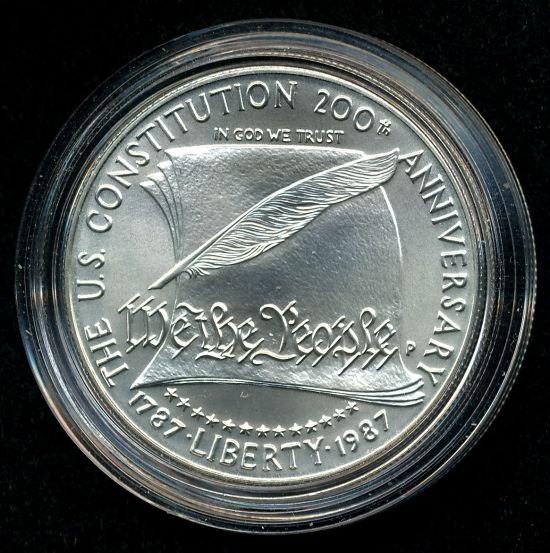
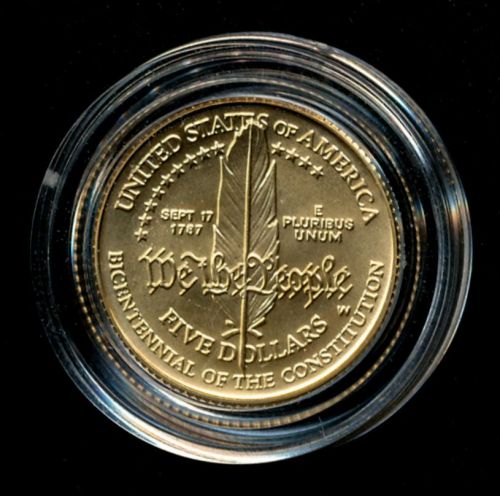
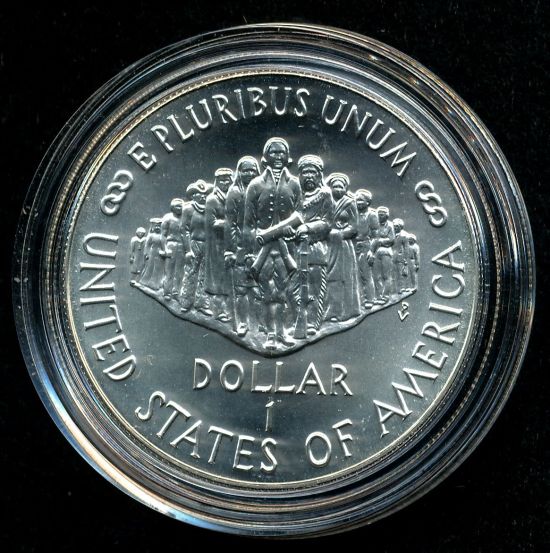 1987 US Constitution Bicentennial Gold Half Eagle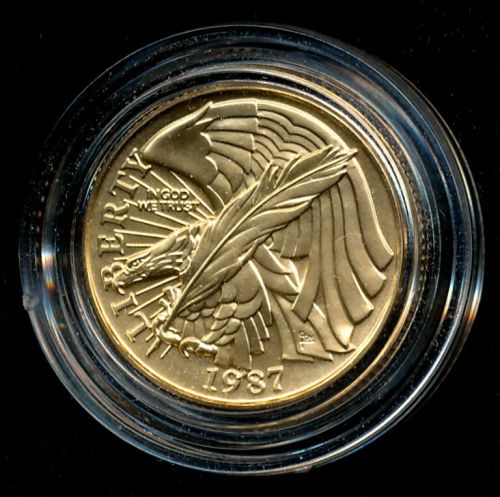
For other of my posts about commemorative coins and medals, including more modern commemorative stories, see:
Commems Collection 








 Posted 06/21/2026 08:45 am


