| Author |
 Replies: 16 / Views: 3,041 Replies: 16 / Views: 3,041 |
Page 2 of 2
|
|
|
|
Pillar of the Community
United States
3077 Posts |
just a guess could it have been in the planchette before it was struck?
|
|
Valued Member
 474 Posts |
Quote:
Chadwick: That is odd. It doesn't look like a die crack because it isn't a raised surface. The 'line' marked by the white arrow(s) is elevated, leading me to think material oozed into a crack in the die during the striking process.
The parallel lines, the best I can tell, appear to be impressed into the coin, meaning they appear to be below the surface of the planchet.  |
|
Bedrock of the Community
United States
14454 Posts |
I really do not believe that at the white arrow is a die crack, looks more like some kind of strike through more than a crack to me. Those parallel lines do not look much like a clash to me wither, just not sure what it could be in that area. I just don't see anything on the Obverse that would cause a line that long to transfer to the Reverse with a clash. Die gouge was the first thing that crossed my mind but I don't think I have ever seen a gouge that long either, so I really have no idea what it is, just what it doesn't look like
|
|
Bedrock of the Community
United States
62064 Posts |
I was thinking a die dent. Like the die was dropped on a piece of wire. It left a mark on the die and this transfers to the coins it strikes. It not real strong and probably didn't get noticed.
|
|
Rest in Peace
United States
7075 Posts |
I'm no expert but I would guess that the problem started with an imperfect planchet because it doesn't interfere with the design at all. But I'm just guessing.
|
|
Valued Member
474 Posts |
Quote:
The 'line' marked by the white arrow(s) is elevated, leading me to think material oozed into a crack in the die during the striking process. @ Chadwick: I stand corrected. I went back and took a closer look and you are right about the 'die crack.' The line is below the surface of the coin and not raised above the surface. Sorry...  |
|
Rest in Peace
United States
9104 Posts |
|
|
Valued Member
United States
64 Posts |
"polishing marx?"
The long lost Marx brother?
|
|
Rest in Peace
United States
9104 Posts |
|
|
Valued Member
474 Posts |
Thank you everyone for your thoughts... 
What should I do with this coin? Is there some specialist to whom I should send the coin to be examined? Should I just hold on to the coin? Any ideas? 
|
|
Bedrock of the Community
United States
62064 Posts |
You could keep it. But as far as selling, even with varieties a good price nowdays os hard to find. Or you could sell it as a normal coin. I would label it and keep if for now.
|
|
Bedrock of the Community
Australia
21792 Posts |
I have guessed at an answer to this type of problem before.
It looks as if a small wire filament (debris) has come between the die and the planchet. If that is the case, the wire has been flattened in the strike.
I don't think the die was damaged during this process, so this coin would be a 'one off'.
|
|
Bedrock of the Community
United States
62064 Posts |
If there was a piece of wire between the die and the planchet it would look more like this struck through error.: 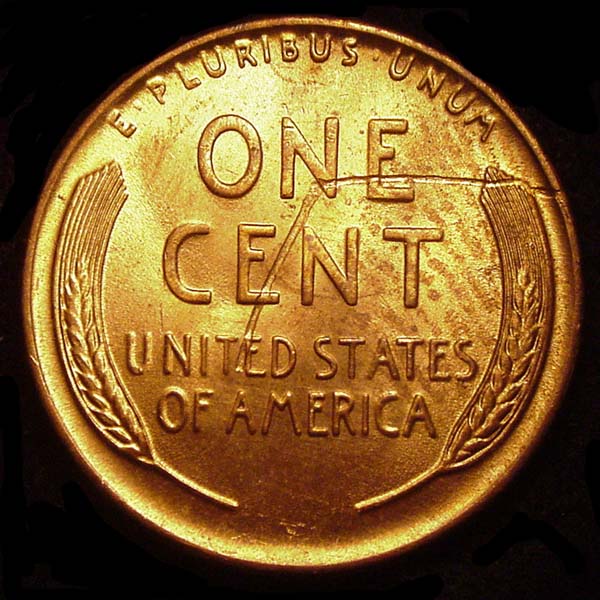 On the OP's coin the mark is on the outside face of the die. Thus no devices have marks through the devices, just inside the fields or outside edge of the die. |
|
Valued Member
474 Posts |
Quote:
coop: You could keep it. But as far as selling, even with varieties a good price now days is hard to find. Or you could sell it as a normal coin. I would label it and keep if for now. The coin in question is sealed in mint cello as part of a 1965 SMS. I wouldn't dare separate the half from the set. I guess I will do as you suggested and tuck it away for future study. |
|
Bedrock of the Community
United States
62064 Posts |
Keep a note with the set incase someone finds more information on this coin. That way you won't forget the question if/when you decide to sell it. Maybe an image in envelope with the set?
|
|
Page 2 of 2
|
Replies: 16 / Views: 3,041 |
Page 2 of 2
|








 First Page


 Posted 01/31/2012 4:22 pm


