|
This page may contain links that result in small commissions to keep this free site up and running.

Welcome Guest! Registering and/or logging in will remove the anchor (bottom) ads and the security checks. It's Free!
To participate in the forum you must log in or register.| Author |
 Replies: 19 / Views: 7,674 Replies: 19 / Views: 7,674 |
Page 2 of 2
|
|
|
|
Bedrock of the Community
United States
10045 Posts |
 The drawings are good--they help me visualize what is present on actual coins. |
|
Moderator
 United States
23731 Posts |
If they only looked as good as the drawings, I think more people would be inclined to collect them.
|
|
Pillar of the Community
United States
3229 Posts |
The more I see Byzantines the more I consider acquiring a few. I agree with DV! The drawing really help! I really like the the desert patina one! |
|
Pillar of the Community
Canada
1610 Posts |
, a close family friend of ours is from Bulgaria, it is true that the laws there are insane according to her. |
|
Pillar of the Community
United States
4778 Posts |
Not entirely sure about Bulgaria, but I know that some European countries generally have laws that regulate the ownership and transport of ancient coins.
|
|
New Member
 Bulgaria
19 Posts |
ALEXIUS I , COMNENUS POST-REFORM COINAGE / 1092 -- 1118 / 2. 3. 7. A Billon Aspron Trachy Mint of Const.(Philippopolis ?) Struck 1092 -- 1118 Weight 3.80 -- 3.90 g Diameter 25-31 mm Avg diameter 28 mm Die diameter 21 mm Die axis -- 180 ˚ Rarity 1 References: Hendy, p.87, Pl. 7. ---; DOC IV, Part II, Pl. VI, B. (31) . Grierson ---; Sear 1936. Notes: This type has high silver content, or has substantial silver plating. The top of the labarum always has a pellet in the middle. In most specimens, the labarum and the emperor's head are proportional to the body, but in other specimens the labarum and head are slightly oversized. There is no concrete evidence to support the suggestions in older numismatic literature that this issue is from the Philippopolis mint -- or that there ever was a mint in Philippopolis. The assumption that these were struck in Philippopolis is primarily based on the major stylistic similarity between this type and the rare hyperpyron numisma, originally found near Plovdiv (2. 1. 5), Sear 1935. It is highly probable some of the dies of both denominations were made by a single die-cutter. But surely the specimens of 2. 3. 6. Ð'. circulated widely in all Bulgaria and cannot be localized only near Plovdiv. For the time being, the question for the mint for both A and B variants remains open. The authors suggest these two variants of 2. 3. 6. type to be separated, as based on stylistic and metric features, we determine variant A (with a standard labarum) as a possible issue of the Constantinople mint. 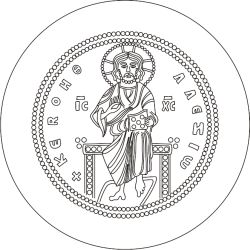 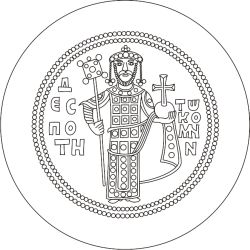 |
|
New Member
Bulgaria
19 Posts |
ALEXIUS I , COMNENUS POST-REFORM COINAGE / 1092 -- 1118 / 2. 4. 7 AE Tetarteron Mint of Thessalonica Struck 1092 -- 1118 Weight 2.90 -- 3.90 g Diameter 20-21 mm Avg diameter 20 mm Die diameter 18 mm Die axis -- 180 ˚ Rarity 1 References: Hendy, p.88, Pl. 8. 10 - 12; DOC IV, Part II, Pl. VII, AE 40. Grierson 1057; Sear 1931. 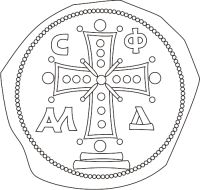 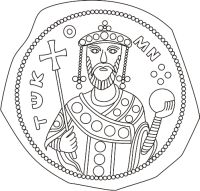 |
|
New Member
Bulgaria
19 Posts |
JOHN II, COMNENUS / 1118 -- 1143 / 3. 3. 2. Billon Aspron Trachy. Mint of Constantinople. Struck 1118 -- 1143. Weight 3.20 -- 5.00 g. Diameter 25-29 mm, average diameter 26 mm. Die diameter 18 mm Die axis -- 180 ˚. Rarity 1. OBVERSE: IC XC in field. Bust of Christ, bearded and nimbate, wearing tunic and kolobion, blesses with right hand in front of chest, and holds Gospels in left hand. REVERSE: circular legend +IWÐ"ECПOTT on left, ПФVPOÐ"NHT or var. on right. Bust of emperor, wearing stemma, divitision, collar-piece and loros; holds in right hand scepter cruciger, and in left, globus cruciger. References: Hendy, p.105, Pl. 10. 9 -- 11, Pl. 11. 1, 2; DOC IV, Part II, Pl. IX, B. 10; Grierson 1070; Sear 1944. 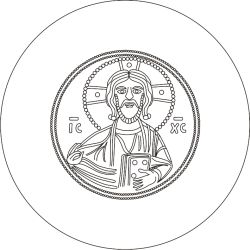 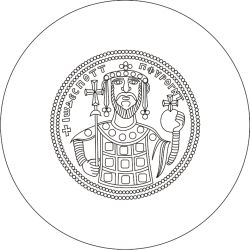 |
|
New Member
Bulgaria
19 Posts |
JOHN II, COMNENUS / 1118 -- 1143 / 3. 4. 6. AE Half-tetarteron. Mint of Thessalonica. Struck 1118 -- 1143. Weight 1.50 -- 2.90 g. Diameter 16 - 17 mm; Die diameter 15 - 16 mm Die axis -- 180 ˚. Rarity 1. OBVERSE: columnar legend O/DI/MI (or H) on left, T/PI/O/s. Bust of Saint Demetrius, beardless and nimbate, wearing lamellar body armour with pteryges, and mantle; holds in right hand sword, and in left, shield. REVERSE: circular legend (+)IW on left, D(E)C on right. Bust of emperor, wearing stemma, divitision, collar-piece, and panelled loros of simplified type; holds in right hand labarum-headed scepter, and in left, globus cruciger. References: Hendy, p. 107, Pl. 11. 15 - 17; DOC IV, Part II, Pl. X, AE 17; Grierson 1078; Sear 1955. 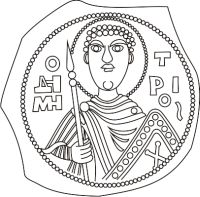 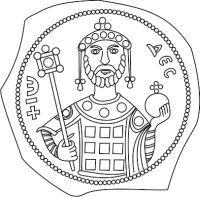 |
|
New Member
United Kingdom
1 Posts |
Lovely drawings....
Wonder what other countries have it illegal to collect ancient coins....?
|
|
New Member
Bulgaria
19 Posts |
Catalogue of the Late Byzantine Coins, vol. 1 (2011) MANUEL I, COMNENUS (1143 -- 1180) 4. 2. 3 Electrum Aspron Trachy Mint of Constantinople Struck 1150 -- 1180 Weight 4.10 -- 4.50 g Diameter 29-32 mm Avg diameter 30 mm Die diameter 21 mm Die axis -- 180 ˚ Rarity 1 OBVERSE: IC XC in field. Full-length figure of Christ, bearded and nimbate, wearing tunic and kolobion; blesses with right hand in front of chest, holds Gospels in left. Two eight-pointed stars in field. REVERSE: circular legend MANOVHL on left, columnar legend O/TE/O/D/O/P/(O/S) or var. on right. Full-length figure of emperor, bearded, on left, and of St. Theodore, bearded and nimbate, holding between them patriarchal cross on long shaft at the base of which a large globe. Emperor wears stemma, divitision, collar-piece, and jewelled loros of simplified type; holds sheathed sword in his right hand. Saint wears chiton, lamellar body armour with pteryges, and mantle; holds sheathed sword in his left hand. References: Hendy, p. 113-114, Pl. 13. 5 - 9; DOC IV, Part II, Pl. XII, El. 4. Grierson 1083, 1084; Sear 1959. 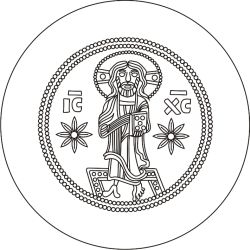 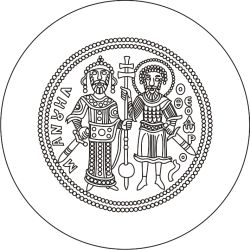 |
|
New Member
Bulgaria
19 Posts |
Catalogue of the Late Byzantine Coins, vol. 1 (2011) MANUEL I, COMNENUS (1143 -- 1180) 4. 3. 1 Billon Aspron Trachy Mint of Constantinople Struck 1143 -- 1147 Weight 2.90 - 4.20 g Diameter 28-31 mm Avg diameter 30 mm Die diameter 21 mm Die axis -- 180 ˚ Rarity 1 OBVERSE: IC XC in field. Bust of young Christ, beardless and nimbate, wearing tunic and kolobion, blesses with right hand in front of chest, and holds scroll in left. REVERSE: circular legend MANOVHL on left, DECP(T) or var. on right. Bust of emperor, beardless, wearing stemma, divitision, and chlamys; holds in right hand labarum-headed scepter, and in left, globus cruciger. References: Hendy, p.116, Pl. 14. 10 - 13; DOC IV, Part II, Pl. XIII, B.10. Grierson 1087; Sear 1962. 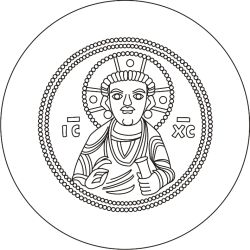 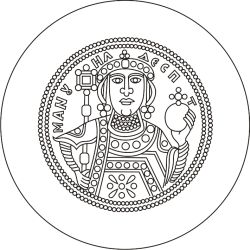 |
|
New Member
Bulgaria
19 Posts |
Catalogue of the Late Byzantine Coins, vol. 1 (2011) MANUEL I, COMNENUS (1143 -- 1180) 4. 4. 5 AE Tetarteron Mint of Thessalonica Struck 1143 -- 1180 Weight 3.30 - 5.40 g Diameter 20 - 22 mm Avg diameter 21 mm Die diameter 19 mm Die axis -- 180 ˚ Rarity 1 OBVERSE: columnar legend O/G/E on left, O/P/GI/(OC) on right. Rarely, O/P is not on right, but on the left field. Bust of St. George, beardless and nimbate, wearing chiton, body armour with pteryges, and cloak; holds in right hand short spear, and in left, rounded shield. REVERSE: circular legend MANOVHL on left, DECP(OTHC) or var. on right. Bust of emperor, bearded, wearing stemma, divitision, collar-piece, and loros; holds in right hand labarum-headed scepter, and in left, globus cruciger, References: Hendy, p.120, Pl. 17. 13, 14, "Heavy standard". DOC IV, Part II, Pl. XVI, AE 18. Grierson 1101; Sear 1975. 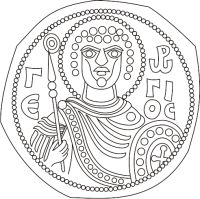 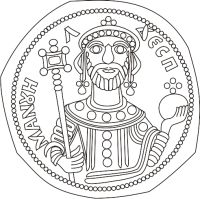 |
|
Pillar of the Community
United States
2596 Posts |
Here is one of my coins of Alexius I over Nicephorus III. Anonymous class "k" bust of Christ / 3/4 length of virgin. 6gms 21mm   The drawings make it easier to see the details for these coins especially since some of them can be an overstruck mess. |
|
Moderator
Australia
17007 Posts |
Quote:
Wonder what other countries have it illegal to collect ancient coins....? Pretty much every country that once was host to an ancient civilization has passed laws prohibiting or restricting the buying, selling, exporting and collecting of antiquities, which includes coins. Italy, Greece, Egypt, Turkey, Lebanon, Syria and Israel are notable for their strict anti-looting laws; some are more draconian than others. Most Eastern European states (such as Bulgaria) have similar laws, though until recently most have shown little interest in enforcing them. Now back to the topic of these coins. I have to admit, I often shy away from late Byzantine coins and spend my money elsewhere, simply because I'm not familiar with the series and because of the typically poor condition of the coins themselves. Seeing line-drawings certainly helps one appreciate the artwork of the coins "as they should have been". And just a question I have on your catalogue: will you be including the coins some of the Byzantine-style "fringe states", such as Bulgaria, Trebizond and Serbia? I've noticed reference material covering Trebizond coinage, in particular, to be hard to find. Don't say "infinitely" when you mean "very"; otherwise, you'll have no word left when you want to talk about something really infinite. - C. S. Lewis
|
|
Page 2 of 2
|
Replies: 19 / Views: 7,674 |
Page 2 of 2
|
To participate in the forum you must log in or register.
Disclaimer: While a tremendous amount of effort goes into ensuring the accuracy of the information contained in this site, Coin Community assumes no liability for errors. Copyright 2005 - 2026 Coin Community Family- all rights reserved worldwide. Use of any images or content on this website without prior written permission of Coin Community or the original lender is strictly prohibited.
Contact Us | Advertise Here | Privacy Policy / Terms of Use
|
| Coin Community Forum |
© 2005 - 2026 Coin Community Forums |
| It took 0.38 seconds to rattle this change. |
 |
|
| |
| |






 First Page


 Posted 02/11/2012 1:31 pm


