| Author |
 Replies: 35 / Views: 11,311 Replies: 35 / Views: 11,311 |
Page 3 of 3
|
|
|
|
Pillar of the Community
United Kingdom
1351 Posts |
|
|
New Member
United Kingdom
23 Posts |
The Churchill Crown is a good coin to have as a pocket piece, because it is worth far more in heavily circulated condition than in uncirculated. An example in VG or F might be worth about £25.
|
|
Pillar of the Community
United States
3402 Posts |
I really do not believe that a Churchill Crown could be worth more in a worn condition than in Unc.?
Please direct me to whomever is buying at those prices!!!!!
KK
|
|
New Member
United Kingdom
23 Posts |
It is indeed worth more (at least according to Coincraft's Standard Catalogue of English and UK Coins) but I'm afraid I don't know anyone who's buying wholesale. It would need to be really low grade and naturally worn, not damaged.
|
|
Pillar of the Community
Australia
4411 Posts |
Worth more in VG than UNC  Bring out the power sander Theres a killing to be made |
|
New Member
United Kingdom
23 Posts |
|
|
Pillar of the Community
United Kingdom
4208 Posts |
Also note that 25p coins arent meant for circulation - this means it that to circulate it is a tricky thing to do, especially as the mint fishes them out because they contain more than 25p worth of Cupronickel.
|
|
New Member
United States
30 Posts |
where is the denomination on this coin?
|
|
Pillar of the Community
United Kingdom
945 Posts |
British Crowns had no denomination on them until they changed to being £5 face value coins in 1990. I suggest the British Empire assumed in their arrogance that everyone would know the value of their coins.
|
|
Moderator
 Australia
17006 Posts |
Quote:
where is the denomination on this coin? As I said in the other thread where this question was asked, British crowns generally don't have the denomination marked on them. Only crowns issued in a relatively narrow window, from the 1920s through to the 1950s, have a denomination on them. The tradition of not placing a mark of value on a coin is hundreds of years old. This theoretically allowed the government to unilaterally revalue the coinage, if it felt the need to do so. Britain never revalued its silver coins, but did revalue its gold coinage, several times. Circulating gold coinage generally didn't bear a mark of value, nor even of weight and purity, and British gold sovereigns still do not bear a denomination mark. The situation in the colonies was different; for example, the colonial government in New South Wales in 1800 formally revalued all circulating coinage, gold silver and copper, increasing the face value across the board in an effort to prevent the coinage from being exported in trade. None of the British coins in circulation at the time carried a denomination on them. Don't say "infinitely" when you mean "very"; otherwise, you'll have no word left when you want to talk about something really infinite. - C. S. Lewis
|
|
Pillar of the Community
4628 Posts |
Well also until 1351, Britain only had pennies and their fractions (With a couple of glittering exceptions, a failed attempt at a Gold Penny around 1245 and Groat in 1279).
Putting denominations on coins only started in the Tudor era and that was just some coins like the 6d and 1/- amongst a few others and always in Roman numerals. Even as late as 1800 coins did not have denominations on them except a few tiny silver ones like Halfgroats and the Maundy pieces.
Even in 1816 with the new coinage, the first sixpences, shillings and up had no value on them, it was assumed you knew the value by size. Only in 1831 did shillings and sixpences get marked with values. Halfcrowns only got denominations on them in 1893 and Crowns in 1927. The Florin was marked with a value in 1849, Groat in 1836 and 3d as a circulation piece in 1887 (Earlier ones were Maundy coins). Pennys to Farthings got denominated in 1860 and fractional ones as early as the 1820s (But these were for foreign places).
So yeah, putting values on coins was generally a late Victorian innovation. Good old Victorians, inventive and full of common sense unlike those foppish Georgians, hard nosed Stuarts and barbaric medievals.
|
|
Pillar of the Community
United Kingdom
945 Posts |
A good summary @Princetane, but just to clarify, the silver threepence was circulation in the UK and had denomination certainly back to 1834. Those issued earlier are debateable - they had dates and denomination, and were issued in Maundy sets, but from the numbers around and the level of wear on them, it is pretty certain that they were in circulation right back to Charles II in 1670.
|
|
Valued Member
United Kingdom
218 Posts |
I can't see the original images but if it's the ones in this then there's so many of them around you can barely give them away. I've got a shoebox full of these ones.. 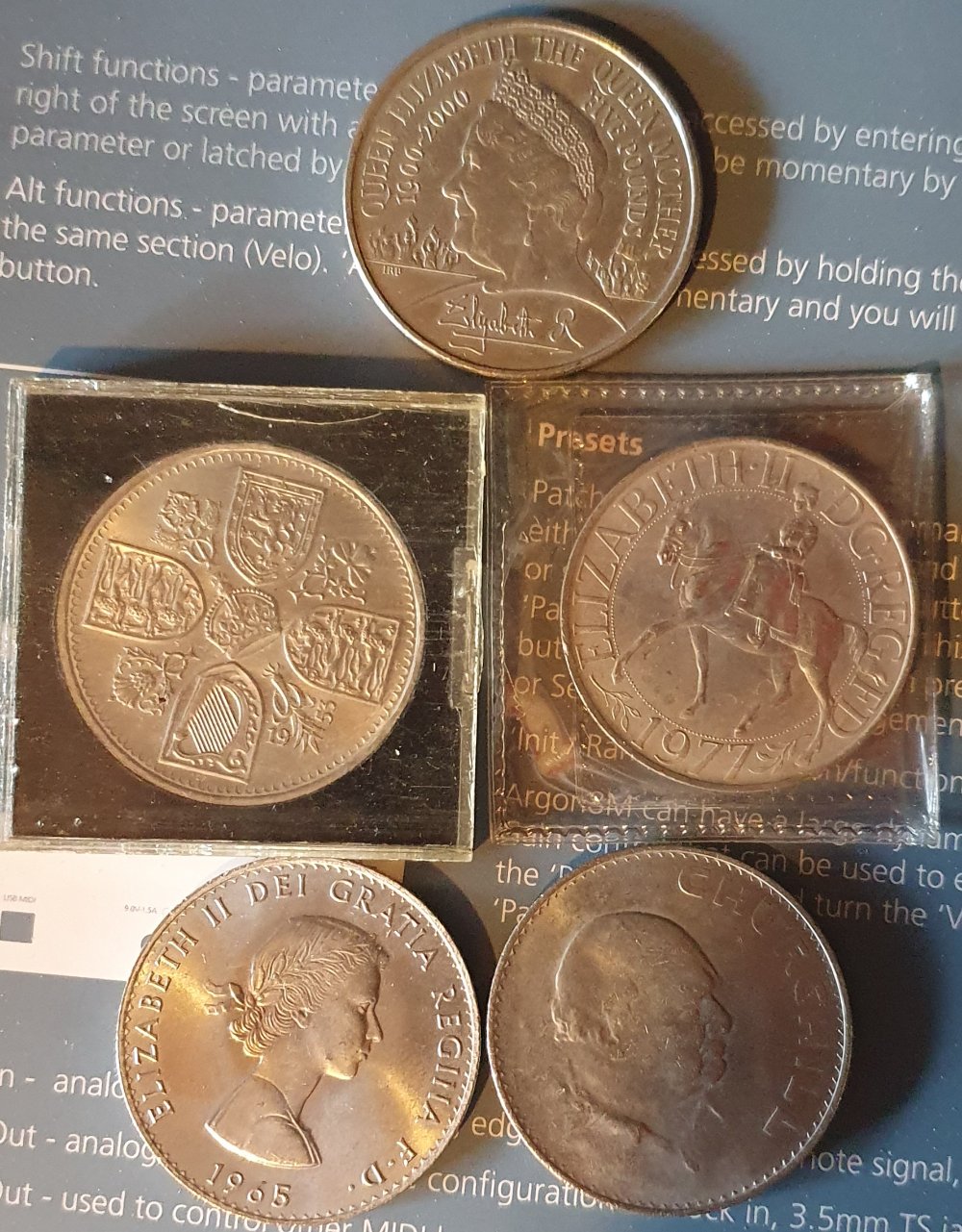 |
|
Pillar of the Community
United Kingdom
945 Posts |
Yes, the Churchill Crown is very common, and apart from a very few Satin proofs or error types, worth very little.
But just to clarify, the top coin in @Gainn's post is a £5 face value Queen mother coin, and you can cash it at most banks for that much.
|
|
Valued Member
United Kingdom
218 Posts |
Quote:
But just to clarify, the top coin in @Gainn's post is a £5 face value Queen mother coin, and you can cash it at most banks for that much. I've never really thought of them as actual money..  Gonna go count how many I have now.  |
|
Page 3 of 3
|
Replies: 35 / Views: 11,311 |
Page 3 of 3
|







 First Page
 Previous Page
 Posted 08/04/2012 09:12 am





