| Author |
 Replies: 22 / Views: 2,826 Replies: 22 / Views: 2,826 |
Page 2 of 2
|
|
|
|
Pillar of the Community
United Kingdom
4208 Posts |
Yeeeeah, id stop cleaning them like that! The proper history and value can be maintained with some more...gentle methods.
|
|
Pillar of the Community
Mexico
1304 Posts |
wow, what a fun adventure getting to know those coins! Enjoy!
|
|
Pillar of the Community
United Kingdom
946 Posts |
The Lot in the photo do not need any more cleaning, and some again have been overcleaned.
Me & Ben are in the UK, I am in London, what "Roman village" site was this, out of interest?
Obviously they were found individually, rather than at once, which would be a Hoard find and need reporting to the local Corner's Office.
|
|
Pillar of the Community
United Kingdom
4208 Posts |
(Im a south of london, out of the way of most roman stuff) Wow! I see some really nice coins in there. I've highlighted some real lookers in the photo, could we get some better pictures of them? Ill explain a couple. The big high detail 'fat guy' looks to be Magnentius. I dont have one of him yet and when I've looked I've seen few that nice. The reverse could be pretty nice - theres a popular Chi Rho reverse. Theres also one which I reckon could be the work of London Mint. another is a high grade tetricus which you dont see often - and a high grade constantinopolis which people love. What do you plan to do with them? 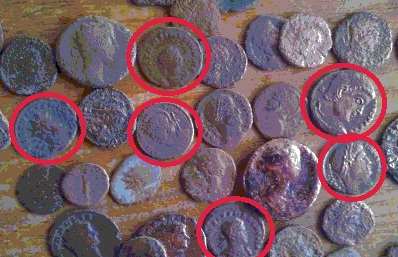 |
|
Rest in Peace
United States
2668 Posts |
That's good to hear! A history of properly handled antiquities and a picture in a first post! You are welcomed to CCF, and we regret that your grandfather did not find us. This is a good hobby, you are never 'out of money'. I look forward to your participation.  |
|
Pillar of the Community
United States
3480 Posts |
I think it might be advisable to re'bury' your coins in a flower pot for a year (or two) they are not happy the way they are right now.
|
|
New Member
 United Kingdom
20 Posts |
Hi Ben. Its not a Chi Rho reverse. I have attached a picture for you. (not very good) sorry! I think I am going to keep these little beauties for the kids as it was my granddads 55-60 years hard work with metal detectors etc on his farm. 99% of all the stuff he found went to the museum all the unwanted stuff which was found to be insignificant and found bit by bit he was aloud to keep. Shame I didnt learn anything about it from him! Especially with him being a field director on various occasions on digs. He used to tell me stories about chasing night hawkers (illegal metal detecter people) off his fields lol! 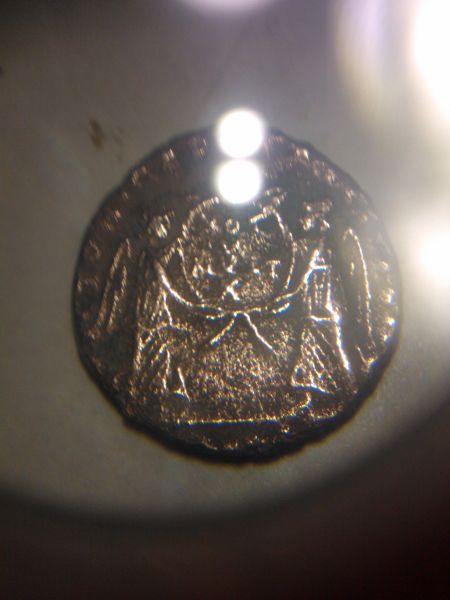 Edited by Richrich3849
04/30/2013 04:25 am
|
|
New Member
United Kingdom
20 Posts |
|
|
Pillar of the Community
United Kingdom
946 Posts |
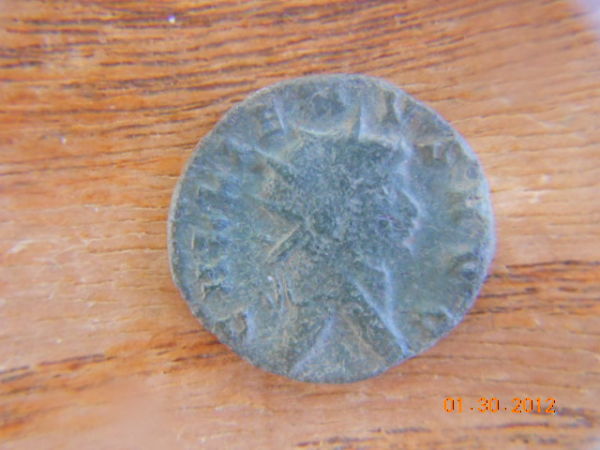
It is best to keep the coins, and learn about the types and the Emperors depicted, if not more about the history of the Empire, as a tribute to the hard work by your Grandfather. They are of more value in that sense than as individual pieces of rarity. The coin you said you like the most, has a nice green Patina. It is an AE (copper alloy) Antoninianus (Double Denarius) of the Emperor Gallienus. http://en.wikipedia.org/wiki/GallienusA type similar to the one in the link below, found in Hampshire: http://finds.org.uk/database/images...ge/id/420060The reverse depicts the personificiation of Peace (Pax). http://en.wikipedia.org/wiki/Pax_(mythology)With the legend "PAX AVG": http://www.forumancientcoins.com/nu...ey=PAX%20AVGBy the time of the sole reign of Gallienus, the Antoninianus coin was becoming little more than just a Copper alloy flan (the disc of metal) with a smattering of "silver" which was more a mixture of Silver-Mercury which soon wore off. Edited by Masis
04/30/2013 07:34 am
|
|
New Member
United Kingdom
20 Posts |
Wow.. Thanks so much Masis that's fantastic! You really know your stuff. How long have you been collecting? What do you think of this coin, its tiny about 15mm diameter smallest coin I have ever seen. The back looks a bit violent 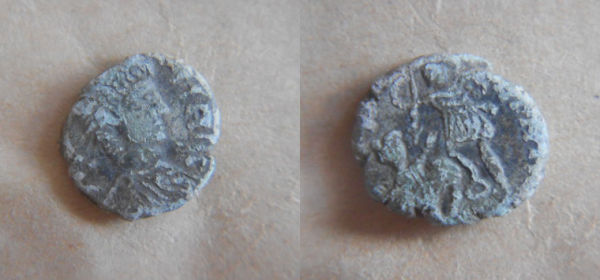 Edited by Richrich3849
04/30/2013 08:44 am
|
|
Pillar of the Community
United Kingdom
4208 Posts |
Rich - 15mm is pretty big for some coins!
It shows an emperor (whichever one it is, the flan is too small, id guess Valens) on one side and on the other, a roman soldier spearing a fallen barbarian horseman. The legend, FEL TEMP REPARATIO, means 'Good times have been restored' (you need to know some latin to really understand the sentiment though) - this refers to rome beating down barbarian uprisings. This is like propaganda on a coin really. This one looks to be minted by barbarians - this is common with UK found coins - my last batch had as much barbaric issue as official.
Looks like very weak patina though, so be careful with it. I would give this a soak in distilled water for a week or so to try and curb the decay (has to be distilled!)
|
|
New Member
United Kingdom
20 Posts |
Hi Ben. Thanks so much for the valuable information you & Masis have given me I really cant thank you two enough. Ive not had them in distilled water. The other coins I showed on page 1 were put in vinegar for a few days. But the rest of my coins are uncleaned which is a good thing by my standards, hehe. Your going to tell me off for using vinegar (sorry).  Is distilled water the way forward for cleaning coins. There are so many methods that people use. I have even seen someone on youtube putting coins into olive oil for months at a time? Thanks Ben |
|
Pillar of the Community
United Kingdom
946 Posts |
Rich, The small coin is a very interesting coin indeed. Some coin collectors will instantly dismiss it for being an "ancient imitation" of a Copper alloy coin from the reign of Constantius II, of the "FEL TEMP REPARATIO" series. http://en.wikipedia.org/wiki/Constantius_IIhttp://www.forumancientcoins.com/nu...%20REPARATIOHowever, from what I have read in "The Coinage Of Roman Britain" by Dr. Richard Reece ( http://www.amazon.com/Coinage-Roman...#043;britain), this was indeed a type unofficially created in Roman Britain, obviously from 348 A.D. onwards when the official ones were issued, by the local Romano-British ( http://en.wikipedia.org/wiki/Romano_British), rather than "Barbarians" such as Saxons or Franks ( http://en.wikipedia.org/wiki/Franks) who dealt in bullion and other Loot. But they may have been created well into the late 5th century A.D. when Rome officially gave up on Britain. http://en.wikipedia.org/wiki/Roman_...f_Roman_ruleA very interesting piece of British history. No need to clean this. As for cleaning, white vinegar is okay for dealing with the "green deposits" on Silver coins, but for Copper alloy it may well strip off the Patina, so not recommended. I first got collecting ancient coins in 2007, a chance web search on my favourite Byzantine emperor, John Tzimiskes ( http://en.wikipedia.org/wiki/John_Tzimiskes), took me to a link of a Silver "Miliaresion" coin on a website called Forum Ancient Coins ( http://www.forumancientcoins.com/ca...ek-coins.asp)that had it for sale. So I bought it and since then, with a hiatus from 2008 to 2011, have collected ancient coins ever since. Edited by Masis
04/30/2013 11:56 am
|
|
New Member
United Kingdom
20 Posts |
Thanks so much Masis I have just bought the book on ebay £12.00. Looks like an interesting read I may have to get a roman coin book to identify the rest (all) of my shrapnel do you have any recommendations? I can see how this can be a very addictive, interesting & rewarding hobby ! |
|
Pillar of the Community
United Kingdom
946 Posts |
Oh  By no means am I linked to Dr. Richard Reece, but since buying this book in the "Museum Of London" shop back in December, I have found it a good introduction into the Roman coinage of Britain, the types we will most often come across from random metal detecting finds and the kind we see in Newspapers when a Hoard is found. He knows what he is writing about, which is important!  There are 47 black and white large size photos of coins and 71 in colour. It is in six parts: 1 Coinage in the Roman World (in 21 easy stages) 2 Coinage in Roman Britain 3 Hoards 4 Site-finds 5 The use of Roman coins 6 Britain and abroad I was lucky to also get a copy earlier this month, of an "old version" ... same title, different author (Gilbert Askew) published in 1951. http://www.amazon.com/Coinage-Roman...#043;britainIt has table lists of the coinage, with an Appendix on the "Barbarous Radiates" type of local coinage. Instead of photos of coins, they are all drawings. Rather than "jumping into the deep end of Roman coin attribution books" you can "dip your toe" with a cheap, useful book on Roman AE (Copper alloy) coins such as "Roman Base Metal Coins: A Price Guide": http://www.amazon.com/Roman-Base-Me...e+GuideThere is also a very good site by Dane Kurth with A LOT of free information on AE Roman coins, with Excel lists FREE to download, on some common types of AE Roman coin: http://www.catbikes.ch/coinstuff/coins-ric.htmHer main site is Wildwinds: http://wildwinds.com/Again, A LOT of information on Greek, Roman, Byzantine, Celtic and English coins. Edited by Masis
04/30/2013 4:17 pm
|
|
Page 2 of 2
|
Replies: 22 / Views: 2,826 |
Page 2 of 2
|







 First Page


 Posted 04/29/2013 2:41 pm





 ized this one