Coin Community Family of Web Sites Join Thousands of Coin, Bullion, & Money Collectors
Join Thousands of Coin, Bullion, & Money Collectors Specializing in Modern Numismatics Vancouvers #1 Coin and Paper Money Dealer 300,000 items to help build your collection! Coin, Banknote and Medal Collectors's Online Mall Royal Estate Auctions - $1 Coin AuctionsRoyal Canadian Mint products, Canadian, Polish, American, and world coins and banknotes.


Username:
Password:
Save Password
Forgot your Password?


This page may contain links that result in small commissions to keep this free site up and running.

Welcome Guest! Registering and/or logging in will remove the anchor (bottom) ads. It's Free!

1802 Mexico 8 Reales - Genuine Or Boston Type

To participate in the forum you must log in or register.
First Page  Showing last 15 replies.
Author Previous TopicReplies: 19 / Views: 3,766Next Topic Page 2 of 2
Pillar of the Community
Hong Kong
1270 Posts
 Posted 11/30/2013  09:54 am  Show Profile   Bookmark this reply Add wonghinghi to your friends list
I think SG between 10.19 to 10.38 actually indicates there is at least 80% Ag. Ring test and sliding down a super N52 neodymium magnets can also test the presence of Ag. Anyway, a nearly sufficient Ag still cannot work out it is an original or a class 2 circulating counterfeit (Boston type). I think we need the help of swamperbob or wait for his book published.
New Member
United States
16 Posts
 Posted 11/30/2013  10:25 am  Show Profile   Bookmark this reply Add wdwms to your friends list
Well with the ring test, if I flick it into the air with my thumbnail 12-18 inches, it resonates for the entire time it is in the air.

Do we message swamperbob or does he check these threads from time to time?
New Member
United States
16 Posts
 Posted 11/30/2013  10:28 am  Show Profile   Bookmark this reply Add wdwms to your friends list
I also put a very powerful hard drive magnet up to it, no magnetic attraction at all.
Pillar of the Community
France
1591 Posts
 Posted 12/01/2013  06:26 am  Show Profile   Bookmark this reply Add MathieuMa to your friends list
wonghinghi : diagonal lines on the rim + circles on the rim which are squares (that one is more annoying, the other is still being investigated) .. :)
Pillar of the Community
Hong Kong
1270 Posts
 Posted 12/01/2013  08:37 am  Show Profile   Bookmark this reply Add wonghinghi to your friends list

Quote:
diagonal lines on the rim + circles on the rim which are squares

MathieuMa, do you mean these two features are two of the many characteristics (up to 20) to determine it is a Class 2 CC?
Pillar of the Community
France
1591 Posts
 Posted 12/01/2013  10:22 am  Show Profile   Bookmark this reply Add MathieuMa to your friends list
Yes indeed :)
Pillar of the Community
Austria
566 Posts
 Posted 12/01/2013  7:29 pm  Show Profile   Bookmark this reply Add coinworldtv to your friends list
My opinion (without SG or XRF or Clues) :

* The first one 100% authentic and nicely preserved.

* The second one a little worn, but also 100% authentic.

Nothing Boston about these pieces!
Pillar of the Community
United States
1666 Posts
 Posted 12/02/2013  12:49 am  Show Profile   Bookmark this reply Add Numismat to your friends list
Soft die cracks, excess blobs of material, cracked look to planchet surface... all diagnostics for "Boston" according to Swamper's meticulous research.
Pillar of the Community
Austria
566 Posts
 Posted 12/02/2013  02:32 am  Show Profile   Bookmark this reply Add coinworldtv to your friends list

Quote:
die cracks, excess blobs of material, cracked look to planchet surface


These are all normal features for the period of striking.

We see these on Roubles, European Thalers and apparently on milled 8 Reales coins.
Edited by coinworldtv
12/02/2013 5:18 pm
Pillar of the Community
United States
1666 Posts
 Posted 12/02/2013  10:20 am  Show Profile   Bookmark this reply Add Numismat to your friends list
True, we see these things, but not consistently on specific dies. These things are usually random, but when you see the same thing for one specific type, it makes you think. :)
Pillar of the Community
France
1591 Posts
 Posted 12/02/2013  10:33 am  Show Profile   Bookmark this reply Add MathieuMa to your friends list
I was wondering, do someone here has a proper Mexico edge to post, with circles which are actually circles ? :D
(I have to check my coins, but no time to go to the safe lately ...)
Edited by MathieuMa
12/03/2013 06:30 am
Pillar of the Community
United States
5362 Posts
 Posted 12/08/2013  03:07 am  Show Profile   Bookmark this reply Add swamperbob to your friends list
Obviously I do not agree that the characteristics of either are those of genuine Mexican made 8Rs from 1802.

There are known varieties of the Boston type dated 1802 that have been verified with XRF. Those were made after 1878 because they lack any gold. But they did circulate and were accepted as genuine 8Rs for decades. Some people still believe they are real. I know they are NOT.

Look at the King's mouth shape. It is simply WRONG for 1802 and a big red flag. SG in the 80% range is perfect for a "Boston" type (which we have elected to officially call Class 2 Contemporary Silver Counterfeits). We are aware of 85 varieties of Class 2 coins that have been fully documented. The list of potential Class 2 coins is several hundred times higher. In hand testing of SG is a first level proof but XRF is ultimate for post 1878 types.

The scale accuracy of 0.05 grams plus or minus mentioned in this thread will negate entirely the effect of not using distilled water. That is so inaccurate a scale that the hangar effect will even be zero. The results achieved can only determine a non-silver counterfeit (Class 1 or 3) versus a silver coin (Class 2 or Genuine). The 0.05 level of accuracy is what Riddell suggested could be achieved using a home made knife edge balance.

A scale that is accurate to 0.01 gram is required to distinguish between a Class 2 and Genuine coin based on SG. A scale accurate to 0.001 is of course better but expensive. At that level (0.001) boiled and cooled distilled water must be used and the hangar effect has to be addressed fully.

Opinion can never replace scientific test data. We delude only our selves when we hold to that belief.

Pillar of the Community
Hong Kong
1270 Posts
 Posted 12/10/2013  08:35 am  Show Profile   Bookmark this reply Add wonghinghi to your friends list
MathieuMa:

Quote:
I was wondering, do someone here has a proper Mexico edge to post, with circles which are actually circles

I still query can we just examine the edge patterns - "circles are actually circles, squares are actually squares" to determine it is a coin of original or a contemporary counterfeit. Is that really reliable? To my understanding, the edge minting is a way to prevent clipping and not a strategy to prevent forgery. Could the Mo mint possess different edge patterns of slightly difference?

To echo MathieuMa's request, I would like to show a Mo 8R that I am sure it is an original, hope this edge pattern can be treated as a model.

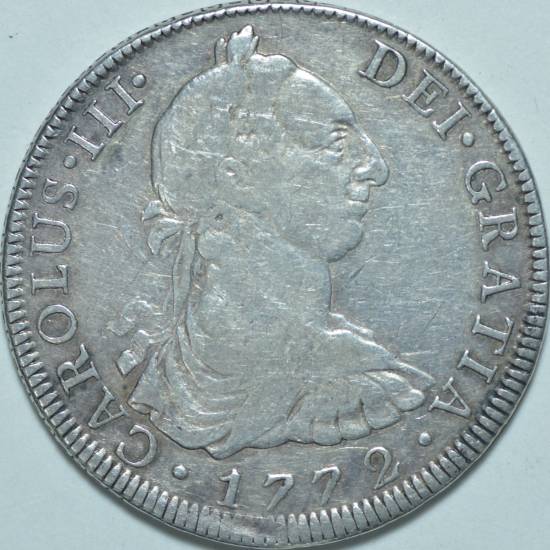
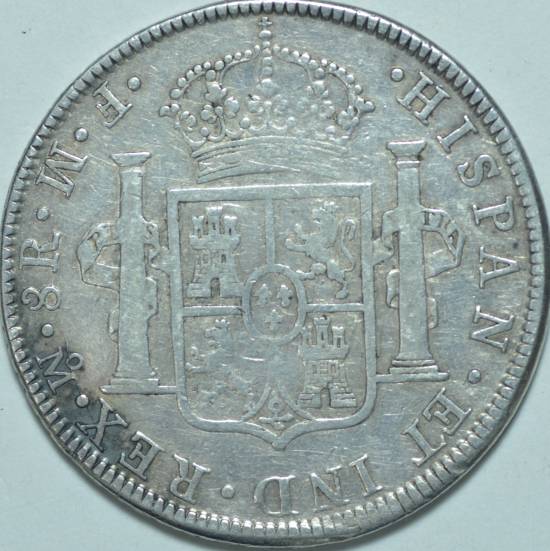
Mexico Portrait 1772 8R: 26.7 gr, 40.7 mm, SG 10.230 (=83.54% Ag)
1802-Mexico-8-Reales---Genuine-Or-Boston-Type
First edge overlap seen
1802-Mexico-8-Reales---Genuine-Or-Boston-Type
Second exactly opposite edge overlap
1802-Mexico-8-Reales---Genuine-Or-Boston-Type

Pillar of the Community
United States
5362 Posts
 Posted 12/11/2013  02:58 am  Show Profile   Bookmark this reply Add swamperbob to your friends list

Quote:
can we just examine the edge patterns - "circles are actually circles, squares are actually squares" to determine it is a coin of original or a contemporary counterfeit. Is that really reliable?


The simple answer is NO. Not if that is all you do. I have never advocated that position. But the edge is a critical factor that coupled with other data - points to a conclusion. Sometimes edge clues are absolutely definitive - ONE OVERLAP is a case where that's all you need. Or a row of SQUARES that are identical is also a good clue to forgery. But a few out of round circles with a variation in spacing on a coin with laminating errors and odd surface cracks and lumps certainly would draw my attention and concern.

The opposite end of the spectrum is the "any edge is OK" approach relying on very randomly applied edges being fine because they might have been made that way. But is there any proof yet that such coins test as genuine using all tests available?

Not as far as I am concerned.

I see the edge as conceptually an anti-fraud device. It added significant labor costs to production. Clipping and grinding were the easy obvious targets for elimination - but a standard edge design also made forgery harder. It was another thing they had to get right. Remember each branch mint used a different edge so a forger needed to not only get the two faces right but also that darned edge NO ONE LOOKS AT.

Today - how many security devices are added to a $100 bill? Does the government always explain exactly how they are applied? What process they use? Do they do it randomly for the Heck of it?

Then think of the 8R as the $100 bill of 1776.

If your goal is to AVOID AT ALL COSTS counterfeits (or restrikes) you will approach the edge discussion one way. But if you are OK with potentially buying silver counterfeits you will think very differently.

As I have said, right now the average dealer basically does not care which type he is selling as long as the coin is silver and he makes a profit. Because he does not care his prices for a genuine and restrike coin will be the SAME. So given your choice between two otherwise identical coins, which do you pick? The one with a variable edge? Or one with a near perfect edge?

Let the Buyer Beware and be WARY. Cherry-picking is the name of the game.

That said the edge on the 1772 Mo FM of Charles III posted last does look pretty good to me. Nice repeated pattern - same size - same wall thicknesses - same spacing - rather boring to look at. That is GREAT. Originals are BORING. SG is a bit low but I will go with that since 10.23 is usually within a possible range of variation for a 1/100th scale result. If that SG was tested on an analytical 1/1000th scale I would be somewhat concerned.

This coin would get a 0/20 rating on my scale of clues.

I would buy it as real if I wanted a real one provided the price was fair.

Regarding the shapes of the O - one side can be compressed very slightly by coming too close to the edge of the coin or of course by crossing the actual plane of the edge which happens on Henry's 1772 coin. The pressure of the strike - especially on well struck up examples (like this one) can compress and distort VERY SLIGHTLY features in close proximity to the faces of the coin. Similar in nature to the effect a post strike edging can have on dentils (though not as pronounced however). It is a stress distribution issue.

But I do not believe compression of the sides of the circle that are PERPENDICULAR to the faces of the coin will happen on genuine coins except at overlaps. Between laps that only happens when the O is punched in a different application than the adjacent rectangle. That has no leeway at all in a Genuine Mexico City struck coin. It did not happen.

The only other reason for a change in the shape or size of the segments is post strike damage and that must always be taken into account.

For anyone interested in seeing a good edge, the best way is by looking at a few dozen genuine MS examples that have not yet been imprisoned in those crazy plastic tombs. They may not all actually be genuine but after viewing a few dozen in person the difference will start to appear. It is not magic it is familiarity.

That was a lot more possible 30-40 years ago than it is today. Back then I couldn't afford $50 for an MS Charles III but I could actually handle them. Ten bucks for an EF-AU was manageable. Most of my exposure to genuine Portrait 8Rs came when I worked in Boston and was training as an authenticator between 1972 and 1978. The shop where I was sold MANY very high end MS examples over that period - thousands in fact. I became as familiar with an 8R edge as any bank teller gets by handling cash.

That same exposure is hard to come-by today. But it is like riding a bike as long as you try until you get it. Once you get it you WILL REMEMBER.




New Member
United States
16 Posts
 Posted 12/13/2013  1:20 pm  Show Profile   Bookmark this reply Add wdwms to your friends list
Thanks for everyone's insight... I've got a new scale and the coin I can confirm weighs 26.99g. I calibrated the scale and then immediately weighed the coin.

Time maybe this weekend to do the SG again. Regardless I feel this one is a Boston type.. not good for my collection, so off to ebay it will go.
Page 2 of 2   Previous TopicReplies: 19 / Views: 3,766Next Topic Page 2 of 2
First Page  Showing last 15 replies.
To participate in the forum you must log in or register.


Disclaimer: While a tremendous amount of effort goes into ensuring the accuracy of the information contained in this site, Coin Community assumes no liability for errors. Copyright 2005 - 2026 Coin Community Family- all rights reserved worldwide. Use of any images or content on this website without prior written permission of Coin Community or the original lender is strictly prohibited.
Contact Us  |  Advertise Here  |  Privacy Policy / Terms of Use

Coin Community Forum © 2005 - 2026 Coin Community Forums
It took 0.43 seconds to rattle this change. Forums