| Author |
 Replies: 21 / Views: 5,855 Replies: 21 / Views: 5,855 |
Page 2 of 2
|
|
|
|
Bedrock of the Community
United States
20753 Posts |
Really should be a standard, always there post called DO NOT CLEAN COINS. However, if you insist on cleaning off the crud, go to a store and buy some Acetone. If soaking a coin is water does not work, then try the Acetone. In reality you may remove the crud but you will find that you've removed some of the coins metal also. Best thing is to leave well enough alone. Cleaning may do more damage than you would like.
|
|
Bedrock of the Community
United States
62064 Posts |
Acid cleaners to remove the crud will also take the top layer of the coin and it will flake off leaving a very undesired appears. It actually turns you coin into a Cull. That happened once to an Indian Head cent that I tried to clean up as a kid. (years ago) But taught me a lesson to share with others. If I need to remove some grime on the surface, I use a little method that works most of the time. It is not for BU or PROOF Cents Just circulated wheats to remove some debris that you want to see under. You need an old, retired full cleaned tooth brush and mineral oil. Remember if you try this on a BU/Proof coin it will be messed up for its life. But on a circulated coin it will remove most of the grime from the surface. So use it one something that you need to see under. It is a little time consuming, but not as harsh as cleaners or acidic other processes. Here is a Before and after of a Copper Coin that I treated just 1/2 to show the difference. 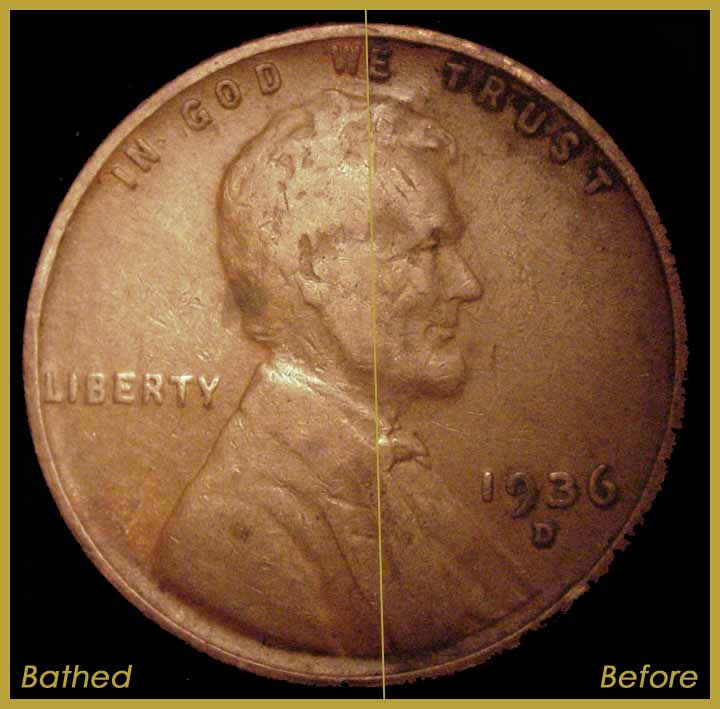 I've only used this process for copper coins. This removes dirt, grime and if it doesn't come off I may try a second time. But if it doesn't come off the second time, it probably won't. You might try a fresh thorn to remove little pieces of debris around/inside numbers, but remember this debris may contain sand and will scratch the surface of the coin. So don't scrub this into the coin. I refer to this process as bathing rather than cleaning as one thinks of the acid process when you say cleaning. Mineral oil acts as a protectant to copper, but need to dab off as much as possible. If you don't, they out they will attract dust and more dirt. I usually put my coins into a 2X2 when finished, but if there is some mineral oil residue left on the coin, it will appear wet in appearance. The procedure I use requires you hold the coin and brush from different angles on the coin. Rotate several times to brush all angles. Repeat till it looks like you want and check under a scope to see problem areas. If you see that more attention is needed in some areas, retry again. If it doesn't come off the second time, then it may not as it is a stain in the copper or green moisture spot or black copper spots that will NOT Come off. All we are taking about removing is surface dirt/oil & grime. Again let me stress: Do not use on a BU coin or a Proof Cent. You may scratch the coin where you don't want it scratch. Also using a very worn out, very soft toothbrush and mineral oil. This will take some time and after bathing press dry and do not rub as you might scratch the surface. I use a plain facial tissue pressed onto the coin to absorb the mineral oil. Time consuming, but the results are nice to you can see what is under the gunk. |
|
Pillar of the Community
United States
914 Posts |
I like to use Xylene on copper pennies to clean them up. Since I like looking for RPM, I have to remove the dirt from the mint marks somehow!
I use a paint brush from Home Depot's Ralph Loren section that's has some stiff round bristles. Then when wet, touch the brush against the coin and do small light circles. The point is to never move the brush, but only let the bristles make tiny little circles where the dirt is hidden. I've had great success with this and have not left any noticeable marks. (Disclaimer: Never use with high quality coins)
Once done, I wash off the xylene with distilled water and acetone.
Another disclaimer: Never clean your coins!
|
|
Bedrock of the Community
United States
62064 Posts |
Here is one I bathed, but forgot to take a before image. But it looks real nice. 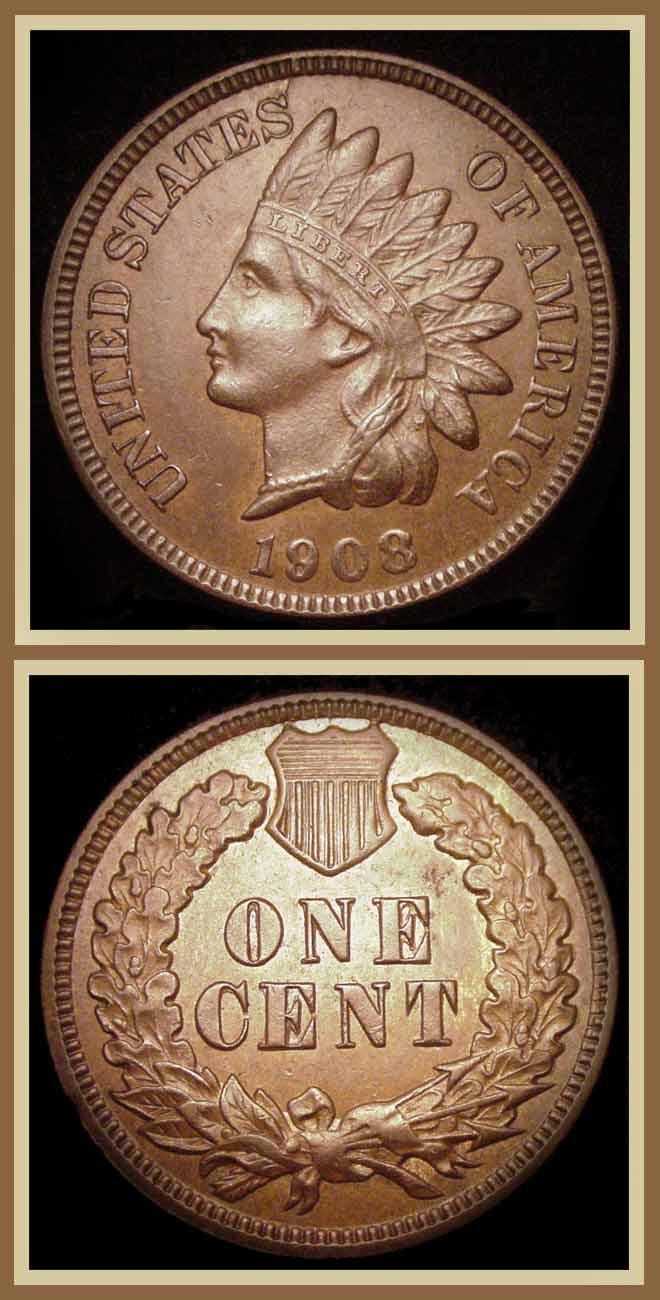 |
|
Valued Member
United States
144 Posts |
"...if the coin can't really be seen because of so much crud on it..."
I'd agree that this is the time to try it. Though you will find many on this site with a religious fervor against it under any circumstances, even if encased in a 2 inch thick layer of road tar.
|
|
Bedrock of the Community
United States
62064 Posts |
In most cases they are right. If you don't know what you are doing, you can cause more damage than good. So always try experimenting on regular circulation coins before you ruin one of your valuable coins. But that is why I call it bathing. It removes the dirt without ruining the metal on the coin.
|
|
Bedrock of the Community
United States
20753 Posts |
As already noted if you do not know what your doing, don't. Do not use any type of oils on a coin. Mineral oils, Olive Oils, jewerly cleaners, etc. are all manufactured items. What may have worked for one individual may distroy your coins or make them valueless. Note that all manufacturers have tolerances in productions and they also periodically modify the chemical formulae to prevent copying or just to improve the product. What was yesterday may not be anywhere near what is today for any product that is man made. Even steel beams have tolerances in productions and that must be taken into account for construction calculations. If you insist on any cleaning at all, just try Distilled water. Heating it gently would possibly also help but do not use a metalic pan to heat the water. The metal or material put on some pans to make them none stick may also effect your coins. Do not use tap water. It contains more junk than you could imagine and in some areas it is Chlorinated. This is why people should always let tap water stand for a day prior to using for house plants. And if you have a water softener, that would mean your water is loaded with NaCl, salt.
The main thing to always remember is those are your coins and if you ruin them listening to people that tell you to try something and they are wrong, making it up, don't know better, they are still your coins. You are the one with ruined coins.
Summation of this boring post is DON'T CLEAN COINS.
|
|
Valued Member
United States
411 Posts |
I agree with everyone about NOT cleaning coins. But I'm curious about olive oil. I know there was a thread a long time ago about this, but I don't remember much about it except that the examples were copper. So I took some Pre-1980s cents from the change in my pocket and left them in a bowl of olive oil overnight. I also put in a cent that I got from change another time that was black, corroded, almost unrecognizable, but you could see the date (1930). The 1930 coin looks the same. The others may be a little glossier, but that may just be the oil, even though I was able to remove what seemed like all of it. Does anybody have any info on this?
|
|
Bedrock of the Community
United States
20753 Posts |
Posted - Today : 6:27:34 PM
--------------------------------------------------------------------------------
I agree with everyone about NOT cleaning coins. But I'm curious about olive oil. I know there was a thread a long time ago about this, but I don't remember much about it except that the examples were copper. So I took some Pre-1980s cents from the change in my pocket and left them in a bowl of olive oil overnight. I also put in a cent that I got from change another time that was black, corroded, almost unrecognizable, but you could see the date (1930). The 1930 coin looks the same. The others may be a little glossier, but that may just be the oil, even though I was able to remove what seemed like all of it. Does anybody have any info on this?
Many individuals have had decent luck with Olive Oil.
Others have had luck with Lemon Juice, Battery Acid, Vinegar, Mineral Oils, etc. However, many others that have tried some or all of these have found just the opposite. There are so many things to consider. As I previously noted such substances are seldom manufactured the same by different manufacturers. Even the same one can differ due to a change in their process, dirty or unclean containers, changes in chemical formulae in the processes or just plain differences in the final product due to tolerances in the process.
An very noted example of a change in the process was when Coke tried to completely change the product and there was so much yelling that they now redid the original and called it Classic. This was only a change in the final product but was basically the same item.
I always tell people that if you attempt to use Acetone on coins to first place some in a glass dish and allow to evaporate. If there is a whitish residue, discard as contaminated regardless of when, where, how you acquired the Acetone. Since it is such a strong solution, after a while it could dissolve some of the inside of the can it was in originally. This could also be true of such items like Olive Oils, Mineral Oils, etc., if in a can. Not as strong as Acetone for sure but mostly any liquid will dissolve something eventually.
|
|
Valued Member
United States
144 Posts |
Another problem with olive oil, besides the variation in ingredients already mentioned, is that it can slowly oxidize, forming lacquer-like substances that may never wash off (other hydrocarbons such as gasoline do this if you leave it in a gas tank for a few months).
As a chemist (and not a coin-cleaning expert), I like acetone a lot better than water, since water facilitates many other reactions (acid etching and oxidation both go faster with water). If you did use water, I would use acetone last (again subject to the high purity warnings already mentioned. I use high-purity stuff at work, which is far more pure than distilled water).
I use acetone to dry things. It washes off the water, evaporates quickly and cleanly, is extremely unreactive, and won't dissolve metals, metal oxides, or metal sulfides (which pretty much describes coin surfaces). Of course, that's not to say when you make a loosely attached particle fall off it won't take some metal with it and be uglier underneath.
Denatured alcohol is different things at different times, often with water, so I don't trust it.
I'd also avoid anything that was stored in a plastic bottle. Not only can the plastic add to the residue problem over time, but most plastics are permeable, so even if the plastic has no additives, that adhesive from the label could eventually soak through. I work with eye-drops, and after years of finding things in the eye-drops that passed through the outer box, through the label, and through the bottle into the solution, I'm surprised they keep the water in. Oh, actually they don't. Many of the bottles lose 5% of the water contents per year, straight through the plastic, concentrating the ingredients by 5% a year.
|
|
Pillar of the Community
Canada
1152 Posts |
quote:
Many of the bottles lose 5% of the water contents per year, straight through the plastic, concentrating the ingredients by 5% a year.
What if I've been using strong ammonia (on an extremely crusty coin which cleaned up good) from the 80's? Oh well, I was careful and it worked... |
|
Bedrock of the Community
United States
20753 Posts |
What if I've been using strong ammonia (on an extremely crusty coin which cleaned up good) from the 80's? Oh well, I was careful and it worked...
Consider yourself lucky. Again as already mentioned in several previous posts here, solutions of just about anything can accumulate contamiates by just standing in their container. As to your statement of STRONG AMMONIA. That too is ambiguous. Was it household Ammonia of the shelf? High concentrated from a chem lab? Paint store?Note that most Ammonia products are used in the home so manufacturers purposely add additives to make it a little more pleasant. Many household Ammonias are composed of an Ammonium Hydroxide solution. basically meaning watered down. Many also contain Anionic Surfactant, a Non-Ionic Surfactant, Miscellaneous Perfumes, color clarifying agents and possibly so called inert salts. Also, pay attention to the none detailed items such as a color clarifying agent. Also, note the lack of percentages for the general public. Ever notice all the warnings on an Ammonia container?
Glad you said you were carefull. Any one of the previous noted substances could be dangerous to you and coins.
|
|
Valued Member
United States
411 Posts |
Is "Koinsolve" acetone? Don't get me wrong - I wouldn't consider attempting IN ANY WAY to alter the surfaces on coins in my collection(s). I was just curious about olive-oil. I couldn't remember what it was supposed to do, so that's why I did my little experiment with pocket change.
I have a 1939 Walking Liberty half-dollar that has a dark green tar-like substance (PVC byproduct?) in the fields surrounding the devices. If it weren't for that, this coin would be graded EF40 or thereabouts. This is not a very expensive coin and it's really worthless as it is, so I might try the Koinsolve on it just to see what happens.
But I'd still appreciate any information about the product.
|
|
Bedrock of the Community
United States
20753 Posts |
Stephen420. Why take chances with substances you do not have or know nothing about? With anything on a coin you do not like, first try just distilled water, in a heatable glass container like a coffee pot. Heat a little and remove. If that doesn't work, distilled water can be used for many things around the house so not a waste. Usually less than a dollar a gallon. Next note you can buy Acetone at any hardware or paint type store also for not to much money. Other so called cleaning agents may or may not work and there is the investment in a substance possibly not useable around the house ever again.
|
|
Valued Member
United States
411 Posts |
Wow greyhav.  That's fascinating information. thanks!  I already have the Koinsolv so if it's a waste, it's already wasted. I have had this substance (it's in a metal can) for several months and I had the plan to do the experiment with the tarred Walker before I bought it, but I haven't been able to bring myself to do it yet. Info about this substance - other than what it says on the label - is surprisingly hard to find. My earlier post above appears to be full of typos, but I started to edit it, and there are no typos. It is posting that way. Wierd.  Edited by Stephen420
08/10/2007 5:01 pm
|
|
Page 2 of 2
|
Replies: 21 / Views: 5,855 |
Page 2 of 2
|





 First Page

 Posted 08/08/2007 12:21 pm


