| Author |
 Replies: 22 / Views: 4,249 Replies: 22 / Views: 4,249 |
Page 2 of 2
|
|
|
|
Pillar of the Community
United States
5010 Posts |
i still don't have a coin from alex. I thought I did yesterday, but the coin I purchased was misattributed by the seller. not a big deal, I didn't buy it for the type, not because it was minted by alexander...but still kind of a bummer.
|
|
Moderator
 Australia
16991 Posts |
The empire of Alexander the Great was the first large coin-using empire. They struck a uniformly designed coinage in numerous mints for quite a long time period (especially if you include all the posthumous types). As a result, the coinage as a whole is fairly common, even if specific varieties within the series are scarce.
A major factor in the question of the relative rarity of ancient coin types is understanding how those ancient coins have survived and how this is affected by the subsequent history of the empire that issued it. Most coins come from hoards; such coin hoards remained hidden until modern times because somebody buried them thousands of years ago and never came back for them. For example: early Roman coins are scarcer today than late Roman coins not simply because the earlier empire "was older", but because the early Empire was peaceful and prosperous for the people living in it; if you buried a stash of coins, chances were good that you'd live long enough to go back and retrieve it again. Someone living in the later Empire was much more likely to die in war, or have his property seized for political reasons, or have the territory in which his property was located invaded and annexed by barbarians - all of which were good reasons why a coin hoard would become forgotten and remain forgotten.
After Alexander's death, the Greek empire began to shrink and was soon divided into numerous smaller kingdoms constantly at war with each other. As with the Late aRoman period, it was a time of high probalility of people "losing" a coin hoard.
Don't say "infinitely" when you mean "very"; otherwise, you'll have no word left when you want to talk about something really infinite. - C. S. Lewis
|
|
New Member
 United States
36 Posts |
Thanks for all the great info everyone...love learning about this great hobby!
|
|
Pillar of the Community
Australia
1006 Posts |
The Macedonians conquered a massive amount of land with the majority of the mines in the area comming under royal control as had been the custom. Also do not forget that the Macedonians already had extensively rich royal mines around Amphipolis which was the primary international mint of the empire leaving very little logistical issues which would be encountered when transporting metals long distances. Also the mines around Damastion and Astibos in Northern Macedonian (called Paeonia) were exceptionally rich in terms of silver and lead with a lot of the silver transferred to Pella, Aegae and Amphipolis however some of it was coined in Damastion and Astibos (some in the South Macedonian style while others in the North Macedonian style.) The plundering of the Babylonian Treasury added significantly to their silver reserves although it was primarily gold in nature.
There was a massive mintage as the Macedonian Empire was international. It wasn't just Macedonia but now Macedonia, Greece, Thrace, Asia Minor, the Middle East, Bactria, Egypt and small parts of western India. There was now a need for an international currency and the Macedonian's produced it with the largest reserves of metals, the most mints and the most die engravers available at their disposal to facilitate the transfers of goods around the Empire.
Ancients are a great way to learn new things in terms of history, geography etc.
Edited by oh my florin
04/10/2015 03:03 am
|
|
Pillar of the Community
United States
949 Posts |
@arnoldoe
If it isn't considered too far afield for this thread, I have to ask about that image of the reverse on your coin. How were you able to keep edge to edge sharp focus in that shot considering the steep angle of the coin? F32 and tons of light? Tilt on the lens? Or did you rotate the image and squeeze it to simulate the effect?
Either way I really would like to know. It's a great shot.
|
|
Valued Member
Canada
266 Posts |
I put the coin on top of my couch with a window behind it + took the picture with an Iphone  Edited by arnoldoe
04/10/2015 1:21 pm
|
|
Pillar of the Community
United States
513 Posts |
lrbguy, you can also use a technique called "focus stacking" to get that effect. You need specialized software (there's a lot of it out there and most has free trials) and then you take anywhere from a few to a couple dozen pictures at different levels of focus and it stitches them together.
|
|
New Member
United Kingdom
25 Posts |
About 12 years ago I was bequeathed a few coins and amongst them this Greek Coin of Alexander with a date of 336 - 323BC. My problem is that my coin enthusiast friend would only rate it as 'probably' genuine. So, my question is, do you think that this coin is genuine? It would be nice to think it is! Can you advise me? 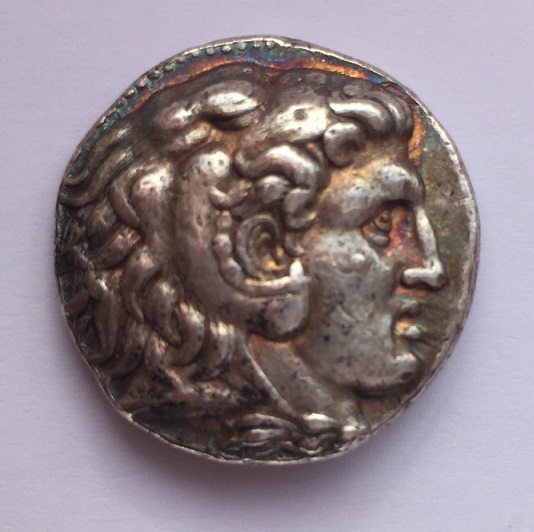 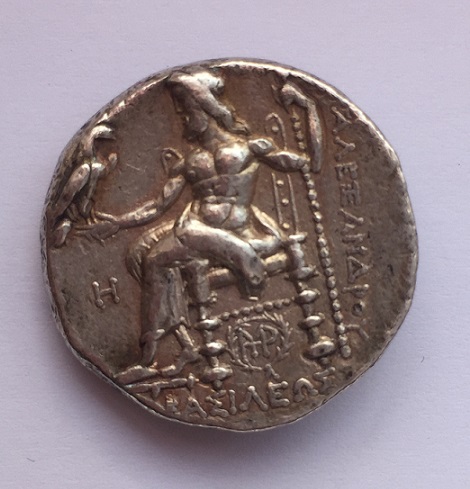 |
|
Valued Member
Canada
266 Posts |
That one would have been made 311-300 BC under Seleucus I
"""Seleukos I Nikator. 312-281 BC. AR Tetradrachm
Babylon I mint. Struck in the name of Alexander III of Macedon, circa 311-300 BC. Head of Herakles right, wearing lion skin / Zeus Aëtophoros seated left; H to left; monogram within wreath below throne. SC 82.7; Price 3708"""
I think it is probably real, but I would wait for someone else to say
|
|
New Member
United Kingdom
25 Posts |
Many thanks indeed for all the information, which I find most interesting!
Presumably 'SC82.7' identifies exactly the coin, but what does 'Price 3708"""' indicate?
My friend, 12 years ago considered it's value at about £60, 'if genuine'.
|
|
Valued Member
Canada
266 Posts |
the Price 3708 is another identifier of the coin, the 3708th coin from
The Coinage in the Name of Alexander the Great and Philip Arrhidaeus by Martin Price
and if real ill guess around 125-175 GPB/ 180-250 USD
|
|
Pillar of the Community
United States
949 Posts |
Since I don't have the Price volume I have to ask, what is it about this coin that links it to mintage by/under Seleucus I since his name does not appear on it? The monogram in the wreath?
For what its worth, based on the appearance in the pic, Peter, the fabric of your coin looks absolutely correct for a silver tet. I think you can expect it to be approved as authentic.
Edited by lrbguy
04/11/2015 6:40 pm
|
|
Valued Member
Canada
266 Posts |
yeah, I used the H and the monogram in the wreath to ID it, you can usually identify these pretty easily, I just went to google and typed in ""alexander tetradrachm "h in left field" monogram in wreath"" http://cngcoins.com/Coin.aspx?CoinID=164579Edited by arnoldoe
04/11/2015 7:12 pm
|
|
Pillar of the Community
Australia
1006 Posts |
It is a genuine coin and frankly has very nice toning on it. arnoldoe's valuation I would say is a little conservative, I would put retail at 200GBP/275-300USD with the toning being one of the big pluses on this coin. On who struck it you need to first identify the mint and date of minting which corresponds to a certain Macedonian Didochi's Kingdom. The price guide should already have this step completed so should help you out. To identify coins you can use Wildwinds here http://www.wildwinds.com/coins/gree...r_III/t.html to identify the mints/dates/rulers corresponding mintmarks. I have found that generally a monogram in a wreath on an Alexander the Great con will generally correspond with the Middle East with Babylon the most likely mint. |
|
New Member
United Kingdom
25 Posts |
Many thanks to:- arnoldoe Irbguy oh my florin and this most excellent forum for all the most interesting information about my coin. I certainly have some work to do to catch up! I am glad that my numismatic 'friend' of 12 years ago is being proved wrong in his opinions of the small coin collection which I inherited. Please refer to my early post under English coins regarding hammered coins of Kings Eadgar & Canute which he considered as 'not genuine'. Many thanks again! |
|
Page 2 of 2
|
Replies: 22 / Views: 4,249 |
Page 2 of 2
|







 First Page


 Posted 04/09/2015 9:52 pm


