| Author |
 Replies: 18 / Views: 5,663 Replies: 18 / Views: 5,663 |
Page 2 of 2
|
|
|
|
Pillar of the Community
United States
5010 Posts |
it is neat! I've seen these before...i remember the name (ant nose) more than I actually remember the item.
i think ancientnoob has some sowrie shells if I'm not mistaken?
|
|
Valued Member
 Canada
93 Posts |
Thanks for the comments, everyone!
I paid $20 for it, so I'm happy. :D
Erin
|
|
Pillar of the Community
United States
5155 Posts |
For $20 I would be happy too. I would love an Ant Nose. I have (as chris pointed out) a cowrie imitation, but no Ant Nose, it remains on the list. Good find!
|
|
Pillar of the Community
United States
2589 Posts |
Will a TPG grade these? Not suggesting that it should be graded, just curious if they would... |
|
Pillar of the Community
United States
6370 Posts |
NGC says they only grade struck ancients, not cast. I think ANACS may be different.
|
|
Pillar of the Community
United States
6370 Posts |
Edited by TypeCoin971793
07/09/2015 9:59 pm
|
|
Pillar of the Community
United States
5155 Posts |
I love ancient civilization, but I don't like purchasing funerary items. Just me but I feel weird about it to the point where I would mention it here.
|
|
Pillar of the Community
United States
6370 Posts |
That's true. That's why I'm not dabbling with the bridge money, fish money, shield money, bell money, or heck (clay) money. They are not actual coins used in commerce, but funerary items, which defeats the purpose in including them in a coin collection.
Edit: that "heck" was changed from the other word. It is what it's called, so don't get mad at me.
Edited by TypeCoin971793
07/09/2015 11:31 pm
|
|
Valued Member
Canada
93 Posts |
Thanks for the link, TypeCoin. It's very interesting.
I'm not at the point of getting funerary items. But, I'm always glad to get more coins and, someday, more artifacts. I kind of have an itch for artifacts now that my first one is on its way. :D
Erin
|
|
Pillar of the Community
United States
2589 Posts |
|
|
Pillar of the Community
United States
6370 Posts |
|
|
Pillar of the Community
United States
567 Posts |
The original photo is upside down. Coole, p. 20-21 in The Early Coinage of the Chou Dynasty states that the legend reads Tang Pan Liang (Dang Ban Liang in Pinyin), meaning "worth half a liang" The round hole is (according to Coole, and I'm inclined to believe him) shorthand for Dang, probably representing the kou radical in Dang.
|
|
Valued Member
Canada
93 Posts |
Thanks for the links, Type Coin.
Thanks for the info, jcmworld.
It will hopefully show up in my mailbox this week. :D
Erin
|
|
Bedrock of the Community
Australia
21792 Posts |
johndakerftw: Congratulations!
You are indeed lucky to have one of those!
I have been looking for years, haven't found one available.
|
|
Pillar of the Community
United States
6370 Posts |
@Jcmworld I don't quite agree with your information. If it was worth Half a Liang, then it would weigh 12 zhu (11 grams in theory), but these coins are rarely more than 3g. Wang Yü-Ch'üan states that these coins have been found with early round coins, specifically a very rare coin that likely preceeded the Ban Liang which read "Zhong Shi Er Zhu," or "Weight Twelve Zhu" (half a liang). If the ant-nose coins were worth a half a liang, then they would most definitely not have circulated with coins that were worth their stated weight. That was tried under Wang Mang and it failed horribly. I would expect the same thing to happen would have happened 300 years earlier. There have been several proposed decipherments of thic coin, but I believe the most likely decipherments are "Bei" (shell) or "Chi" (small). The coins are small and in the shape of cowrie shells (which werre very important and valuable in ancient China), and they are regarded as imitation cowries. In this case, "Bei" makes sense, and the character on the coin resembles some of the archaic versions of "Bei" (from Coole's book): 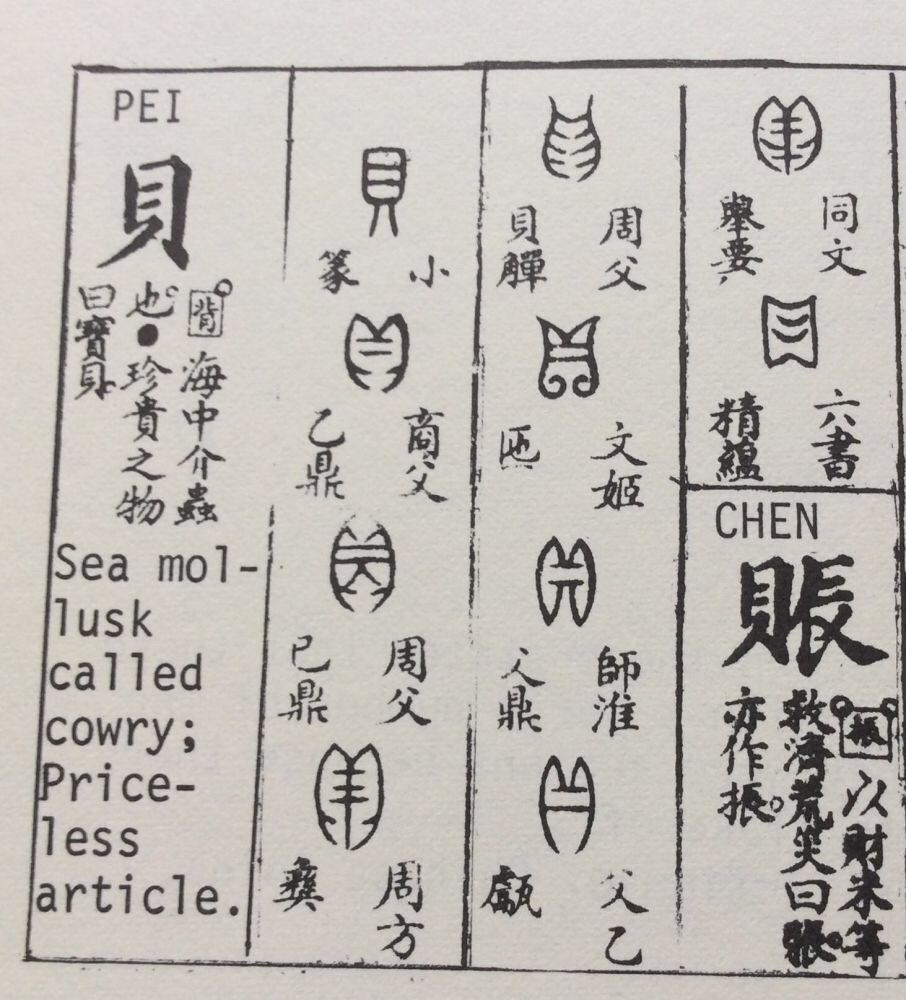 The other theory, "Chi," holds its basis in that the characters look very similar and that records the state of Chu state that there were "small ones" in circulation. These coins have been attributed to the state of Chu because they have been found only in the territory occupied by this state. However, if this theory is true, then the ant-nose coins are much older than they are believed to be. The record mention above was written during King Chuang's reign, who reigned from 613-591 BC. This conflicts with the evidence of ant-nose coins being found with the round coin as that coin was not issued until the 3rd century BC. Chinese coins have been known to circulate for hundreds of years (believe me; I have looked through a couple of hoards and have found that ancient coins circulated for about 500 years before being lost from circulation, and cash coins circulated 500-1000 years.). I will give Coole's reasoning the benefit of the doubt. If the dot he claims is actually part of the inscription (meaning "worth" and read from the dot down), then why is it so much deeper then the rest of the inscription (sometimes a hole), and why is the dot/hole on the bottom and not a part of the inscription on many of the other types (Xing, Jin, Chün, and Tao to name a few). The stated weight would still have been more then twice the coin's actual weight, which would have been shunned from circulation as the weight system used was well established by the beginning of the Eastern Zhou Dynasty in 770 BC. But this all requires more research... Also, this type is technically called "Ant and Nost Money" not "Ant-Nose" money. The type represented here is a "Nose" coin as it looks like a face. The second most common variety is the "Ant" coin as it looks like an ant. |
|
Page 2 of 2
|
Replies: 18 / Views: 5,663 |
Page 2 of 2
|






 First Page

 Posted 07/09/2015 09:03 am





 occasionally has them for $5 (for damaged) to $12 (pristine) + $5 ship.


