| Author |
 Replies: 37 / Views: 4,331 Replies: 37 / Views: 4,331 |
Page 3 of 3
|
|
|
|
Pillar of the Community
 United States
3360 Posts |
Quote:
My experience with Rockwell testing suggests that if this is from a ball tip it happened before coining. My understanding is precisely what you say here. It applies to a planchet test. (See the link quoted in OP). |
|
Pillar of the Community
United States
5964 Posts |
Quote:
mark would be larger given the zinc substrate I would think they use different pressures on different coins. I also think there should be no ridge. |
|
Bedrock of the Community
United States
17884 Posts |
It is clearly not a Rockwell test on the planchet. While you might test a planchet to see if the annealing was successful, you most likely would discard that planchet and not use it. If you did use it, the force of the strike would wipe out the test mark either completely or almost so. That clearly isn't the case here. So could it be a Rockwell test on a finished coin? Why would you do such a test? No almost certainly this is just PSD. |
|
Valued Member
United States
449 Posts |
If anyone is curious there are other types of harness tests:
1. Rockwell (as many of you have listed)
2. Brinell
3. Vickers
4. Knoop
5. Shore
|
|
Pillar of the Community
United States
3360 Posts |
Quote:
you most likely would discard that planchet and not use it. You are in agreement with the source I cited: Quote:
Such planchets are supposed to be discarded. This is the reason that coins with this test mark have a rather high rarity rating. However, the same source disagrees with your statement: Quote:
If you did use it, the force of the strike would wipe out the test mark either completely or almost so. It states: Quote:
If a planchet with a Rockwell test mark is struck by coinage dies, the pit is not erased. The pit's originally circular outline may, however, be distorted into a slight oval as the coin expands beneath the impact of the dies. The link is here: http://www.error-ref.com/?s=rockwellEdited by Pete2226
07/15/2015 1:25 pm
|
|
Rest in Peace
United States
7075 Posts |
I think this is going to be tough to prove either way.
The biggest problem is that the coin is circulated. If if was fresh out of a mint roll then you'd know it happened at the mint and it doesn't look like a typical bag mark.
But since the coin has been circulated ... it could have happened anywhere.
All I can suggest is to keep searching for coins with test marks on the bay and the error coin sites, etc. Maybe there's more to be learned or an exact match.
|
|
Pillar of the Community
United States
3360 Posts |
Quote:
All I can suggest is to keep searching for coins with test marks on the bay and the error coin sites, etc I have - it seems that there are very few. Doesn't mean I will not keep trying! Quote:
Maybe there's more to be learned or an exact match. I am sure that there is more to be learned (always is)! An exact match is highly doubtful because of the randomness of where the test is done on a planchet. |
|
Rest in Peace
United States
7075 Posts |
It would probably help if you could get measurements (diameter and volume) and find a known test error with no distortion and compare the measurements -- but jeepers...it's so tiny!
|
|
Pillar of the Community
United States
3360 Posts |
Quote:
It would probably help if you could get measurements (diameter and volume) and find a known test error with no distortion and compare the measurements -- but jeepers...it's so tiny! The one "documented" example I have found is located here: http://www.error-ref.com/?s=rockwellI guess it helps a little, but the location on the coin is different, so the metal flow after the strike is different. |
|
Pillar of the Community
United States
2775 Posts |
Pete2226, Strangest thing happened last night I thought might be interesting. I would never purposely deface any US coin or currency, but while poking my papermate pen at a piece of dirt, the butt end of my pocket knife accidentally hit the end of the pen. Not once, but twice. The first hit left an ever so slightly smaller perfectly round dimple. Second time broke the tip of the pen and left not only ink all over, but this DSD (double struck dimple) seen below. Food for thought. I'm not an expert on your example, which could be the real deal, but I am an expert on mine. Easy to see why its hard to confirm. Thanks, Doug. 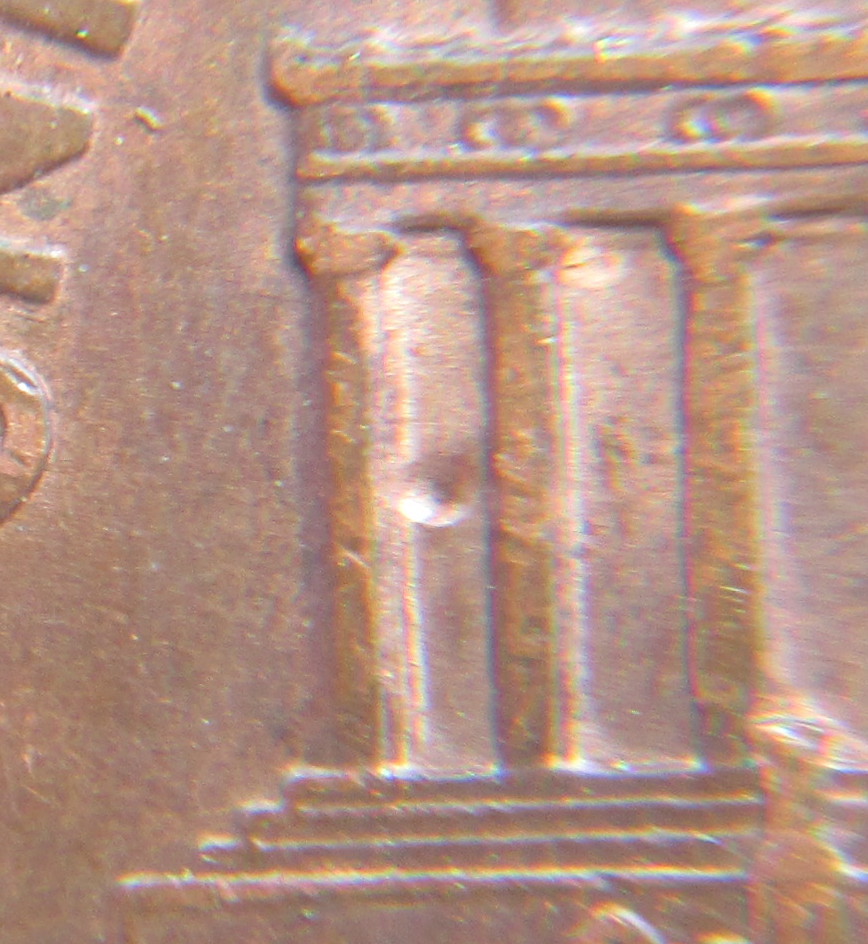 edit: 1999D LMCEdited by Halo1st
07/15/2015 8:13 pm
|
|
Pillar of the Community
United States
3360 Posts |
Halo1st - thanks for your experiment...food for thought. The first thing I notice is a "pressure ridge" on the lower edge of the indention. As I understand it, this is indicative of an impact on the coin after it has been struck. So, while it is similar to a Rockwell Test Mark, it becomes clear that it was done on the coin itself and not the planchet before the strike. The other difference is the shape of the indention in your experiment which is different from that in a Rockwell Test. Yours is more "cone" shaped rather than hemispherical as is the case with a Rockwell Test indention. I think this is a minor difference, however - determined by the shape of the point which made contact. Had you used something different, you might have been able to more closely resemble the indention from a Rockwell Test. The key question is how to do this on a coin without a pressure ridge being formed! I do not know if that is possible!  In the only documented example I have found, you can see the hemispherical shape of the indention (made slightly elliptical by die flow) without the presence of a pressure ridge. You can see that here: http://www.error-ref.com/?s=rockwell |
|
Bedrock of the Community
United States
17884 Posts |
You will note in the image of the Rockwell test on planchet the test mark ended up in a raised area of the design, te last places to fill when the coin is struck and the best place for prestrike damage to the planchet to survive. The reason it is oval in that image is becase it was wiped out or filled in by the field areas on either side of the column. Planchets often have nicks or gouges on their surfaces before striking and typically they are wiped out by the strike. They will usually only survive on the devices on lower pressure strikes that do not fill completely. Also consider adjustment marks on early coinage. They typically show on the devices but only the heaviest ones will show clearly in the fields, and even then they will be crushed. The mark on the OP coin is in a field area. if it had been in the planchet it would have been crushed. Still say it is PSD. |
|
Pillar of the Community
United States
3360 Posts |
I understand, Condor101, that you are saying it is impossible for a Rockwell test mark on a planchet to survive in the field, because all metal would flow into the mark. I can understand what you are saying about a raised area of the design being the last to fill when applied to the obverse, because it would be the highest point on a coin which is being held in a horizontal position. A raised area on the coin on the reverse would be the lowest point. The only answer would have to be that the metal flows from the center of the coin (planchet) outward, unaffected by gravity. Is that the way it happens? To say it a different way: I do not understand why the metal would be less likely to flow into an area containing a column. The Reverse is the anvil die, as I understand it, so the column area on the coin being struck would represent the lowest point on the coin which is being held in a horizontal plane. Why wouldn't the metal flow to the lowest point first? Why wouldn't that make a test mark in the field more likely to survive than one on a column? The test mark in the field would be higher than the test mark where a column ends up being struck. I also note that in the photo on error-ref, the test mark is not just exclusively on the raised portion of the column. It is broad enough to carry into the field on both sides. It seems that, if the mark cannot survive in the field, at least the portions of it in the field should have been eliminated? I have been searching for other verified images of a Rockwell Mark on a planchet and have found none at all. Very curious about that - not even any others not in the field!  Edited by Pete2226
07/16/2015 1:44 pm
|
|
Rest in Peace
United States
7075 Posts |
Frustered? I understand.
If the tested metal is not used to make coins, then the only coins with that error got out of the mint by accident (or with some help). So, they're rare.
Halo1st has shown how easy it is to make that mark.
I think it would be a tough call on an uncirculated coin. Yours is circulated so you may never know.
It's frustrating, but a lot of interesting stuff is.
Wish I could answer your questions about metal flow...but I never studied materials science....but I do know this much: metal can be reliable and predictable but not one hundred per cent of the time.
|
|
Pillar of the Community
United States
3360 Posts |
I appreciate the sympathy, Buddy! I guess that it is not the first time in my life I have been frustrated, though!  |
|
Page 3 of 3
|
Replies: 37 / Views: 4,331 |
Page 3 of 3
|






 First Page
 Previous Page


 Posted 07/14/2015 9:36 pm





