| Author |
 Replies: 27 / Views: 4,942 Replies: 27 / Views: 4,942 |
Page 2 of 2
|
|
|
|
Pillar of the Community
United States
5362 Posts |
thq - I wish the scans were bigger. I think it would be advisable to get the larger resolution shots - but here is what I think I see from these:
1. The matching weakness on the edge which aligns on BOTH sides clearly points to a planchet that for whatever reason was thinner at the edges when it was struck. This is a rolling error that is quite common on both originals and counterfeits. It is associated with poor quality control in the rolling process. This type feature is often seen on the Boston types because they were "rush jobs" for the most part.
2. At this area of weakness - you describe fissures. I do not see these as compression fissures but rather like fissures caused by aggressive strain on the ingot during the rolling process. Once again, this feature is seen on both real and fake 8Rs.
3. If I am interpreting the positions of the edge correctly based on your description - it is VERY UNLIKELY that this coin was edged on the standard two die edging mill. It looks far more like a forgery.
4. Since the coin is HIGH GRADE silver, the date of the forgery simply can NOT BE BEFORE 1870. Prior to 1870, there was no financial incentive for forgers to make a High Grade Silver counterfeit. The incentive to make fakes began when the difference between the intrinsic value and the market value exceeded the cost of manufacturing and shipment of the coins.
5. The incentive to forge Bustman Dollars for the China trade was highest from the mid-1870s until the mid-1890s. The incentive (at a reduced rate) remained until the Bustman was demonetized in China about 1933. The window of manufacture if a full weight silver Circulating Counterfeit is therefore 1870 to 1933.
6. There is only one other period of time when high grade full weight silver forgeries were/are made. That is between 1950 and the present. The coins in this group are NUMISMATIC forgeries. They can be difficult to separate from the 1870 to 1933 group.
7. The "wavy" line is not totally clear on the pictures, but several different counterfeit types have a similar line next to the circle and rectangle design. The fact that you call it wavy is an indication of forgery as well. The real apparatus did not allow for a wobble. If it was eccentric at all it would be a "gradual" movement across the width of the edge.
8. The scans are too small to see any raised spots in the fields or signs of the die being a transfer copy.
No rush, but I would like to see the bigger scans as soon as you get them.
|
|
Pillar of the Community
United States
3348 Posts |
Again, Bob, thanks for the many comments. I'll get the micrographs of rim, ISP fissures and surface graininess as soon as I can. Regarding two of the comments:
7. The "wavy" line is not totally clear on the pictures: The line is a demarcation between figure and bevel, and wanders around the coin. Similar to Jaobler's photos.
8. The scans are too small to see any raised spots in the fields : The raised spots are just barely visible as a scatter of little bits, on a line from the chin to RA, close to RA. Even under magnification I'll have to cross-light to emphasize them.
"Two minutes ago I would have sold my chances for a tired dime." Fred Astaire
|
|
Pillar of the Community
United States
5362 Posts |
Here is what I believe you are referring to as the wavy line. It is typically a counterfeit feature as seen on one of my own Boston forgeries. Shown here; Image Insert: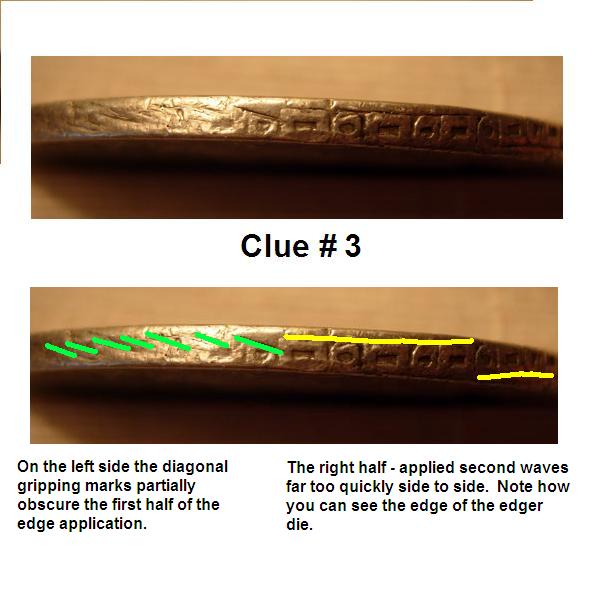 Now I can see the spots you are referring to. I wondered about the 2 white spots in front of the King's chin. If they are raised - that eqautes to small holes in the die surface and you need to ask yourself - How often do you see these spots on REAL coins? |
|
Pillar of the Community
United States
3348 Posts |
The diagonal grip marks in your photo are pretty similar to what I see on my coin, but the marks on mine appear to be deeper. I see on your example that the grip marks obliterate the rim figure, too. The wander I see in the rim line is more gradual than on your example, but as you can see in my last photo half of the rim figure is gone before it disappears completely. At other points on the rim it is well centered.
I have seen raised bits like these on an AU 1878-cc quarter, and they are well described by Briggs. When I first saw them on this 8 reales I didn't think about them being caused by die pits. But no, I don't see them often, and would have expected the coin to have a normal flat field like almost every other coin I have.
Our microscopist is back in tomorrow, and I hope to have upgraded photos then.
"Two minutes ago I would have sold my chances for a tired dime." Fred Astaire
|
|
Pillar of the Community
United States
5362 Posts |
Small die lumps DO EXIST on real coins. They happen when the die surfaces are damaged by rust or when the grinding of the die surface exposes bubbles (small voids) in the original die metal. Rust is perhaps most common cause when real dies are considered. The mint tends to use the BEST grade of steel because it results in longer lasting dies. Counterfeiters use what they have so counterfeit dies tend.
I am not saying all lumps are proof of forgery, but when I see them, I take extra time looking at the coin. Die lumps splits and cracks occur far more frequently on counterfeits than on real ones. It is like recut letters and spelling errors. Both happen on real coins BUT they happen far more often on counterfeits.
|
|
Pillar of the Community
United States
3348 Posts |
Finally the microphotos. First the surface fissuring at ISP: 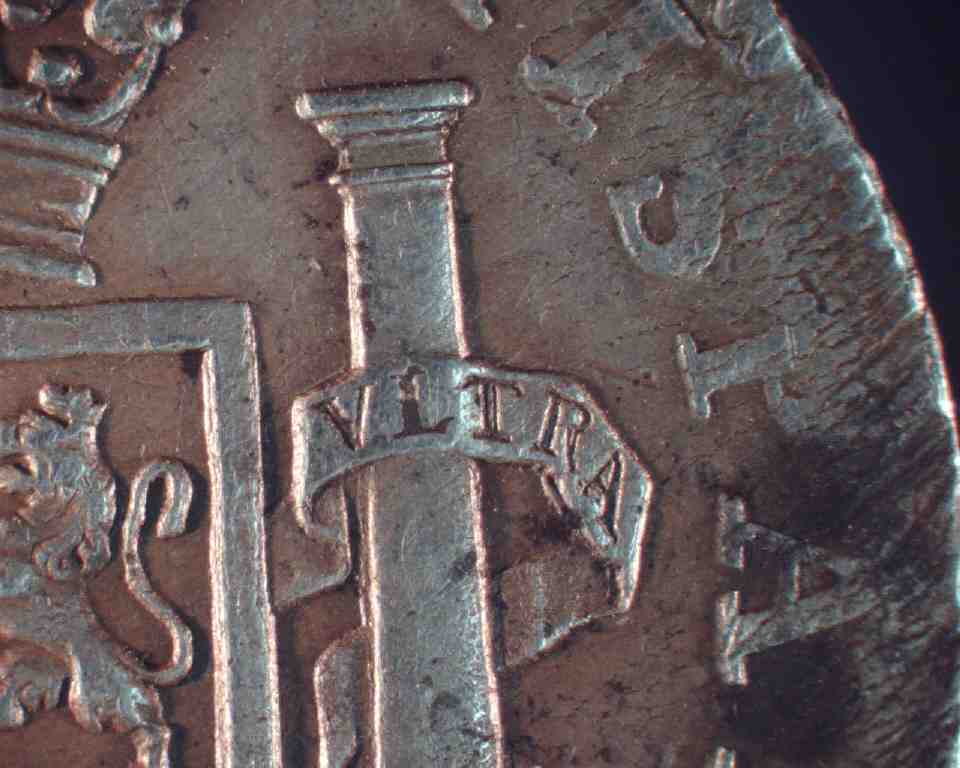 Next the surface bumps in the field near GRA: 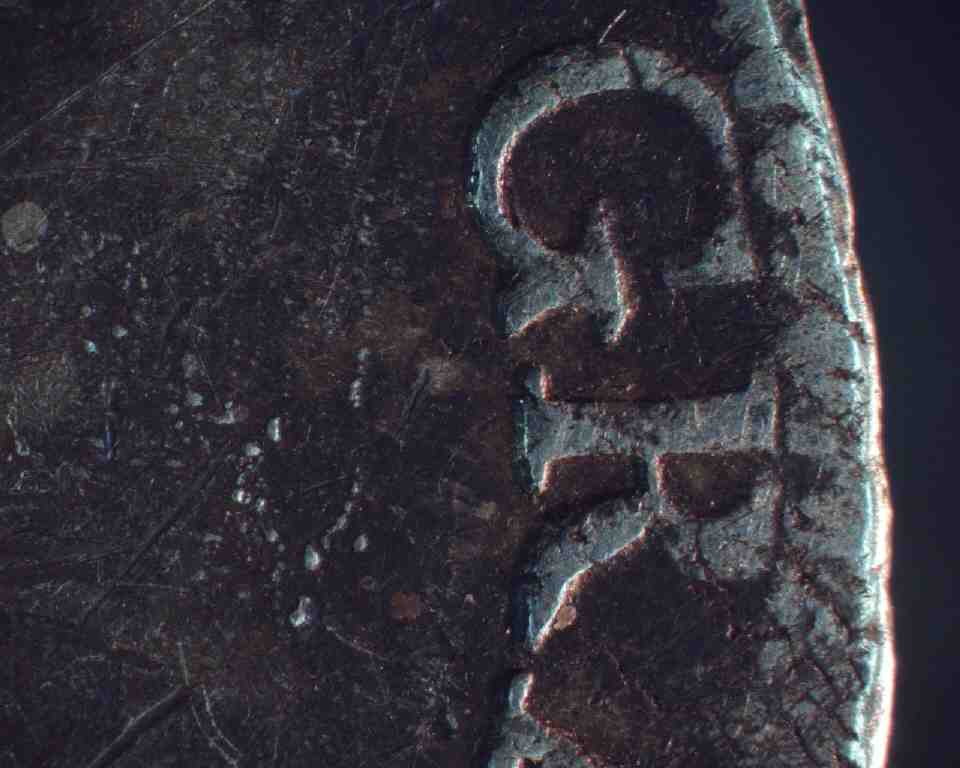 Next the rim grooves. Note that part of the horizontal line is intact - the grooves are apparently applied on top of the rim figure. At the bottom of the picture you can see one partially obliterated rectangle, almost running off the edge of the coin. 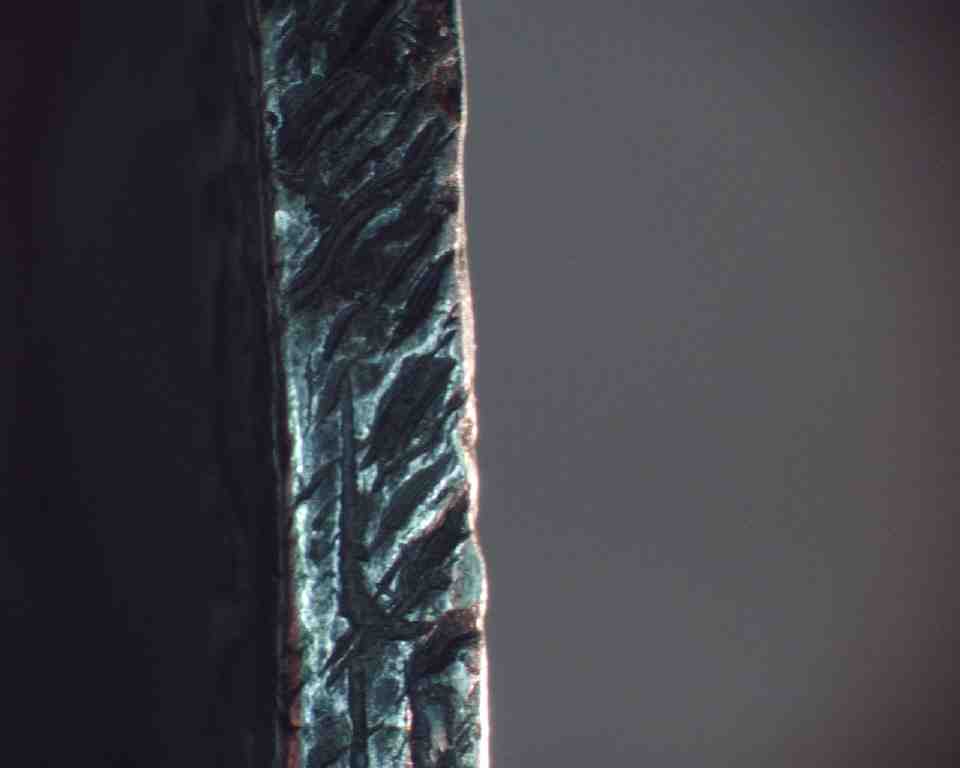 Finally the blank rim section. Note the close detail of the rim line: 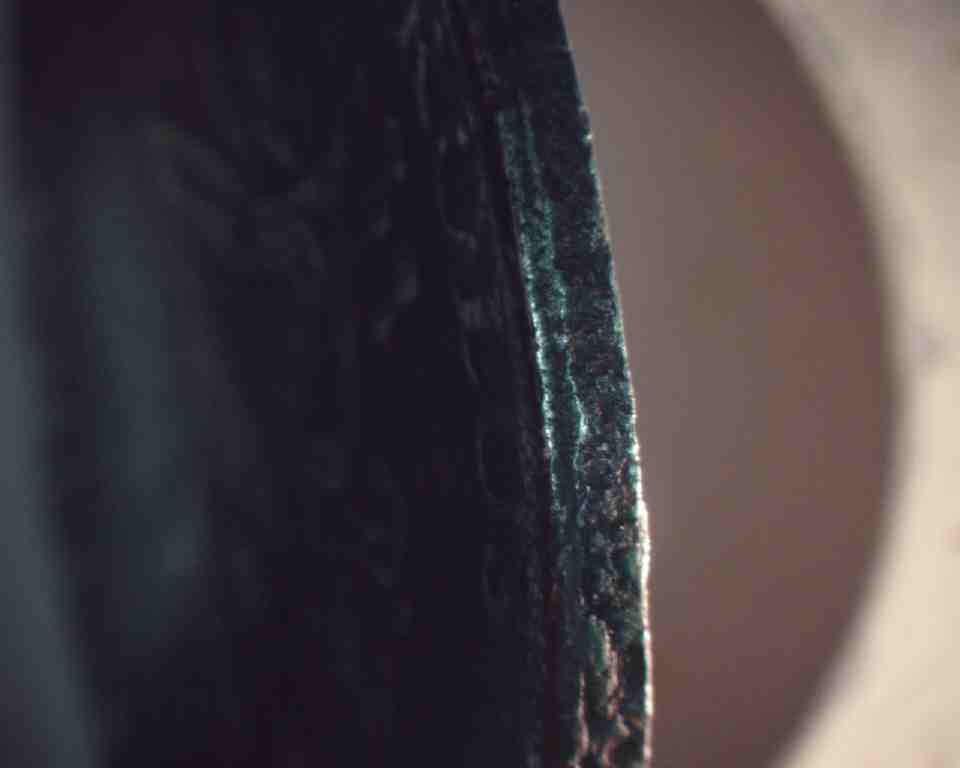 I hope you can form a better opinion with these, Bob. They have cost me many donuts. "Two minutes ago I would have sold my chances for a tired dime." Fred Astaire
Edited by thq
02/22/2008 4:30 pm
|
|
Pillar of the Community
United States
5362 Posts |
I somehow lost my first attempted answer. Here goes again. The pictures are GREAT - the detail is fantastic. The fissures are precisely the same as those often seen on Boston types. This does NOT prove the coin is a forgery by itself. The edge pictures of the overlap areas are the best proof that the coin was not edged in a Standard edging mill. That fact is proof that the coin is a forgery. The picture of the lumps indicates to me that they are due to voids in the die as opposed to rust. Die rust normally does not show abrupt and deep penetrations into the die. A void on the contrary does. The most normal void is due to bubbles in the die steel. These can be exposed by the die finishing (called grinding or lapping). This step produces the flat field and removes stray marks and lumps caused by the die making process. When a void is exposed in this way and then a coin is struck - some of the coin metal extrudes into the void - the sides are normally straight. The top of the extrusion is often dimpled. That is exactly what I see in the large scan. Here is s sketch of what I am trying to say. Image Insert: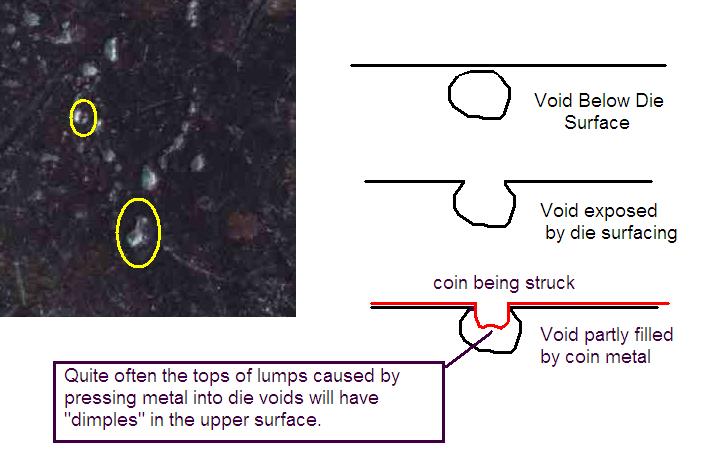 |
|
Pillar of the Community
United States
3348 Posts |
Thanks, Bob. The photos are a tribute to what can be done with a Nikon magnifier/viewer. The surface bumps are seen in several places on the obverse, but I can't find any on the reverse. Is the poor metal quality evidenced by the obverse strike seen with real dies as well as couterfeits (in particular, these later Spanish colonials)?
Before I print off this monster reference guide, I'm still a little bit curious about the quality of the counterfeit image. The dealer that sold me this coin was convinced that this coin was a genuine Mo strike (with possible seawater damage), so the counterfeiter has done his work well. How did the Boston forgers make dies which reproduce the originals so well? Are there any specific points of obverse/reverse detail where they clearly fail?
"Two minutes ago I would have sold my chances for a tired dime." Fred Astaire
|
|
Pillar of the Community
United States
5362 Posts |
You ask a very KEY question - how did they make the dies? I have never been able to figure that out. I have heard many different stories but none of these has convinced me as to how they were executed. The best story so far was that the dies were made with a 1 to 1 panto-graphic lathe but I have no real proof of that contention at all. Some of the dies exhibit small surface texture irregularities which look like a possible mechanical cutting mechanism was involved - like a tiny rotary drill or cutting bit that could be closely controlled in three dimensions to cut away the die metal. The fields are ground flat removing most of the evidence for cutting but the high points of the design (recesses in the die) are often impossible to smooth out. A similar cutting lathe was used by Francis Henning to make his nickel dies in the 1950s and the machining technology involved was invented prior to the 1890s. So it is at least possible that a mechanical lathe would work. If you look at any of Henning's nickels you can see exactly how fine his work was. There is no feature on a Portrait 8R that would be beyond that level of technology. Do you recall the recent "discovery" that some very rare VAM varieties of Morgan dollars were actually contemporary counterfeits? The Coin World article I read attributed them to the 1890 to 1930 era. This was a big story within the past 12 months - however, the fact that the micro O dollars were forged was a story I first heard back about 1964. The story came from the same coin dealer that originally told me about the Boston forgeries. He knew they were fake years before Coin World went public with the story. This coin dealer never indicated that he knew how the dies were created just that the coins were counterfeited and done very well. He did make claims to know some of the actual forgers involved in making some of the Portrait 8Rs and I have wondered for years if it was the same forgery ring that produced both coins. But I don't know. I do know from reading about them that the micro O dollars are VERY WELL MADE and I know from observation that so were the "Boston" style 8Rs. Regarding those small lumps - they do happen on real coins. All die steel may have small trapped air bubbles that lead to surface failures - however, the number seen on real dies is small. Mints use very high grade steel by comparison with forgers. So based on the numbers I see on your coin - the die steel used was POOR. It is unlikely (in my opinion) that the dies were real. Regarding the dealer's comments (the one you spoke to) about "seawater damage" - what the heck was he talking about? Seawater damage on the dies or on the coin? These are raised features on the coin not recesses so exactly what was he referring to? I think "seawater" is getting blamed for something it didn't do. Regarding "specific points of obverse/reverse detail where they clearly fail" - the one clue the old dealer told me to watch for was a "crooked or odd smile" on the King. He seemed to understand that and claimed he could identify the fake 8Rs just by the smile but I have never made a correlation with a specific detail. So I can not identify them in that way. |
|
Pillar of the Community
United States
3348 Posts |
Thanks again. I've spent a lot of time trying to determine whether certain art prints are original wood blocks or photomechanical line block reproductions. It's almost impossible to tell, because the photo techniques exactly reproduce the original features. You can look at secondary features such as you did on the 8R's rim, die voids and planchet rolling defects. In the case of printing, the line blocks can endure tremendous striking pressure hence will embed in the paper and will make feathery dark outlines at their sharply square edges. But in reading contemporary articles on the technique, done right, no one can tell the difference.
Seawater? I'm not sure whether that refers to the darkening and staining, the edge weaknesses (what I originally thought were file marks, and which from a distance could be taken for corrosion)or the bumps (ie die rust or surface deformations on the coin).
Next up, I've got a French decime restrike coming. I'll shoot a picture of it with the Nikon. There's not much doubt about its authenticity, just a demonstration that under pressure to salvage already-made coins a mint can really botch things.
"Two minutes ago I would have sold my chances for a tired dime." Fred Astaire
|
|
Pillar of the Community
United States
3348 Posts |
I hate to beat a dead horse, but this 1805 Mo on ebay looks counterfeit, too....lots of raised metal bits on both obverse (directly in front of Carolus' nose there is a large one) and reverse, as well as odd-looking edge detail. Am I seeing things? http://cgi.ebay.com/1805-Carolus-ll...a5_W0QQitemZ320222082052QQihZ011QQcategoryZ541QQssPageNameZWDVWQQrdZ1QQcmdZViewItem "Two minutes ago I would have sold my chances for a tired dime." Fred Astaire
Edited by thq
02/29/2008 10:05 pm
|
|
Pillar of the Community
United States
5362 Posts |
I think you have found another one. It is at least a GREAT candidate. Take a look at the first C and A in CAROLUS - there is a round lump which appears to have a hollow at the high point near the A and a curved raised segment near the C. There is a second raised curved segment touching the Point after the roman numerals IIII.
BTW I heard from Don about the coin you bought. I would definitely believe he had no idea. These coins are in the class of the Micro O dollars - VERY HARD TO ID.
|
|
Valued Member
United States
235 Posts |
Bump -- to revive this topic. The edge of my coin [1804 Spanish dollar] has poorly-formed rectangles from the "S" in CAROLUS to the "A" in GRA. The bottom edge looks as if it was fioled off.
|
|
Pillar of the Community
United States
1801 Posts |
I also noted one other thing on two counterfeit Bolivians I have at home (1797 and 1807) - the last S in CAROLUS is smaller than the rest of the letters in the King's name. I will have to check to see if I can find an original Bolivian 8R from 1805 with a small S at the end of the King's name. This feature could link the counterfeit dies.
Hey Swamper Bob, did you ever determine if this was a feature of the counterfeits only or common to all the Potosi Carlos IV portrait 8's? By the way, thanks for the great info on the "Boston Fakes".
|
|
Pillar of the Community
United States
5362 Posts |
The font size of any one letter is probably not enough to diagnose a class of forgeries. I have definitely seen different size letters used on real coins, so it is quite possible that what you see MAY be real.
I am often more bothered by letter shapes than purely by size.
|
|
Page 2 of 2
|
Replies: 27 / Views: 4,942 |
Page 2 of 2
|








 First Page


 Posted 02/21/2008 07:32 am


