| Author |
 Replies: 20 / Views: 3,537 Replies: 20 / Views: 3,537 |
Page 2 of 2
|
|
|
|
Pillar of the Community
 Canada
737 Posts |
Edited by TaeKenDo
07/04/2016 6:39 pm
|
|
Pillar of the Community
Canada
737 Posts |
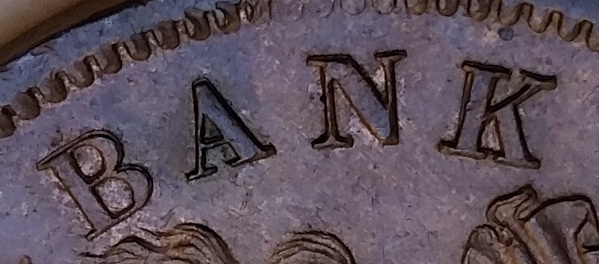
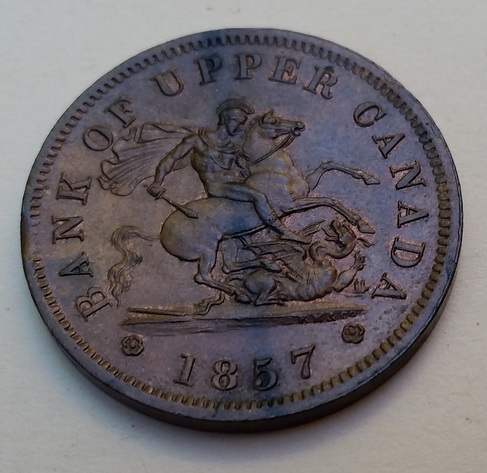
This last one came back from ICCS as MS60. The first one I posted looks like it's in better shape with cleaner edges. I hadn't noticed the doubling before I sent it but would they even consider marking this on the holder..? If so, I might try another TPG. But if it's not a Variety or Error, maybe not worth it. Might just list the two on ebay & see what happens. The MS60 trends at $150 I believe so who knows. |
|
Pillar of the Community
United States
840 Posts |
Concerning the initial St. George token.
I concur with ICCS MS 60.
Shift entry doubling is rather common to this series as the quality control
of that era was not up to snuff.
This is Courteau variety 278, having a rarity factor of 8 (on a scale of 1-10),
1 being common.
doug
|
|
Pillar of the Community
Canada
737 Posts |
Good to know Doug, thanks!
Ken
|
|
Pillar of the Community
United States
840 Posts |
Concerning the second token.
This should also grade MS-60.
This is Courteau variety 292, having a rarity factor of 8.
doug
doug
|
|
Pillar of the Community
Canada
737 Posts |
I don`t see the difference Doug...
|
|
Pillar of the Community
United States
840 Posts |
Doctor Courteau identified some 44 different varieties of this series.
And in my research, I have discovered a few more. Of this series, Dr.
Courteau first separates the token in two major categories as to the size
of the Dot within the Obverse Rosettes. Then Dr. Courteau identifies the
dot patterns within the Reverse Anchor Rope. The counting of the Dots commences
with the upper left arc of Dots (below the upper section of the Sword, the next
grouping concerns the segment of Dots betwixt the upper section of the Sword and
the Fledging (feather), the final point of reference concerns the number of Dot
in the segment betwixt the Fledging and the Anchor Shaft. Dr. Courteau further
identifies the size and placement of the Grass Blades extending from the right
Cornucopia.
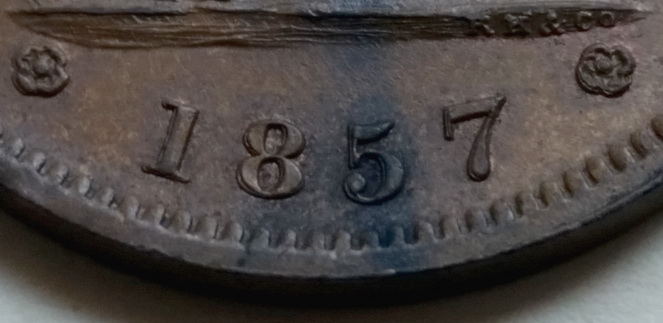
Dr. Courteau further identifies the placement of the numeral 7 in relation to the
denticles. Dr. Courteau identifies the size and description of the design elements
below the Man's right Arm. Some are two lines, some are small forks, some are large
forks, some are tri-forked, etc.
There are other details identified by Dr. Courteau, but the above should suffice
to demonstrate that the photos provided of the tokens are positively from two
different dies.
enjoy
doug
|
|
Pillar of the Community
Canada
737 Posts |
He sounds like a Doctor, you do too! haha Thanks, I`ll follow what you wrote while inspecting the coin.
Edited by TaeKenDo
07/09/2016 10:43 am
|
|
Pillar of the Community
United States
1101 Posts |
Doug, now you've got me interested. I see the difference in the dots in the three segments, and in the grass blades. The 7 is over the denticle on one coin, and between on the other. Design below the man's right arm is different. One has folds in the fabric and the other doesn't. Are the dots in the rosettes the same on those two?
....I think I'd better quit looking at these and stick to my 1859's....
|
|
Pillar of the Community
United States
840 Posts |
Welcome to the enigma of St. Georges.
Doctor Courteau's description of the Dots are somewhat confounding.
Dr. Courteau referenced the Dots as being either large or small. UGH.
The large are rather obvious.
Concerning the small Dots, some are tiny, some are small, while
others are what I would call medium. Dr. Courteau lumped these
together as being small. True, they are smaller than the conspicuous
large dots. Confusion is that medium dots are not small and are oftentimes
confused with being the large dot varieties. I call the dots of the tokens
in the photo to be of the medium type.
p.s. My highest academic achievement is an Associate of Arts degree (two years).
doug
|
|
Pillar of the Community
United States
840 Posts |
FYI
Compare some of the diagnostic markers previously mentioned
with the recent posting of Wade's MS St. George.
to wit: Small Dot, small fork below Arm, different Anchor
Rope Dot pattern, etc.
doug
|
|
Pillar of the Community
United States
1101 Posts |
These are beautiful tokens in high grade. They are really fascinating to study. Were the upper left sections of the anchor ropes hand punched into each die?
|
|
Pillar of the Community
Canada
2786 Posts |
Doug, When is your book coming out  ? With your additional research and the availability of digital pictures (rather than hand drawings or verbal descriptions) tokens are due for some modern publications (it's been a century after all). I'm just starting to scratch the surface of all the varieties, seems to me they could compete with the 1859 one cents - just need a little more exposure to the collector base. |
|
Pillar of the Community
United States
840 Posts |
Of all the Canadian Colonial Tokens, the St. George series is considered to be
the most elaborate and detailed of the tokens. The manufacturing and production
were high quality. This anomaly in and of itself is the culprit for many unversed
token collectors to over grade their ensamples. I have seen many VF's being offered
as MS tokens. Many have never seen true MS's (thus not having a sound basis for
reference or comparison). Even at VF, ample detail remains to mislead many into
believing the token to be of a higher grade. This series can not be attributed
along the lines of traditional tokens, but rather along the lines of decimal coinage.
Concerning a 'book,' kindly be patient. My research manuscripts are complete. At
present I am not at liberty to go into further detail, save to say, this project is
a joint effort involving a handful of the leading experts adroit in this field.
doug
|
|
Pillar of the Community
Canada
737 Posts |
|
|
Page 2 of 2
|
Replies: 20 / Views: 3,537 |
Page 2 of 2
|





 First Page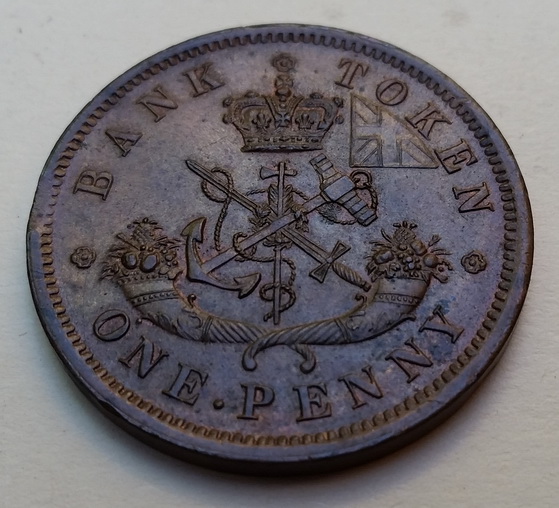

 Posted 07/04/2016 6:54 pm


