| Author |
 Replies: 16 / Views: 2,773 Replies: 16 / Views: 2,773 |
Page 2 of 2
|
|
|
|
Pillar of the Community
 United States
1267 Posts |
|
|
New Member
United States
40 Posts |
|
|
Bedrock of the Community
United States
12437 Posts |
I voted for other, in this case the beginnings of die crumbling on the denticles quote:
As it's been reported many many times that a Die Cud is impossible in this this series
Would that be because the busties were not struck in collar? |
|
Pillar of the Community
United States
1267 Posts |
quote:
Would that be because the busties were not struck in collar?
Possibly so. The closed collar didn't come into "vogue" until 1836. I read a great theory by the late Russ Logan who claimed it was impossible for a die to break away to form a Cud due to its tapered design, but some (this one as well) I've seen might counter this theory. |
|
Valued Member
United States
328 Posts |
That looks like a die chip; a small Cud. |
|
Moderator
 United States
23522 Posts |
I can't see it being post-mint. There's no apparent displacement of metal from the rim inwards to account for the "overlap" I see in the denticles; that detail keeps me from thinking Cud, as well. My guess is it's a fortuitous lamination at just the right place. |
|
Pillar of the Community
United States
1173 Posts |
I voted for Die Cud...there are a number of denticles affected. The fact that some of the denticle detail is still visible argues against a Cud, but I could see a broken die that hadn't completely fallen away creating this appearance. SuperDave...far more experienced than I...may be right, though...it's a fortuitous lamination, but the odds seem so much against that explanation. |
|
Valued Member
United States
120 Posts |
|
|
Forum Mom
United States
5877 Posts |
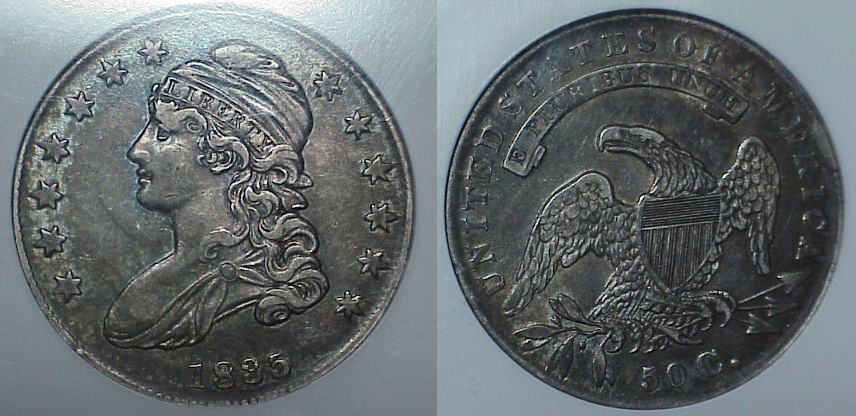
I don't believe it can be called a Cud because the edges of these coins are milled and not struck in a collar. However, that may be the best way to describe it. I have seen varieties of this series with joined milling or gaps in the milling as indicators for the variety. I think it is just an anomaly in the obverse (or reverse) die that was used. I looked through the Overton book (which I'm sure you did also, Ben) and couldn't find this as a marker for any of the obverse dies. Have you attributed it yet? It is possible that this is a later die state of a known variety and this would be the marker for that state. I definitely don't think this is post-mint damage. The area looks to be raised which would indicate additional metal and I don't see signs of any denting. |
|
Member
United States
3242 Posts |
Bonedigger mine was a VF-30 and a little lighter toning.
|
|
Pillar of the Community
United States
1267 Posts |
quote:
I don't believe it can be called a Cud because the edges of these coins are milled and not struck in a collar. However, that may be the best way to describe it. I have seen varieties of this series with joined milling or gaps in the milling as indicators for the variety. I think it is just an anomaly in the obverse (or reverse) die that was used. I looked through the Overton book (which I'm sure you did also, Ben) and couldn't find this as a marker for any of the obverse dies. Have you attributed it yet? It is possible that this is a later die state of a known variety and this would be the marker for that state.
I definitely don't think this is post-mint damage. The area looks to be raised which would indicate additional metal and I don't see signs of any denting.
Hello Susan, The coin has attributed as an O-109 which happens to be one I needed.  Take Care Ben |
|
Pillar of the Community
United States
1984 Posts |
I am on the fence. Could be a planchet anomaly combined with chipping in the die, there are plenty of Overtons with denticles joined either in pairs or threes. Does look like the meeting of a weak die and a defective planchet, does it appear doubly struck?
|
|
Pillar of the Community
United States
1267 Posts |
Here is an unusual 1833, O-109, CBH in EF-40ish condition with an apparent (Cud/Planchet Lamination Issue/Rim Ding) just by star 13. What do you make of it? After looking at the coin in hand and with a loupe, I think it's a lamination issue more than a ding or Cud. Here are the best pics I could get using my handheld camera, sorry... Take Care Ben  |
|
New Member
United States
26 Posts |
I'm going to throw it under a Ding. From the rest of the scratches it might even just be normal wear and tear. They weren't real nice with these coins.
mike1352
|
|
Pillar of the Community
United States
812 Posts |
I'm voting "other." I think it is a die chip in the denticles. This would usually be called a Cud, but I guess there is an issue with using that term for pre-1836 coins. It does not look like damage. |
|
Page 2 of 2
|
Replies: 16 / Views: 2,773 |
Page 2 of 2
|




 First Page


 Posted 03/27/2008 3:26 pm





