| Author |
 Replies: 20 / Views: 7,031 Replies: 20 / Views: 7,031 |
Page 2 of 2
|
|
|
|
Pillar of the Community
United States
949 Posts |
Your coin has bronze disease, not verdigris. Removing the green chemical salts and sealing the areas will only make matters worse. Here is why: once BD starts it sustains itself within the fabric of the coin. Sealing it from air and moisture does not stop the action which continues beneath the sealant. But the sealant does hinder your ability to treat the coin chemically.
The treatment which will stop the progress of bronze disease involves the use of sodium sesquicarbonate and a specific set of procedures for applying it and removing it. Unfortunately this treatment will also destroy some patina. The treatment is not worse than the disease when the BD is in its later stages and is forming pits. That is what it is doing to your coin.
the green deposits are the result of chemical action between the bronze and HCL
BTW- don't let this coin or the material on it make contact with other bronze coins in your collection. True BD is "contagious."
Edited by lrbguy
01/21/2017 12:51 pm
|
|
Valued Member
 200 Posts |
|
|
Pillar of the Community
United States
7067 Posts |
|
|
Valued Member
200 Posts |
Thank you!
Now I go and buy the ingredients. :)
I will post pictures when I will finish the process.
|
|
Moderator
 United States
23731 Posts |
Before you go and buy chemicals you may want to try this. I've done this and it halted the progression of the disease. Place the coin in a 200 degree oven or under a lamp that will heat the coin to remove the moisture trapped in it. Once the coin is heated remove it quickly and place it under and air tight jar so the moisture does seep back into the coin as it cools. Once cooled you can remove what remains on the green deposits. Than you can give the coin a coat of REN wax. Simple but it works.
|
|
Pillar of the Community
United States
5010 Posts |
That's what I used to do, but be careful using wax! I had BD on this coin, treated it with distilled water/baking soda, scrubbed, then baked it (didn't use the air tight jar however). looked good, then applied some wax, here it is a few months later...  As lrbguy said... the BD just kept going under the wax. I treated again with distilled water, baked to dry, then treated with verdi-care, then it look like this...  It still looks like that two years later. I just checked it again. Dont' forget to cheep checking your coin, that stuff tends to come back! |
|
Valued Member
200 Posts |
Thank you all of you! I did both process twice! :D Just for sure, but I did not cover with wax. The coin is still in quarantine, but looks ok!  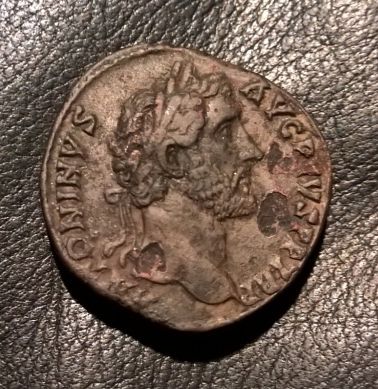 |
|
Pillar of the Community
United States
7067 Posts |
Wow! Great job. Does the reverse look this good?
|
|
Moderator
United States
23731 Posts |
I agree you did an excellent job.
|
|
Moderator
United States
34562 Posts |
nice job @baltas!
"If you climb a good tree, you get a push."
-----Ghanaian proverb
"The danger we all now face is distinguishing between what is authentic and what is performed."
-----King Adz
|
|
Valued Member
200 Posts |
Thank you!  Both side better in hand. Still some brownish patina remain. I made a small trick. After I finished cleaning there were holes, where the metal was shiny. So I dripping liver of sulfur, to earn that darker area. 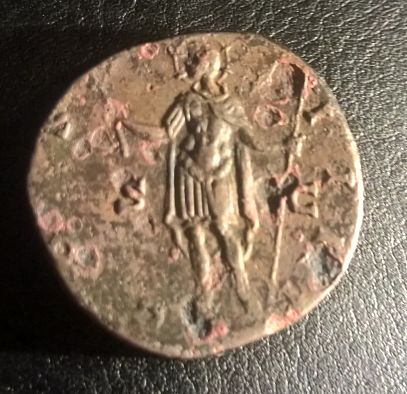 (If I am right the coin is "healthy" now, because I put water into the holes around a week ago, and nothing bad happend.) |
|
Pillar of the Community
United States
949 Posts |
Baltas, this is an excellent result. I am not familiar with "liver of sulfur" but it might just be interfering with the bonding of the chloride, substituting a sulphate or sulphide or sulphite ion. The chemistry is hairy (for me), but it looks good if this works. I prefer this to the use of carbonates. Can we see it 6 months from now? I still wouldn't wax it just yet, but if it's clean for a few months, then maybe.
|
|
Pillar of the Community
United States
988 Posts |
"this is an excellent result. I am not familiar with "liver of sulfur" but it might just be interfering with the bonding of the chloride, substituting a sulphate or sulphide or sulphite ion." He only used the liver of sulfur to darken the shiny bits, not treat the bronze dise ASE |
|
Pillar of the Community
United States
949 Posts |
Quote:
liver of sulfur to darken the shiny bits, It helps to know what this stuff is and how it is used. As I said, I'm not familiar with it. What is it? |
|
Valued Member
200 Posts |
Yes, I used that stuff only for coloring the naked parts.
Wikipedia:
"Liver of Sulfur is a poorly defined mixture of potassium sulfide, potassium polysulfide, potassium thiosulfate, and probably potassium bisulfide. Synonyms include hepar sulfuris, sulfur, sulfurated potash and sulfurated potassa.
Liver of sulfur is mainly used in metalworking to form a patina, turning copper alloys brown or black.
Typically liver of sulfur comes in a dry rock form which must be broken into smaller pieces and dissolved in hot water for use."
I do not like the color of this patina, but perfect if you want to correct small surfaces.
Of course I will post new pics a few months later.
|
|
Page 2 of 2
|
Replies: 20 / Views: 7,031 |
Page 2 of 2
|







 First Page


 Posted 01/21/2017 12:58 pm





