| Author |
 Replies: 20 / Views: 3,126 Replies: 20 / Views: 3,126 |
Page 2 of 2
|
|
|
|
Pillar of the Community
 Canada
1996 Posts |
i had a feeling okie would be the 1st one to chime in!,
wow I thought the sample sizes were larger than that although okie's search of thousands of 1881's was probably closer to what I would have thought.
the reason for my question is a variety I recently discovered (that I had mentioned in another post)
i have probably looked at a few hundred between online auctions coin show and dealers not to mention others that have looked at theirs. and besides mine papeldog has the only other one I have seen.
so I am trying to get a feel of how rare this might be and whether or not it would fetch any descent premium, as always thanks to everyone who helps me on this site
|
|
Moderator
 Canada
10477 Posts |
I have been fortunate to find two 1881 single serif N varieties... one was the ugliest, corroded G-4 you could imagine, and the other one was a really nice problem-free F-15. I sold it to a really good friend who loves Vicky varieties much more than me (photo is below)... then I wrote a short column about it in the CN Journal (October 2013 issue). Now, this specific variety is in the PCGS Registry, which pretty much guarantees that 100% completion of the full set will almost be impossible. 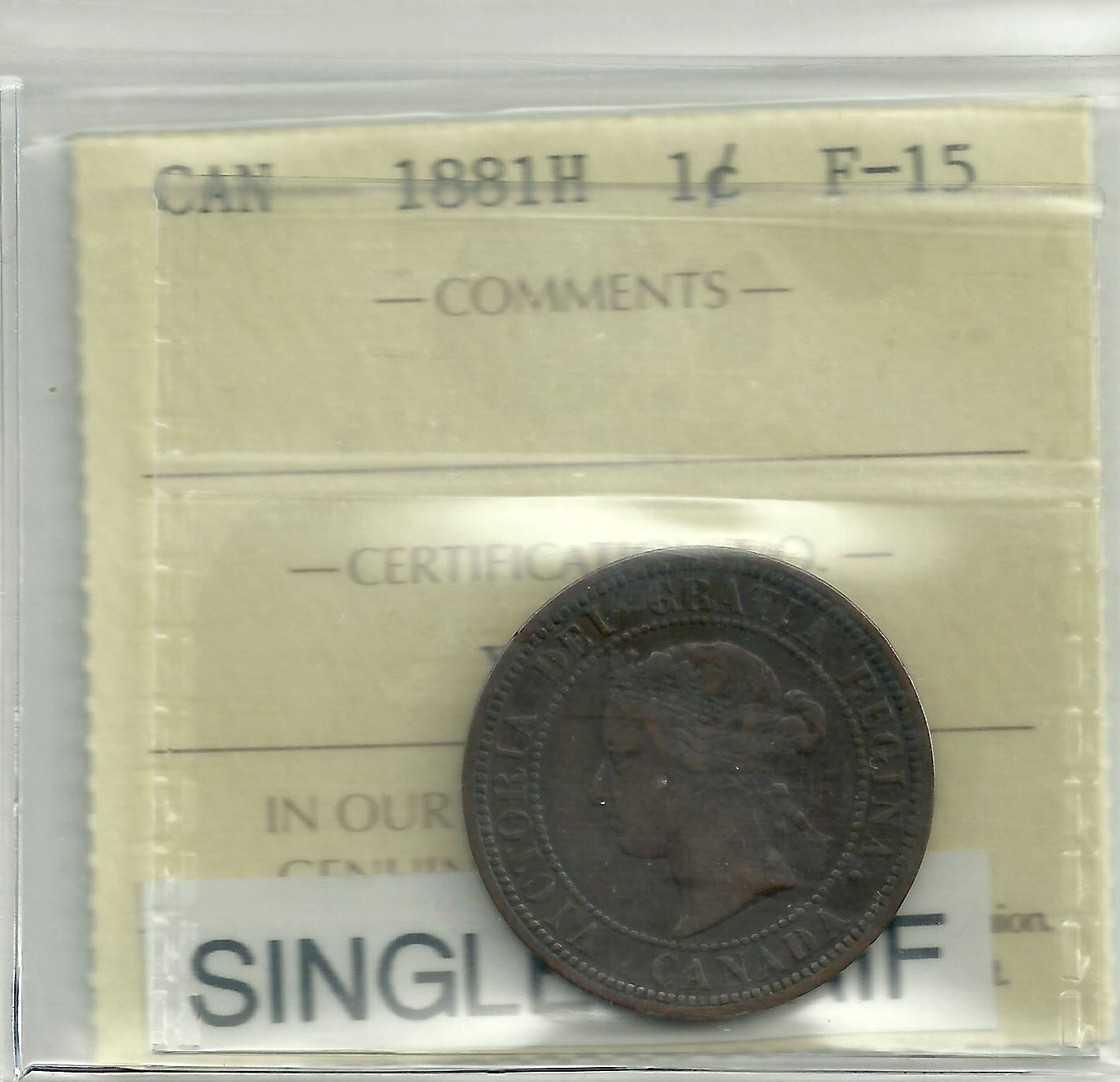 "Discovery follows discovery, each both raising and answering questions, each ending a long search, and each providing the new instruments for a new search." -- J. Robert OppenheimerContent of this post is licensed under a Creative Commons Attribution-NonCommercial 3.0 Unported License. See: http://creativecommons.org/licenses...0/deed.en_USMy eBay store
|
|
Pillar of the Community
 Canada
5660 Posts |
Gidgit: Maybe I wasn't clear on the terminology as to what I meant by "pops" or populations. The 40 or so random initially that I referred to above is what you each would have in hand at home to start. Then you post your initial queries on a forum (the old CCRS was great for that). Then the 3-5 friends of yours with similar likes/goals would look at their OWN 40-50 or so and you would then have a total random pop of 150-200 maybe. Then the specific variety with all the markers would be properly ID'd (you all may have found 2-3 or less in your 200 total)and then hunt would go on at shows or ebay searches. Then we would estimate how many we had looked at physically at shows or dealers and add that to our total looked-at population that, by then, approached 1000. 10-20 years ago I would search 100-300 of each date at any given show, so it doesn't take long to look through 1000 coins of a specific genre to start getting an accurate count or population scarcity. Then we all would add up our looked-at totals and our "found" totals and get a relative scarcity. From the start date of someone's "look what I found" to getting a semi-accurate scarcity total from 4-5 people looking for the same thing might be 2-3 years, sometimes less. Once we published the large cent variety section, then a truly "random" search was no longer possible for that specific variety. We all knew when we got together to start the thing that we were cutting our own personal throats about searching for specific varieties for our own collections. Dealers started looking for them and marking them and ebay vendors started detailing them. At one time, in the thick of things 15 years ago or so, I had 5,000 or more Vickies .. .1000 of those 1859's. Brad Gravestone had as many 1859's and Dan in Illinois could have given me a run for my money with early Vicky totals. When we published the 2011 Charlton, almost all dates had a total looked-at population of well over 1000 (counting shows and inspections). For accurate die-tracking, you need well more than 500 on-hand total between your group. To set up "scarcity" the small group of us compared the ease at which we could find a specific variety given our perceived scarcity and assigned it with a "multiple". The multiple was how many times this variety was worth more than a "normal" coin of that date/Obv base solely on scarcity. Then we would take the average price of that normal coin and multiplied it by our "scarcity multiple". Then we took that $$ total for a VF-20 and compared that total to a VF-20 1858 large cent. Each person then had to decide whether they would rather value that dollar total for the variety or buy the 1858. We gave the "multiple" number to Charlton as to how many times a normal coin value was the variety worth. Unfortunately, Charlton applied the multiple evenly across the board .. taking their own published price and multiplying it by our "multiple". They added or subtracted nothing for condition from G up to UNC. Charlton immediately took 20 or so of the 80 varieties that we listed and put them in the front of the book, in addition to the back section. Once any coin is listed in the front of the Charlton, then Trends picks it up and starts printing it in each edition (normally). After 2-3 years of being in Charlton and Trends, prices from G up to UNC started to spread out rather than just being multiples of the normal coin. Almost without exception, our perceived scarcity and value was right on or close to the mark and has stayed so. Very few of the 80 we marked have dropped in price and many have gained and all have stabilized. What we did with the Vicky cents would be nearly impossible to do now. You need a small cadre of people with similar collecting interests that want to accumulate items to do research. Then you need a single collecting forum to gather and post interim findings .. CCRS was great for that 15 or so years ago because it was the only things around. You had to have access to lots of shows or lots of coins and you all have to be in separate areas. Our group had me in the T.O area, one further North, one in the Chicago area, one in Calgary, one in LA, one in BC, and a late one in Quebec. We got inputs from others on CCRS for additional info. Nowadays you have 3-4 forums and, when someone starts a thread asking for pops and info on a variety, you may get the same person posting his totals on the same 3-4 forums. When you add things together, you may have included the same persons total 3-4 times and no guarantee that you are all looking at the same thing. Add to that is the fact that raw coins unsearched are almost impossible to find any more, so there are few "random" samples available. And the cost to acquire large accumulations of anything other than cents is insurmountable. When we were doing the Vicky cents, you seldom paid more than $5 for any coin in mid-grade and you came home from shows with 20-30 coins at a time .. all raw. In the early days, you might find 2-3 REAL scarcities at any show. At one time, I had nearly 20 1884 Obv 1's and still have 10 .. and paid no more than $10 for any of them. Good luck on your searches. Everyone can benefit on past researchers and their publications. The Canadian coin market is small and very little has been written on some of the denominations. It is a real challenge to gather all that is necessary to ID'ing specifics and getting the word around for all to see. All I can recommend is to find similar collectors, read as much as you can and search the archives of every coin site that is out there. Lots of work has been done in the past and is there for the taking. At the very least, you HAVE to get at least one of your group to have a good working relation with a publisher or associate of something like Charlton or Haxby or CCN to make sure than your findings get known to the general population. Above all, you need some dedicated people or person that can put in many hours of looking through a scope and recording findings. Edited by okiecoiner
02/09/2017 1:44 pm
|
|
Moderator
Canada
10477 Posts |
Wow Bill.... and you said that you hated to write!! You will need a nap after that thesis!!  "Discovery follows discovery, each both raising and answering questions, each ending a long search, and each providing the new instruments for a new search." -- J. Robert OppenheimerContent of this post is licensed under a Creative Commons Attribution-NonCommercial 3.0 Unported License. See: http://creativecommons.org/licenses...0/deed.en_USMy eBay store
|
|
Pillar of the Community
Canada
9927 Posts |
That was an interesting read, thank you.
|
|
Pillar of the Community
Canada
5660 Posts |
Well, all that mentally stored knowledge would have been lost once all of us in the group get over 70 like I am. Our Charlton donation of collector knowledge in 2010 (for the 2011 edition) was the first variety section that wasn't derived from dealer info or guesses. Other folks have now provided independent research for other denominations, like you have SPP with your nickel dollar contributions and Paul's 50 cent studies. I think that the small cent variety sections can also be done cheaply with the proliferation of bulk roll hunters, but once you get into dimes and quarters, it will have to be a group effort and accurate populations will be tough to come by. I believe that you all know that I get long-winded when it comes to old Vicky information... especially stuff that will be lost over time. You are very lucky, SPP, with your dollar and penny studies since they can always be redeemed at cost and at little or no loss.
|
|
Valued Member
United States
302 Posts |
Okie, the reason why I speculate that the 1881H SSN is from a partially-used die carried over from 1876 is that such a die would already be hardened, "locking in" the SSNs. It's extremely unlikely that the Mint would later soften a die to make a change as trivial as repairing the Ns.
|
|
Pillar of the Community
Canada
5660 Posts |
Hax: I agree that it's a '76 die that slipped through without having the N's corrected. As with any working die that needed the final digit or digits whacked in or a letter corrected ('59, '93, '96, etc, a die had to be annealed (softened) and the punch hardened each time before a hand-held whack.... maybe 2, 3, 4 times.
|
|
Valued Member
United States
302 Posts |
I really doubt that the dies and character punches had to be heat treated between "whacks". To do so would have been so time-consuming and expensive that it would have totally defeated the economy of using full-side punches with partial dates. The Mint would have spent most of its time heat-treating! However, it was necessary to anneal the developing die between blows from the full-side punch during the process of die-sinking.
|
|
Pillar of the Community
Canada
1275 Posts |
I'am certainly no expert on this matter but it seems odd to me that they would use a partially used die from 1876 as they would have to change the final two digit in the date. If they had a partially used die from 1876 left over would they not of just minted coins with the 1876 date or just discarded it.
Maybe I'am just not understanding the drift of what's being discussed here.
Cheers, Bill
|
|
Pillar of the Community
Canada
5660 Posts |
From what I have been led to believe and from what I've read, the working die WAS annealed between the die-correction whacks. Maybe there was no resoftening of the dies between corrections/additions, but I've always believed that there were .. sometimes days or weeks between annealing of the dies and hardening of the punches.
|
|
Valued Member
Canada
395 Posts |
I assumed he was just speculating that the Obverse die for the single serif was leftover obverse die from 1876.
|
|
Pillar of the Community
Canada
3234 Posts |
Remember that the subject here is in the repairs made to the obverse die and not the reverse.
|
|
Pillar of the Community
Canada
1275 Posts |
Yes DEVLEC thank you. Now I can't understand how I didn't understand.  Cheers, Bill |
|
Valued Member
United States
302 Posts |
It was probably an almost universal Mint policy to carry over useable non-dated dies. But what about dies bearing the date? More often than not the Mint carried over "stale-dated" Colonial dies, sometimes overdating them, but often leaving the old date. In one of the 2008 issues of Numismatica Canada, I published a paper on this subject: "Canadian Victorian Overdates and the Use of Unaltered "Stale-Dated" Dies". In that paper I presented evidence for multiple Victorian dates where part of the coinage was struck in a later year. A great example is seen in the Province of Canada cents of 1858-59. At least 13 1858 dies were overdated, yet it is clear that one of the 1858 dies was used unaltered in 1859. We know this because it is linked to the same obverse die as one of the overdate reverses and the obverse is in a later state when used with the 1858 die! That particular case has been published by both Rob Turner and me.
Edited by JHax
02/11/2017 3:39 pm
|
|
Page 2 of 2
|
Replies: 20 / Views: 3,126 |
Page 2 of 2
|








 First Page


 Posted 02/09/2017 12:34 am


