First of all, I do apologise for my 'temporary' absence. As some of you might know, I am now in the last year of the Dutch-equivalent of what you call high school. The past few weeks have mostly been filled with studying for my last midterms and the like, and I spend the little free time I had on positing something on Chinese coinage. To be honest, I also nearly forgot about posting this topic. Oops. Luckily I was remembered by an enthusiastic poster in this topic. Thanks, Bob!
Well, eventually, the correct answer was posted by one of you. Drumroll please.
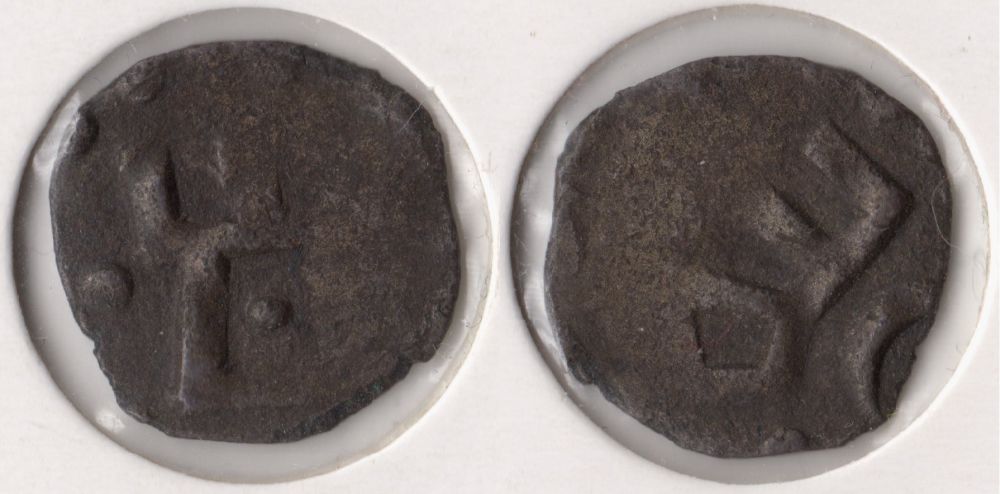
Denmark, the city of Lund, Christopher II, 1319 -1332.
Obv. Turreted tower, pellet to each side, and pellet.
Rev. simple key, crescent to the right, field of pellets to the left.
Bob, you were indeed correct! But you didn't think I'd leave you without a write up, right?
Christopher II's reign is often seen as one of the biggest disasters in Scandinavian medieval history. Not only did he lose a large part of the Danish kingdom to his enemies and even some of his vassals, but the Danish state formally dissolved after his death, only being reinstated by his son, Waldemar, a couple of years later. What really attracted me to this series was the nature of the coins themselves, and how beautifully they connect to the royal and economic history of this region and period. If we look at the coinage of the (Christian) Danish kings throughout the ages, we start with beautiful, high-grade silver, with the king often named and portrayed. As we get to the 13th century, the quality of the coinage starts to decrease dramatically, with the silver alloy containing less and less silver as time progresses, and busts disappearing completely. Around the reign of Christopher II, the situation reaches its all-time low. The alloy these coins were minted from contained barely any silver, and often come out of the ground looking more coppery than silver. Compared to other specimens, my coin isn't even in that bad of a condition. This is, in my opinion, a nice historical 'mirror' to what happened to the economy during this period.
In short: the rule of Christopher II's brother, Erik VI, was also an outright disaster. Crops failed, while the king was spending large sums of money on tournaments across the sea in Germany, peasant rebellions, etc., the entire lot that you would expect from a terrible king. By the end of his rule, he had almost completely bankrupted Denmark, and had not produced a living heir. A couple of nobles, seeing a grand opportunity, quickly seized it, and voted that the king's brother, Christopher, should be his successor. Christopher agreed, but in return had to sign the Haandfæstning (a sort of charter, not unlike the English Magna Carta, limiting the power of the king, and granting more to those who wrote it, the nobles and the church.) Christopher did so, and mounted the throne in 1320 as Christopher II. He however, seemed to have
inherited the inability to rule from his brother; he completely ignored the Haandfæstning, trying and failing to collect taxes from most of his subjects, and to pay-off the huge debt this had caused, started pawning away large parts of his kingdom to neighbouring kings and nobles. Several charters, and a period of exile later, Christopher II was still king, but had virtually no power. After a dispute in which the puppet king sided with the loser, he was exiled yet again, to Lolland this time, were he died a year later in 1332. It is easy to see why Christopher II's reign is seen as such a disaster; the Danish crown went completely bankrupt, held virtually no lands, and were basically powerless. The Danish state formally even dissolved after his death.
As mentioned by Bob, this coin was minted in the city of Lund. Lund, situated in what we would now call the most southern part of Sweden (Scania), was one of the bigger mints of the Danish kingdom, issuing coins for most of the different Danish kings since the tenth century. This minting was carried out by the Archbishops of the diocese of Lund. Lund was one of the larger, if not the largest, catholic centres in Sweden, and its archbishops were often of decent importance and fame. One such, and perhaps the most famous, example is Archbishop Jens Grand. As an import figure in both the Danish politics and religion, it is thought that he is perhaps one of the culprits of the murder on Christopher II's father, Erik V. Anyway, back to this coin. The bishops responsible for issuing this particular coin type were Jens's successors: Esger Juul (1310-1325) and Karl, often nicknamed 'The Red' (1325-1334).
The death of Christopher in 1332 caused a huge power-vacuum in the country. While many different dukes, princes and other nobles were vying for power on the Danish mainland, the Danish provinces in current Sweden were largely neglected. The Swedish king at the time, Magnus Smek (the 'Caresser', a nickname he acquired due to his (alleged) homosexuality), was quick to take advantage of this. Amongst the provinces Christopher II had pawned away was Scania, the province on which the Swedish king had set his sight. He redeemed the pawn the Danish king had gotten on Scania from the Count of Holstein, acquiring this province, as well as several others, for the Swedish crown. This however, is where we encountering a problem concerning the coinage. Lund, located in Scania of course, also fell into the hands of king Magnus. The then bishop, Karl the Red, continued minting under this new authority. The problem is that, despite the rest of the mints in the Swedish kingdom issuing regular Swedish pfennigs and brakteats, Lund continued minting coins in a similar style to those issued during the Danish period of unrest. So how do we know for sure that this coin was issued by Christopher II? Well, we don't. Classifying these low-quality coins of the 'civil-war' ('civil-unrest' would perhaps be a better choice of words) period, basically from the reign of Erik VI to Waldemar Atterdag's reign, is terribly difficult. I don't know all the ins and outs, but I am assuming the authors to have done their homework when attributing this type to Christopher II. Anyway, after Lund belonged to Sweden for a short while, it eventually passed back to Denmark, under their new king Waldemar. While a son of Christopher II, he certainly did not inherit his father inability to rule; he quickly regained all of the lost provinces, reclaimed the royal power his predecessors had lost and reinstated the Danish kingdom.
But why did I specifically buy this coin? Well, there are multiple reasons. First of all; I wanted to get a medieval coin from Scandinavia. Having a couple of relatives living in Sweden, I have visited the general region quite a few times. I remember visiting them frequently as a child and travelling through the beautiful, snowy landscapes in particularly the south of Sweden. I wanted to combine this with my numismatic hobby, but was quite disappointed when it turned out medieval coins from the region were relatively expensive. On every trip there ever since, I have tried to find something for a decent price. Funnily enough, I eventually found this for sale right here in Holland.
Another reason I wanted to pick one of these up, was because of their relatively excellent connection to actual historical events. I have seen dealers selling for example an English Henry V penny (London mint) with the label "the battle of Agincourt!". Sure, this event happened during the reign of this king, but there is no further connection with this coin and this event. Granted, this coin doesn't even mention the king it was issued under (although, looking at the state of the monarchy, this is not strange.). But the simplistic design and the relatively low purity, give it the appearance of a coin issued during a period of intranational crisis. If you can't tell so already, I am a pretty big fan of this coin... ;)
For quite some time, this was the only coin that represented medieval Scandinavia in my collection. That changed a couple of weeks ago. During a short visit to Gothenburg, Sweden, I decided to check out the "antikhallarna", a collection of several antique stores (perhaps better identified as "booths"), in a beautiful, wooden 19th century bank building. Normally, hardly any antique-store has coins, let alone decently priced. The same here; mostly watches, books, and rarely a 20th century silver daler thrown in. Initially nothing that would fit in my collection, let alone for a decent price. The last shop inside the antikhallarna I checked out however, was completely different. Mainly Chinese artefacts (I am not familiar enough with Ming era figurines to comfortably say anything about their authenticity, but they looked okay). But also a book filled with antique coins. Mostly late Romans, or 16th century Swedish coins. But this one stuck out, and after immediately recognising it, I was delighted when the asking price wasn't that for off from the usual value; after a little bit of negotiating, I even got it a little under ;).
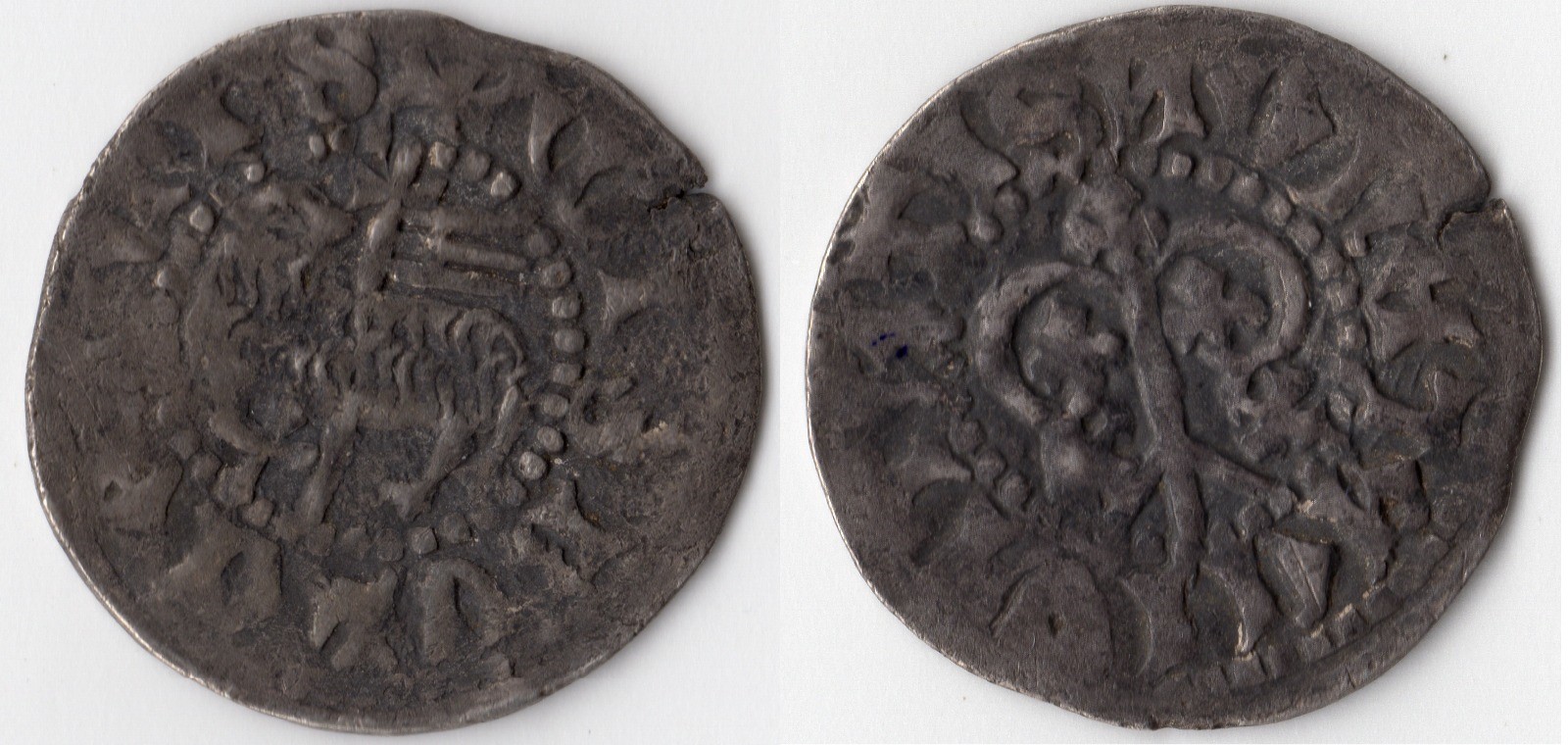
Götland, Visby, 1 gote (örtug). -Ex Myntauktioner I Sverige AB, auction 1, lot 359
Obv: MONETA CIVITATIS ("coin from the city"), the M is actually an 'N', a common variety within this series.
Rev.: +WISBVCENCIS (of Visby)
Last we left off, we had the terrible reign Christopher II behind us, as well as the short interregnum, and a new king by the name of Waldemar appeared on the scene. After he finished reuniting most of the lost parts of Denmark, as well as some new neighbouring territories, he decided that his lust for territorial expansion still wasn't quenched. Thus, his eyes fell upon a new, and extremely rich, target: the isle of Götland.
Götland, and especially its capital of Visby, had been known since Viking times to be extremely wealthy, due to its strategical position: As a member of the Hanseatic league, most of the maritime trade from the Baltic had to pass via the city of Visby (probably a tax had to be paid as well), which thus became the commercial centre of the region. In theory, the island belonged to the Swedish crown, but in practice, Götland basically governed itself. This also mend minimal defences. In 1361, Waldemar began his siege; the Danish army measuring about 2200 professional soldiers strong, while the force of Götland was numerically equal to this, these were mostly untrained peasants, merchants and the town militia. The slaughter was one of epic proportions; 1700 men were cut down by the invading forces, and the island was conquered by the Danish, who naturally looted everything. In the next couple of decades, while technically still under the Danish crown, the Danish presence would eventually slowly decline, and the island, while never reaching the same level of prosperity as before the Danish attack, regained much of its independence. This unfortunately also attracted unwanted attention from a group of pirates, known as the Victual Brotherhood, who raided the island in 1394 and set up their headquarters in Visby. Not that this pirate occupation would last long; Teutonic knights took over the island a mere four years later. The grandmaster of the Teutonic order would later, in 1409, sell the island back to Queen Margaret, who ruled the now unified kingdom of Denmark, Sweden and Norway.
Now finally; back to my coin. With such a turbulent history, the island falling alternately into Danish, Teutonic, Swedish and pirate hands, one would expect the Gotlandic coinage form this era to be most chaotic, everchanging and eccentric, with different types looking nothing alike. Nothing could be less true though. From about 1270 to ca. 1440, only two types of coinage would be issued. The first, as well as the oldest, being a simple breakteat (Hulpenning) with a 'W' (Wisby). The second, issued from about 1320 to 1440 was 'my' type: The Angus dei with a flag or pennant (the coat of arms of Götland) on the one side, a lily-tree (if that even is a real thing) on the other. Much like the English Edwardian pennies, the differences that exists between different issues are either stylistic (square vs. long flag, with or without cross, etc.) or present within the legend (reversed N's, different marks, etc.). To make a real long story short; from what I could gather (which is undoubtedly rather limited), my coin should stylistically belong to either the first, or second of the three general periods these were issued (1320 -1380, 1380 -1420 and 1420-1440). In this case, the weight is the answer. Coins form the first period seem to measure anywhere between 1.2 to 1.4 gram. The second between 0.95 and 1.1 gram, and the last from 0.6 and 0.8 gram. My coin clocks in at a solid 0.93 gram, which, taking the tiny edge-failure in account, puts it in I believe the second group, dating it form 1380 to 1420. I am well aware that there are newer publications that are able to make far more accurate attributions, but those are unfortunately rather costly, compared to the cost of these Götlandic coins. For now, I am happy knowing that this coin was issued in Visby, somewhere in the late middle ages.
To conclude; indeed, something entirely different from the Chinese coins I regularly post, but I have to say medieval coinage is sort of my second passion. Most of my collecting budget does go to Asian coins, but every now and then, I will have the urge to buy something medieval again. Preferably something big and silvery, but if it has a great story to tell, like these two, it is most certainly welcome!
This write-up turned out to be a little longer than I expected; (I originally planned on doing just the first part, but I decided my new purchase would fit perfectly in this topic). Let's hope it was worth the wait!
Mika







 First Page


 Posted 02/21/2017 7:53 pm





