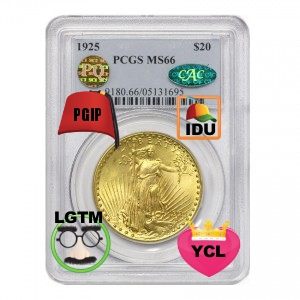
Quote: I remember the days before slabs.
TPG expanded access to our hobby and brought consistency in grading that didn't exist before.
I do and don't agree

I do agree in that the people while like slabs for the idea of slabbed coins (nothing wrong with that), perpetuate the idea the TPGs actually have this down to a factual science which is reliable. They see a consistency where they want and perceive one to be. They will likely argue that since these are the most expert people (oops... CAC!), out there, that the
TPG opinions are the most reliable. In that sense, there is a perceived consistency and it drives the slabbing market.
I don't agree in that when forums are searched, the very fact there is no consistency is more than apparent. Otherwise how would one TPGs "experts" grade a coin differently than another TPGs "Experts?"
How in the world would another kind of company make a business out of their own experts rating the work of the
TPG experts? But again, the people perpetuating the idea of factual consistency probably just never took the time to think about it. Their hobby is fun the way they perceive it to be. So to them it does not matter.
You will find TPGS can keep in business also b/c they are not held accountable as to why they specifically grade a coin the way they do - aka. explaining what specifically makes a coin MS62 vs MS 63. Which also is why resubmitted coins can come back with a different gade!
Grading coins, TPGs will tell you, is not a science - it is an art. This "art" is also why the same coin when graded by one company's "qualified experts" will not give a coin the same grade as a competing company's "qualified experts."
The tech was there years ago to make a totally impartial computer graded system based upon many variables. How do I know? I used one with the capabilities in the 90s to inspect our parts being made in a plastic injection molding plant. The machine measured down to the micron level anything we told it to and reported anomalies. From that we could also have it determine whether or not the part was passable or not. To program it was easy, you walked it through measuring one part, giving it all parameters through menus and onscreen visual inspection, and the machine could do it for itself form then on. These were stored in the machine for future use on the same part.
In other words, it graded in a scientific manner on a scale that is way more than needed for coins. And, it gave a log of why its calculations produced the grade.
The one area I see this machine not applicable to coins was pointed out to me though. This system could not grade for human eye appeal. Nonetheless, accountability (a "log") by the grader would mean much more consistency and accuracy. A machine like this could be used, a human input a number for eye appeal, and the tabulation still be done in a much more scientific and accurate manner. The thing is, with even our phones now having face recognition, I am not so sure the process is far beyond a mobile app anymore.
As it is, even people with total faith in the TPGs will be some of the first to say that when coins are cracked out and are re-submitted, they don't know the grade that will be given. If these systems were as perfect as the marketplace they have made holds them up to be, this would never happen. And surely there would never be a need for a sticker saying the experts were checked by other experts and found to be as expert as they claimed!
I have talked with dealers who used to actually be paid to grade by the main TPGs. They all told me the same story. They were paid by how many coins they got through in one day. So it was about volume. They also said this is why cracking and re-submitting makes for different grades.
My LCS dealer said he has questioned other dealers for years who annually send in the monster boxes of ASEs to be graded. He said a consistent 20% come back as MS70 and everything else lower. He said this alone has him convinced its a numbers game. The
TPG just grabs a random 20% to put in MS70 slabs - enough to keep interest in people keeping up the market for them. He told me to start examining some of the MS70s. I did - and found some with marks, rim dings, etc.
One major thing the TPGS hurt in the hobby is that the masses have been focused onto key coins now while everything else in a series is relegated to junk silver. Older price guides like the
RedBook used to have prices for each coin from G through Unc. This was because based upon mintages and MMs, coins had a varying degree of value depending on how hard it was to find them.
A lot of the fun of the hobby has been killed. It used to be when finding an old coin in change, you would go home, look up the mintage, and get a differing value. You had a real "feel" for how hard it was to locate a coin.
An example:
It used to be, let's say, a 1954-S Franklin was more "special" and worth more than a 1964 JFK half b/c of mintage differences and the less common S mint mark. Now these S coins are thrown into a junk bin and melted together -- unless they are "slab-worthy." I am still sure I can find a lot more JFK 64 halves, than 54-S halves, but the focus of actual numismatics has been shifted to focus on what the plastic says.
Things like FBL ratings on slabs DO show a superior coin. But since the tech was not there to make everything FBL, now what used to be seen as top notch, BU coins, are not as "worthy" anymore b/c slabs have made people think its only a "really good" coin if its labeled as being FBL. The focus is again shifted.
For the people buying mostly sight unseen and online, there is a perceived consistency. But when you start looking at forums and actual, real life situations, you find the alleged consistency is a phantom. Again, so very many times you can see dealers and collectors saying to "buy the coin, not the slab."
It might be the people who just enjoy the slabs (nothing wrong with that), who perpetuate the idea that these TPGS have an actual, legitimate value to the degree the TPGs say they do.






 First Page


 Posted 02/26/2017 7:09 pm





 that faith in TPGs exists.