| Author |
 Replies: 19 / Views: 3,928 Replies: 19 / Views: 3,928 |
Page 2 of 2
|
|
|
|
Rest in Peace
United States
17900 Posts |
Publication alone lends copyright. I believe copyrights are good for 75 years.
|
|
Valued Member
United States
442 Posts |
https://www.copyright.gov/ See left side of webpage for searchable database. For your protection, your literary work should be copyrighted (cost $35). I have challenged websites that listed my book(s) in .pdf format. A Cease & Desist Letter gets noticed by them (especially when one sets a 7-day deadline, demand that all infringing material be destroyed, request payment for copyright violation). They always pop-up and I send a Cease & Desist Letter via email. I now copyright all my important literary works.
|
|
Pillar of the Community
 United States
4623 Posts |
Minor correction DrDarryl...
All your works are copyrighted when created (that's the Berne convention, to which the USA is a signatory)
You are registering them with the Copyright office.
Once a work has been registered, as you indicate, it's a lot easier to assert your rights.
-----Burton 50+ year / Life / Emeritus ANA member (joined 12/1/1973) Life member: Numismatics International, CONECA Member: TNA, FtWCC, NETCC, EveryCountry (online) coin club Owned by three cats and a wife of 40+ years (joined 1983) Author: 3rd Edition of the Sample Slabs book, https://www.sampleslabs.info/ |
|
Valued Member
United States
442 Posts |
1. Assertion of copyright must be made on the literary work. 2. Literary work must be registered with the U.S. copyright office. If these two items are not performed, legal challenges will not hold up in the court of law. The challenged literary work will be classified as public domain and it can be used freely in its entirety and without credit to the original author.So who wants to challenge my literary work in a court of law with this Certificate of Registration (from the U.S. Copyright Office) in my hand? 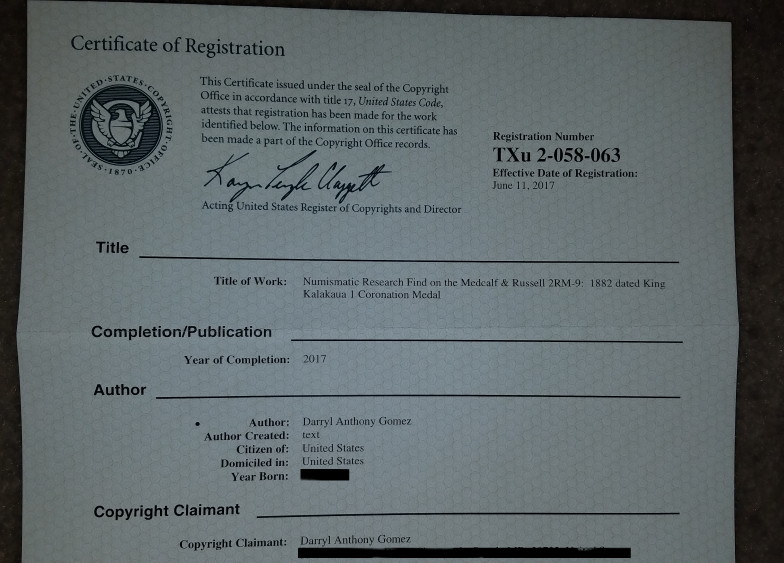 |
|
Valued Member
United States
442 Posts |
It also should be noted that one should protect information in your literary work from unscrupulous use by redacting "key or discovery information" from misuse in the public domain. Here is the related literary work example that I've share on the internet. 1. Note the copyright assertion has the year and the literary work owner on each page. 2. Note that I redacted key information of my discovery. I've taken these precautions to protect my literary work from monetarily gain or abuse within the public domain. If anyone wants to publish this work, they will have to discuss it with me on my $$ terms. 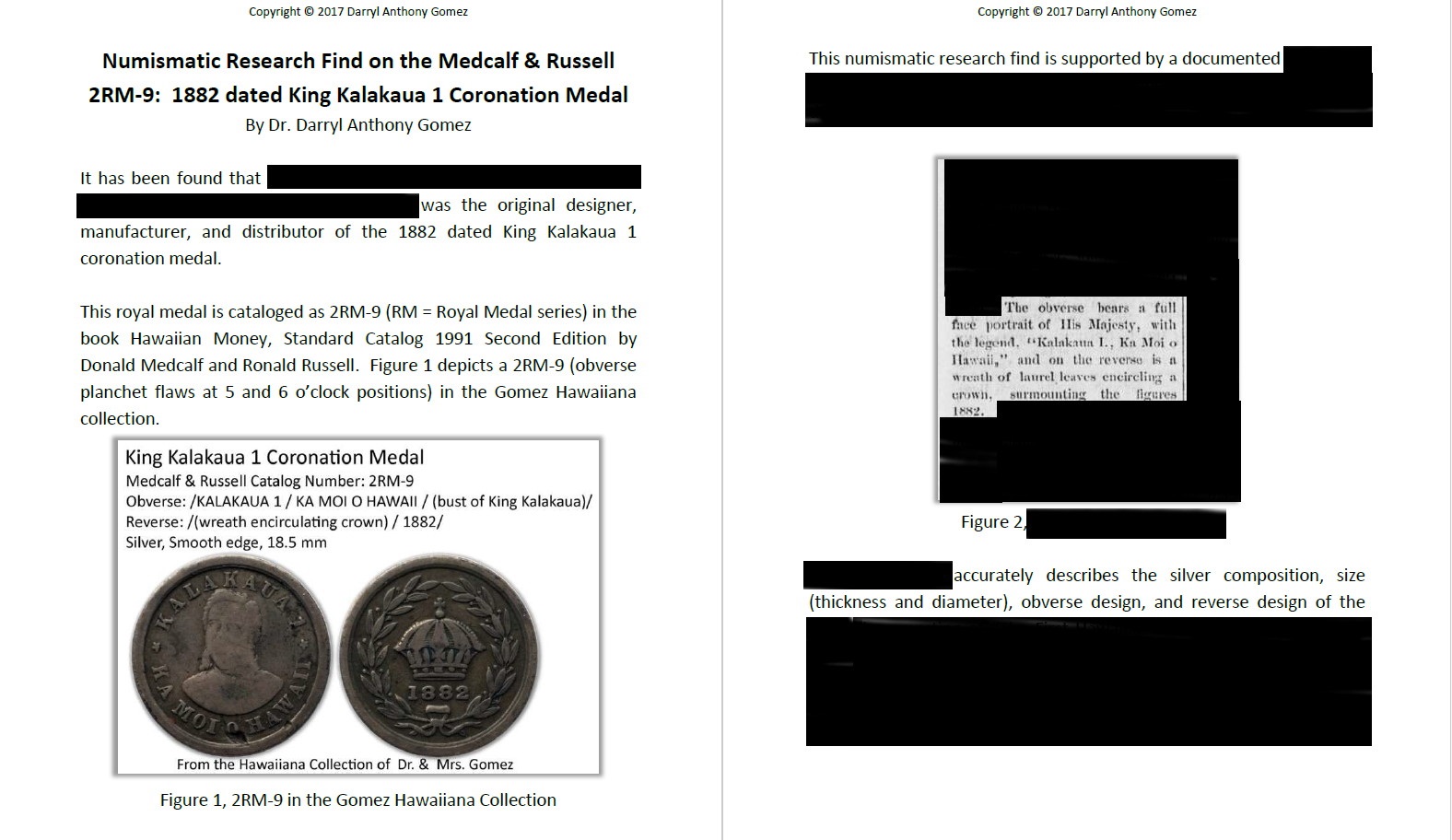 Edited by DrDarryl
12/09/2017 5:37 pm
|
|
Pillar of the Community
United States
4623 Posts |
Quote:
1. Assertion of copyright must be made on the literary work.
2. Literary work must be registered with the U.S. copyright office. That simply is not true. https://www.copyright.gov/help/faq/....html#myworkQuote:
When is my work protected?
Your work is under copyright protection the moment it is created and fixed in a tangible form that it is perceptible either directly or with the aid of a machine or device.
Do I have to register with your office to be protected?
No. In general, registration is voluntary. Copyright exists from the moment the work is created. You will have to register, however, if you wish to bring a lawsuit for infringement of a U.S. work. See Circular 1, Copyright Basics, section "Copyright Registration." Now there are other benefits from registration (same source): Quote:
Why should I register my work if copyright protection is automatic?
Registration is recommended for a number of reasons. Many choose to register their works because they wish to have the facts of their copyright on the public record and have a certificate of registration. Registered works may be eligible for statutory damages and attorney's fees in successful litigation. Finally, if registration occurs within five years of publication, it is considered prima facie evidence in a court of law. See Circular 1, Copyright Basics, section "Copyright Registration" and Circular 38b, Highlights of Copyright Amendments Contained in the Uruguay Round Agreements Act (URAA), on non-U.S. works. -----Burton 50+ year / Life / Emeritus ANA member (joined 12/1/1973) Life member: Numismatics International, CONECA Member: TNA, FtWCC, NETCC, EveryCountry (online) coin club Owned by three cats and a wife of 40+ years (joined 1983) Author: 3rd Edition of the Sample Slabs book, https://www.sampleslabs.info/ |
|
Valued Member
United States
442 Posts |
"The devil is in the detail" Taken from the FAQ section of the U.S> Copyright website. 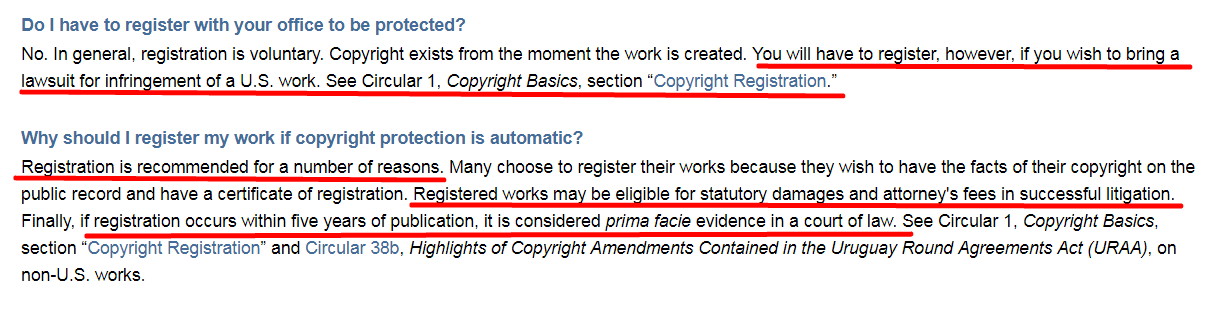 |
|
Valued Member
United States
442 Posts |
Actions can be taken towards any hijacked literary work. The most troublesome are websites that make a pdf version of the hijacked literary on the internet. The first step is to determine the Digital Millennium Copyright Act (DMCA) point of contact or the owner of the website. The second step is to send a letter to the DMCA or owner. The Digital Millennium Copyright Act (DMCA) is a United States copyright law that implements two 1996 treaties of the World Intellectual Property Organization (WIPO). The following is a modified form letter (from an internet template) that I used to make initial contact with multiple DMCA point of contacts (prior to getting a U.S. Copyright Office registration). This letter was sent via email attachment to each of the DMCA of the infringing websites. 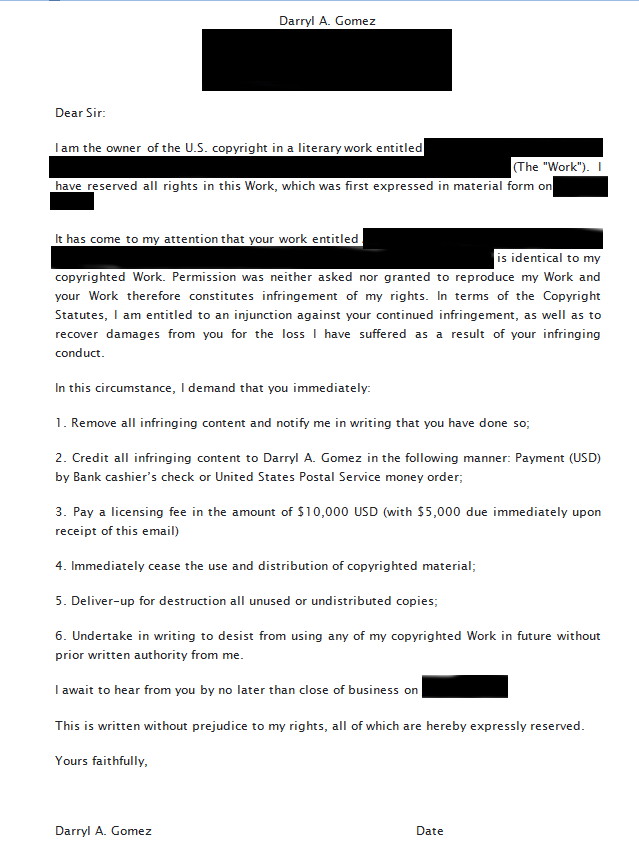 |
|
Valued Member
United States
442 Posts |
Quote:
That simply is not true. "Copyright" is a form of intellectual property law, protects original works of authorship including literary, dramatic, musical, and artistic works, such as poetry, novels, movies, songs, computer software, and architecture. A good copyright case is Napster.  (taken from https://en.wikipedia.org/wiki/Napster) |
|
Valued Member
United States
442 Posts |
Reframing my answer with two points:
The pitfalls in the lack of a copy right notice on the work:
Notice makes potential users aware that copyright is claimed in the work.
In the case of a published work, a notice may prevent a defendant in a copyright infringement action from attempting to minimize his or her liability for damages or injunctive relief based on an "innocent infringement" defense.
Notice identifies the copyright owner at the time the work was first published for parties seeking permission to use the work.
Notice identifies the year of first publication, which may be used to determine the term of copyright protection (authors life plus 70, 95, or 120 years).
Notice may prevent the work from becoming an orphan work by clearly identifying the copyright owner and specifying the term of the copyright.
The pitfalls of non-registration of the work:
A lawsuit for copyright infringement, except in cases involving a foreign work, cannot be filed until the U.S. Copyright Office approves or refuses your application for registration.
Infringement actions for statutory damages and attorneys' fees cannot proceed until an effective date of registration occurs.
Full remedies (actual damages and lawyer fees) cannot be recovered for any infringement three months after initial publication (unless registration is made before the three month period ends).
Point of contact information of the copyright owner will not be unavailable (at a US Copyright Office database) if the author relocates or change publishers or fails to update information with the US Copyright Office.
Summary: A copyright notice on the work and registration of the work documents critical information for the period of the author's life plus 70, 95, or 120 years.
Edited by DrDarryl
12/15/2017 04:37 am
|
|
Bedrock of the Community
United States
12477 Posts |
Does that mean you agree with me, DrDarryl?   I would suggest, if within 24 hours, editing your latest post to add additional comments if no one has responded instead of creating a new post. It makes things more streamlined.  In Memory of Crazyb0 12-26-1951 to 7-27-2020
In Memory of Tootallious 3-31-1964 to 4-15-2020
In Memory of T-BOP 10-12-1949 to 1-19-2024
|
|
New Member
United States
3 Posts |
Hello Mr Hartill,
Not sure how to directly email to discuss with you what I believe is an exciting discovery. I believe I have discovered a 22.1092A Value 100 coin.
I am totally new at this but the lot I purchased came from an extremely wealthy man and the " rare " items from that estate keep surprising me. The coin is sized between the 2 identical larger and small coins... I believe it weighs around 57 grams.
I also have a 10 Kings # 15.6 ( page 117 of your book ).
I don't believe there are many people that are aware of and understand the majority of what I have. I'd love to talk about them
|
|
Moderator
 United States
34567 Posts |
@tonyideal, first welcome to CCF. Second, while the title of this thread is obviously a call to Hartill, you may have better luck starting your own thread and posting pics of your coin. Plus the eye candy would be interesting for those of us not quite on your level.
"If you climb a good tree, you get a push."
-----Ghanaian proverb
"The danger we all now face is distinguishing between what is authentic and what is performed."
-----King Adz
|
|
New Member
United States
3 Posts |
Thanks for the welcome and by no means am I at any level.. lol.
I've been lucky to find some not so conventional stuff that pans out once in a while. Mr. Hartill wrote the manual and I thought if he saw the post he would reach out. I would love to get him or another authority to see what I got. Thank you again so much ! I'll take you upon the suggestion sir.
|
|
Moderator
United States
34567 Posts |
Ok super! I look forward to seeing your post(s). For coins minted after 1600 AD, posting them in the world coin section of CCF is the best idea.
"If you climb a good tree, you get a push."
-----Ghanaian proverb
"The danger we all now face is distinguishing between what is authentic and what is performed."
-----King Adz
|
|
Page 2 of 2
|
Replies: 19 / Views: 3,928 |
Page 2 of 2
|





 First Page


 Posted 08/24/2017 11:32 pm


