Coin Community Family of Web Sites Join Thousands of Coin, Bullion, & Money Collectors
Coin, Banknote and Medal Collectors's Online Mall 300,000 items to help build your collection! Royal Estate Auctions - $1 Coin AuctionsSpecializing in Modern Numismatics Royal Canadian Mint products, Canadian, Polish, American, and world coins and banknotes. Vancouvers #1 Coin and Paper Money Dealer Join Thousands of Coin, Bullion, & Money Collectors


Username:
Password:
Save Password
Forgot your Password?


This page may contain links that result in small commissions to keep this free site up and running.

Welcome Guest! Registering and/or logging in will remove the anchor (bottom) ads. It's Free!

An Odd Pair Of Portrait Eight Reales

To participate in the forum you must log in or register.
First Page  Showing last 15 replies.
Author Previous TopicReplies: 20 / Views: 5,017Next Topic Page 2 of 2
Pillar of the Community
United States
5362 Posts
 Posted 01/21/2018  02:34 am  Show Profile   Bookmark this reply Add swamperbob to your friends list
1c5d7n5m The use of conchos in the SW US is associated loosely with the post Civil war period say 1870-1900. There are of course many modern made examples trying to take advantage of the value of the genuine historic pieces. I would view the genuine examples as rather rare.

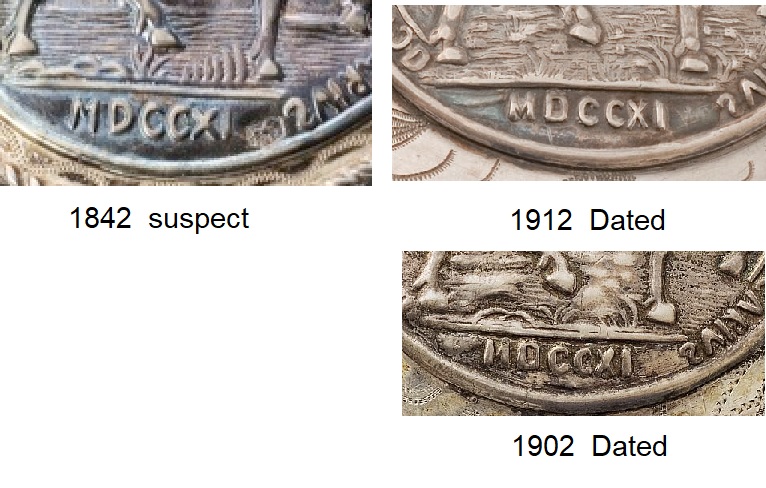
The example you show from the auction is dated to 1842 in the auction. I wonder why? The item itself appears to be very modern. The date on the "coin" MDCCX equates to 1710. I would estimate it could have been made last week or 25 years ago, but not in 1842.

Regarding the 1809 and 1792 8 reales. The wire that forms the belt connection loop and the connector for the clasp looks like modern drawn steel wire. This looks far too modern to date before WWII. In addition the soldered connectors look modern with no patina at all.

The host coins may be genuine but the item is very unlikely to be from the nineteenth century.

Pillar of the Community
Belgium
1185 Posts
 Posted 01/21/2018  05:05 am  Show Profile   Bookmark this reply Add 1c5d7n5m to your friends list
swamperbob

The source from the two examples of large silver "broekstukken" shown above is not an auction or private seller but the Digital Collection Nederland, supported by the Rijksdienst voor het Cultureel Erfgoed (the Dutch official agency for cultural history). I understand your concern for the date 1842, given the Roman date MDCCXI on the two plates. The webpage gives description of the origin of this piece that can be translated as follows Silver pair of trouserpieces made in 1842. These trouserpieces were worn by a boy or man in Axel until WWI.

Unless they made a big error of judgment, we can assume that these pieces were not made after WWII. On the other hand, 1842 is too precise given the fact that the silversmith is unknown in this case, whereas for other items in the collection the maker is known. Given these doubts I have asked Digital Collection Nederland the about the evidence that made them decide to date this piece at 1842. One tends to believe that the information provided about pieces in public collections is correct.

http://data.collectienederland.nl/p...0180-Z.10-78

For the pair of 8R: your hypothesis may be right; I will search a bit more in this strange niche of the numismatic world and pay attention to clips on items from the 19th century. If the clips are modern, one could wonder: Would someone be so stupid to ruin a pair of original 8R in the 20th century? If the pair of 8R is a modern numismatic fraud, all details would fit, including the point I wasted some money on a worthless item.
Edited by 1c5d7n5m
01/21/2018 05:06 am
Pillar of the Community
Belgium
1185 Posts
 Posted 01/21/2018  05:25 am  Show Profile   Bookmark this reply Add 1c5d7n5m to your friends list
some extra information

The website allows connection of the piece discussed above to related pieces, which indeed look quite similar. The dating occurs via the silversmith mark, punched in the silverware which indeed are visible. It is clear that for the three pieces below the oldest is most worn and the newest looks like that. In this respect the fourth item of 1845 which looks the most modern is a bit suspect.

IF the four dates are correct, the conclusion is that this design was traditional in the area it was used for almost one century. Again we are not discussing coins, but ornamented silver plates that evolved from pairs of thaler sized coins along the familiar motto "the bigger the better".

0180-HM.4605
http://igem.adlibsoft.com/wwwopacx/.../HM.4605.jpg

this piece is dated 1912 and was produced by M. de Pleyt in Schoonhoven (a town in Zuid-Holland famous for its silver industry, in particular the production of silver ornaments)

0180-Z.74-48

http://igem.adlibsoft.com/wwwopacx/.../Z.74-48.jpg

this piece is dated 1902 - silver smith unknown


0180-HM.1237

http://igem.adlibsoft.com/wwwopacx/.../HM.1237.jpg

piece is dated 1858 - silver smith possibly G.F. V. Geelen from Schoonhoven who was active between 1853-1880

for comparison the 1845 piece again

http://data.collectienederland.nl/p...0180-Z.10-78
Edited by 1c5d7n5m
01/21/2018 05:39 am
Pillar of the Community
United States
5362 Posts
 Posted 01/21/2018  9:52 pm  Show Profile   Bookmark this reply Add swamperbob to your friends list
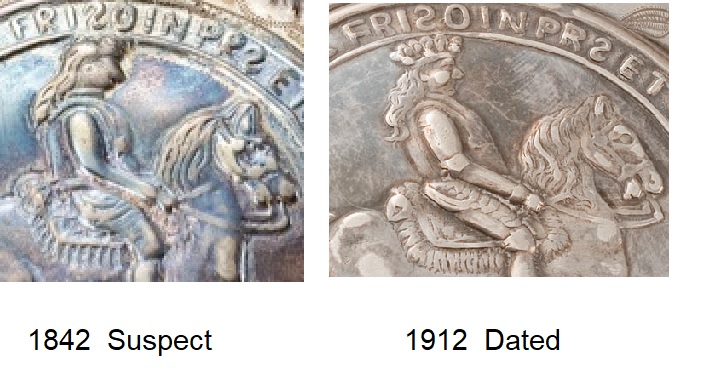
I agree the piece does look like some form of traditional design. Most of these traditional jewelry designs tend to degrade over time. A comparison of the object buckle is clearly very degraded compared to the 1912 dated item.

An-Odd-Pair-Of-Portrait-Eight-Reales

I think this demonstrates that the designs of the turn of the century had degraded by the time the piece in question was produced. The comparison of the Rider's body is even more extreme.

An-Odd-Pair-Of-Portrait-Eight-Reales

I suspect a really recent forgery with forged jewelers marks.
Pillar of the Community
Belgium
1185 Posts
 Posted 01/22/2018  6:34 pm  Show Profile   Bookmark this reply Add 1c5d7n5m to your friends list
hello swamperbob, your point is well taken

it seems we meet some of same tricks in the (what should be fun) world of folklore
the fraud could here indeed be the silversmith mark (1842) that was stamped on a modern object

I am working on a conversation with the Dutch Openluchtmuseum

Related to the above, but now concerning "real" coins, is another object from the
public collection of the Dutch Openluchtmuseum:

0180-Z.29-65

An-Odd-Pair-Of-Portrait-Eight-Reales

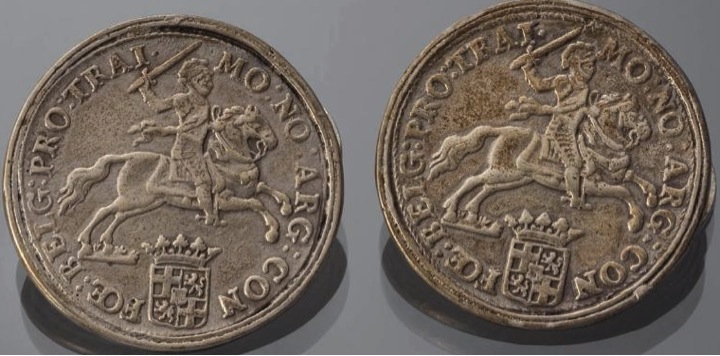
a pair of "Klepstukken" used in the well known fishermen town of Volendam, North of Amsterdam. The Klepstukken are pairs of one large and one small silver coin and are used (for trousers) in a cufflink way. In this example, the large two coins are described by the museum as genuine end of 17th century " (silver riders" of 1793 which are ducatons, about 31 grams, the "fathers of the 8R" , the small coins are described as a pair of half guilders from king William 3, 1863, 1866).

The two ducatons are looking weird, everything seems wrong:
- degenerated details of what normally should be a very nice and careful design
- the planchet is too large, so that there are rings outside the normal area of the coin
- do I see copper color on the surface of the coins?

although the pictures are not very good, the half guilders on the other side of the pairs seem "coppery" too:
http://data.collectienederland.nl/p...0180-Z.14-69

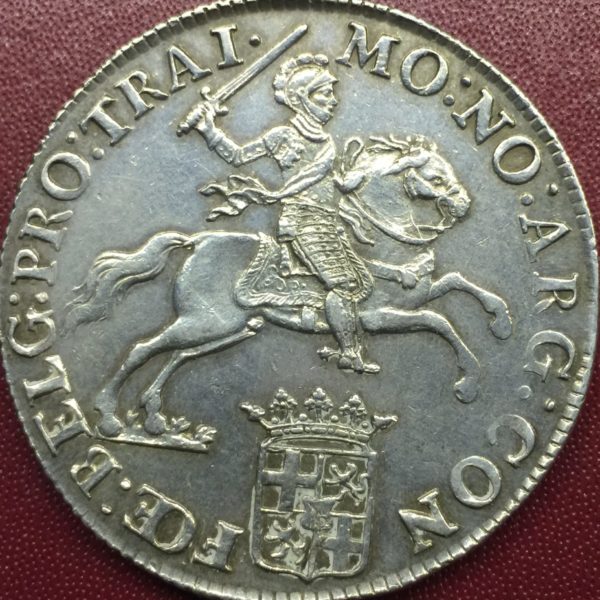
to support my point of a counterfeited 19th century pair of ducatons, see a genuine ducaton from the same Province and year

An-Odd-Pair-Of-Portrait-Eight-Reales
Pillar of the Community
United States
5362 Posts
 Posted 01/22/2018  11:26 pm  Show Profile   Bookmark this reply Add swamperbob to your friends list
It is obvious from the picture of the pair of coins last posted that they are casts of an already slightly degraded type. They lack the clarity of a struck coin and the minor details are starting to merge. In addition, as you point out, the outer rings are out of place on screw press struck coins.

I see no copper on the surfaces. I believe you are wondering if they may be silver plated copper. You need to be aware that casts are not normally layered as if plated. Casts can be silver/mercury "gilded" but in those cases, a meniscus is usually present at horizontal to vertical transitions. Any form of silver wash is unlikely as well for the same reason. Both tend to wear off of high points easily.

Silver plated over copper using electricity could not date before the 1840s. The procedure was not industrialized until that time. A few experimental pieces of copper plate on silver were made accidentally prior to 1840 but the reverse seems not to have been possible.

Silver plate of the Sheffield type is older than electroplate. In that case the surface silver can be alloyed to match the percentage of silver in genuine coins. Sheffield plate is created by hot welding silver layers over an ingot of copper. After bonded the three layer ingot can be rolled to thin it to a small fraction of the original size. The silver and copper work as if they were a unit and the silver layer can be thinned to a few thousandths. The process dates to 1770 as a single sided plating and a few years later for two sided plate. The edge needed treatment to cover it separately. The first use of a silver ribbon to cover the edge occurred in 1785. After that point the method was widely used.

A cold bonding of silver foil to a copper core was known from antiquity and can be achieved during the strike of a coin. It was rarely used until the late 1770s because the foils was easily destroyed and poorly bonded.

Using the dates of the various forms of silver plating is helpful to determine if the rest of the item makes sense.
Pillar of the Community
Belgium
1185 Posts
 Posted 01/23/2018  5:18 pm  Show Profile   Bookmark this reply Add 1c5d7n5m to your friends list
thanks for helpful explanation, understanding the technology and the time fram it was used is helpful

at another section of the nederlandsopenluchtmuseum collection, one can inspect the piece at high resolution:
http://www.collectiegelderland.nl/o...werp-z.29-65

unfortunately this webpage does not show the other side which could be interesting too, because the half guilders (dated around 1860) may perhaps be silver plated copper counterfeits?

low resolution photo of one of the pair below; the color of the half guilder is strange

An-Odd-Pair-Of-Portrait-Eight-Reales
Pillar of the Community
Belgium
1185 Posts
 Posted 01/24/2018  11:46 am  Show Profile   Bookmark this reply Add 1c5d7n5m to your friends list
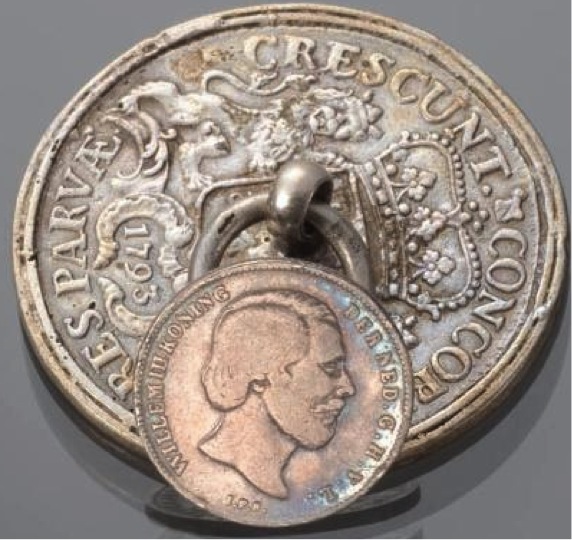
Object Z.14_69 in the same collection looks like another pair of counterfeited ducatons (dated 1765, 1790).

Impression from the photo's is that an inner plate was attached by the counterfeiters to two outer plates that have the "degenerated" ducaton silver rider; details are poor as in the other pair

An-Odd-Pair-Of-Portrait-Eight-Reales

An-Odd-Pair-Of-Portrait-Eight-Reales


higher resolution images online:
http://www.collectiegelderland.nl/o...werp-Z.14-69
Pillar of the Community
United States
5362 Posts
 Posted 01/26/2018  01:24 am  Show Profile   Bookmark this reply Add swamperbob to your friends list
I would agree the last pair are clearly cast copies. They are made for jewelry which means they were not originally made as counterfeits meant to pass into circulation. I place all of these 'replicas' jewelry, buttons etc. in their own class. There are many items made using coin motifs which are collectable in their own groups.

However, the technology used and the history of the changes in technology can be used to date counterfeit coins in the same way as buttons. No coin can be made before the technology was invented. It is an axiom that is too often neglected.
Pillar of the Community
Belgium
1185 Posts
 Posted 01/26/2018  4:14 pm  Show Profile   Bookmark this reply Add 1c5d7n5m to your friends list
swamperbob

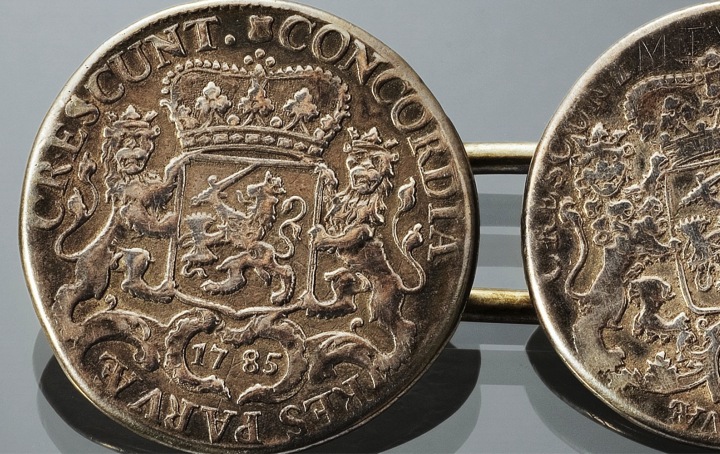
I agree with your idea that also the second pair of ducatons are casts. As far as I can see, the objects 0180-Z.29-65 and Z.14_69 match well as they are the only pieces in this collection based on cast counterfeited provincial 18th century ducatons. There are other pieces with coins that look genuine, but these were made in the 17th century, using different techniques in different regions (Bunschoten and Groningen) than the Volendam area. See example on photo below and photo of other example in the beginning of this thread.

The short synthesis is that the rich man jewelry of this kind in the second half of the 19th century was based on big silver plates, that have nothing to do with real coins. The two pairs of cast counterfeit ducatons made after 1850 in Volendam do not match with this evolution and may be the alternative for someone less wealthy.

Therefore, there are two possibilities
A) these pieces were made by the local silversmith as kind of jewelry and have nothing to do with coins
B) these pieces were counterfeits that could not be exchanged for new money when the old monetary system was replaced.

It seems of interest to consider B, and I consider A less likely.
Indeed, after the French occupation (Napoleontic period), the Netherlands became a kingdom with one centralized mint and silver pieces solely based on a decimal system and the guilder. This means that provincial large silver pieces (ducatons, florins, daalders minted by the seven different provinces) were gradually removed from the circulation to be replaced by new coins. According to the literature (ref 1-3), the final phase of this replacement took place between 1842 and 1849, i.e. not long before the two pairs of "Klepstukken" above were made. It seems conceivable that the authorities organized the exchange on basis of visual inspection, so that old silver coins that looked OK could be exchanged into new types. This must have been a filtering system for obvious counterfeits.

So if you were from Volendam where "Klepstukken" were part of clothing tradition and you were in possession of these false ducatons that could not be exchanged, the logic would be to convert them to "Klepstukken". Perhaps pieces from a larger area in the Netherlands found their way to this traditional industry. In this sense, the two counterfeit pairs of the Digital Collection Nederland, (Openluchtmuseum.nl) seem quite interesting.

References
1. Dr. H Enno Van Gelder "De Nederlandse Munten" (1970) p171-172
2. A. Vrolik, Verslag van het verrigte tot herstel van het Nederlandsche muntwezen van 1842—1851, 1855;
3. J. Schulman, Handboek van de Nederlandsche munten van 1795—1945, 1946.

a pair of Broekstukken (Groningen, after 1785) using genuine ducatons


An-Odd-Pair-Of-Portrait-Eight-Reales
Edited by 1c5d7n5m
01/26/2018 4:20 pm
Pillar of the Community
United States
5362 Posts
 Posted 01/28/2018  12:32 am  Show Profile   Bookmark this reply Add swamperbob to your friends list
Very logical deductions, however some of my experiences with counterfeits might influence your conclusions.

Based on my experiences with circulating counterfeit coins, their re-use for alternative purposes was somewhat common. I have seen them stamped as advertising pieces and some that were stamped as tickets for lotteries or theatrical performances. A few are known that were made into "dog tags" used by soldiers in the US civil war for identification of the dead. Some were used as a host for "love tokens." I know of two that were used as official tokens at workhouses in the UK (both of those are Spanish counterfeits). These all tend to be rather rare types.

In some cases, base metal counterfeits were shipped to colonies where they were used as a form of token coinage after being removed from circulation in the mother country. The colonies needed specie and used underweight counterfeits as a substitute when nothing else was available. I am thinking particularly of Canada and the US where England dumped counterfeit 1/2 pence by the tens of thousands.

During the Hard Times in the US (ca 1837) Spanish 8R counterfeit coins circulated as a similar substitute for higher denomination coins in rural areas.

Jewelry reuse of circulating counterfeits (with the exception of 2 Reales coins used as buttons) is unknown in my experience. The 8 Reales sized buttons all seem to have been purposely made as buttons. I am not saying it did not happen, I just have not run into any of them.

I would be interested in any examples that you might run across that appear to be circulating counterfeits used for jewelry. In the case of the pair of cuff-link like items shown above - the half guilder coins generally look like they might be counterfeit but the larger older coins seem to be simply casts made as jewelry. They are stylistically incorrect and would not seem to have been successful forgeries.

Regarding the following conclusion:


Quote:

Therefore, there are two possibilities
A) these pieces were made by the local silversmith as kind of jewelry and have nothing to do with coins
B) these pieces were counterfeits that could not be exchanged for new money when the old monetary system was replaced.


I actually think that A is the more preferable of the two options.
Pillar of the Community
Belgium
1185 Posts
 Posted 01/28/2018  4:51 pm  Show Profile   Bookmark this reply Add 1c5d7n5m to your friends list
Interesting additional thoughts. Especially the example of the Hard Times in the US is interesting. It makes me think context is very important, the amount of poverty, and the existing counterfeits "on the market"

Today Volendam is well known because of tourism and the traditional Dutch costumes. This tourism started to blossom at the end of the 19th century, between 1800 and 1850 the small town (which was part of Edam) was quite poor. So for the examples above I remain with the idea they are recycled counterfeited coins. Still waiting for the responsible person in the Museum where these pieces are part of the collection. Perhaps they have extra information which I will add add to this thread if relevant.

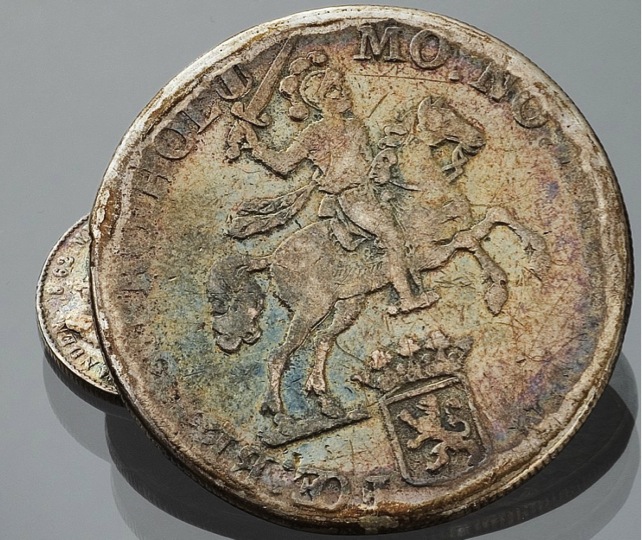
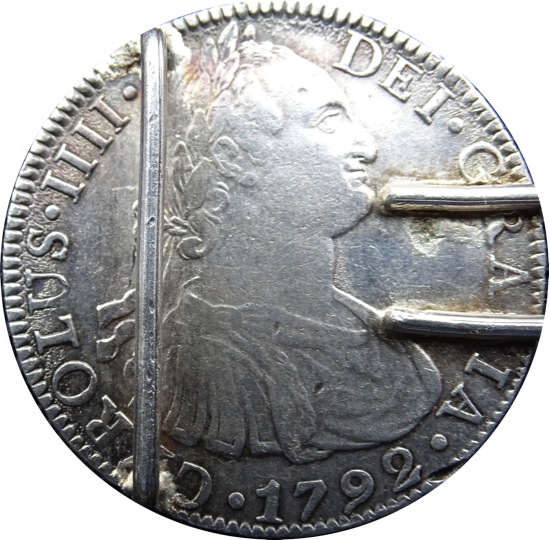
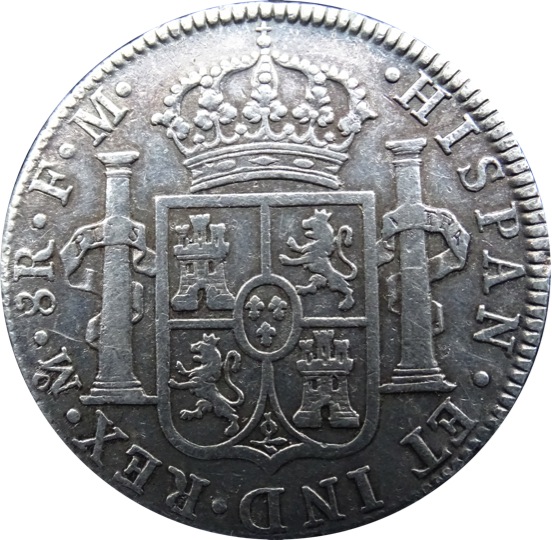
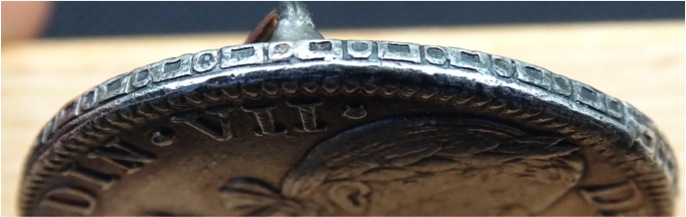
Today I made some better photo's of the pair of 8 reales, described by the seller to originate from another area than Volendam, and made as buckle and hook type "broekstukken" (see photo at start of the thread).

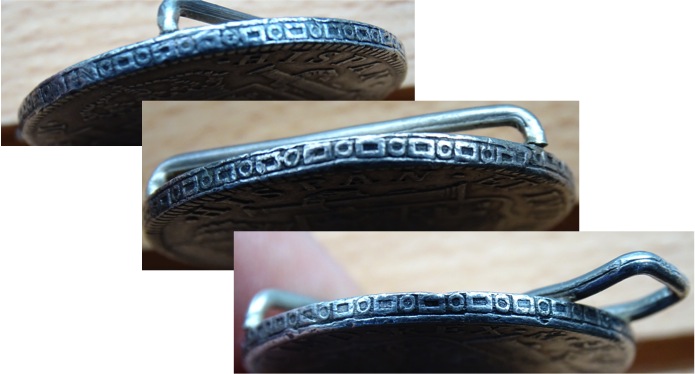
Here is the Charles IIII 1792 piece, with a few images of the egdes
unfortuntately there is no good picture of the second overlap as short as the first and 180° away on the circle of the edge

curious to know what you think of this piece


An-Odd-Pair-Of-Portrait-Eight-Reales

An-Odd-Pair-Of-Portrait-Eight-Reales
Pillar of the Community
Belgium
1185 Posts
 Posted 01/28/2018  5:14 pm  Show Profile   Bookmark this reply Add 1c5d7n5m to your friends list
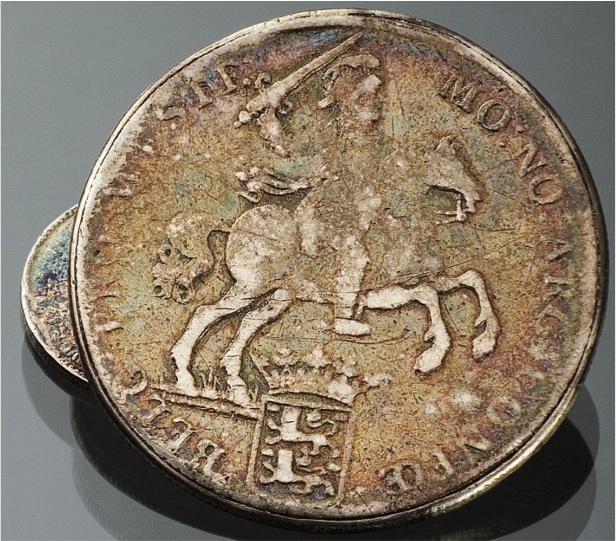
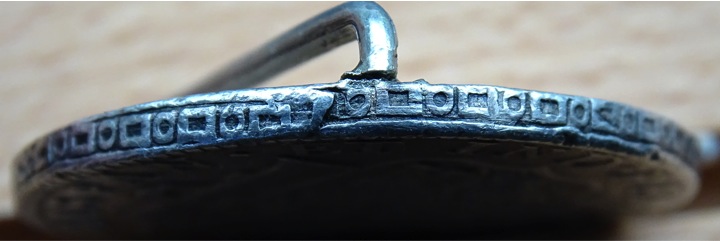
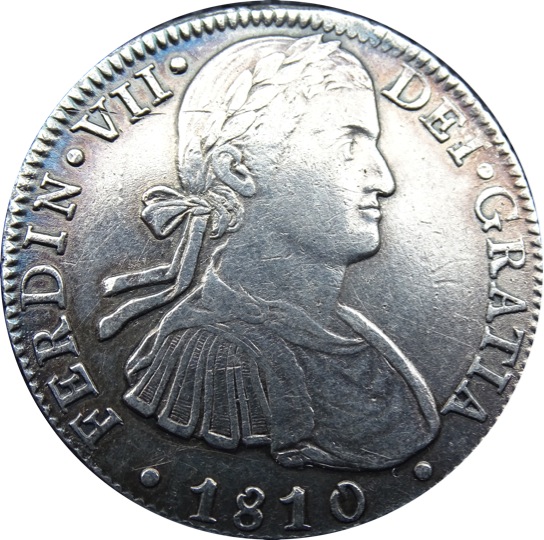
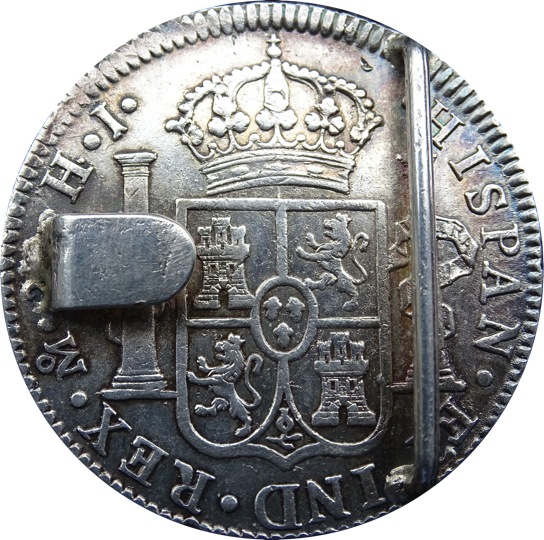
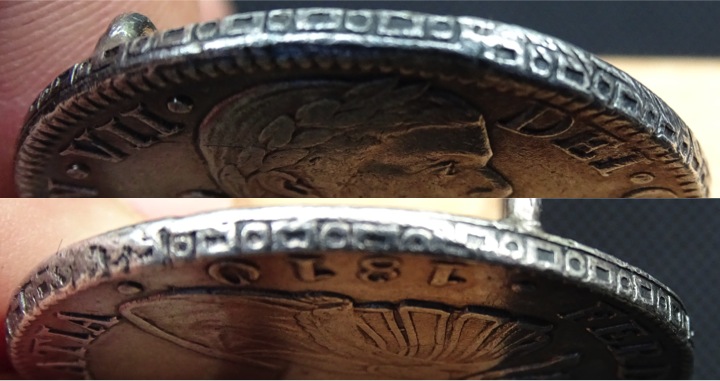
here are some pictures of the 1810 piece of the strange 8R pair
overlaps are both quite long and exactly 180° degrees apart

curious to know it they are frauds, counterfeits of perhaps genuine
whatever the "outcome": this pair of strange 8 reales brought me far away from the small area of numismatics I know something about => as I wrote above, my ignorance about this pair brought me to the wisdom here at CCF


An-Odd-Pair-Of-Portrait-Eight-Reales
Pillar of the Community
United States
5362 Posts
 Posted 02/02/2018  01:59 am  Show Profile   Bookmark this reply Add swamperbob to your friends list
1c5d7n5m The pictures came out nice. I believe both coin will fall into the general category of probable Class 2 silver counterfeits. These are trade restrikes made several places (including the Netherlands and UK) for trade in China.

The manufacture of counterfeit 8Rs to meet Chinese demand started in roughly 1789 in China where the local officials commissioned Silver artisans to make replica 8Rs to feed the demand for them in the inland markets where they were trusted more than other dollar sized coins. The premium then was about 5% over silver content. The Chinese versions were said to be crude and they were withdrawn when the makers started using debased silver. There is no known method of absolutely identifying these counterfeits because no examples were documented at the time with identifying characteristics. I own several super crude Charles III counterfeits that I would love to prove are this early Chinese type.

In until about 1820 the existing supply of 8Rs made before the adoption of the Ferdinand VII coin design (with the thin face and thin ribbons) were adequate to meet demand. By 1800 the word market traded at a 4% premium for so called Carolus dollars and money dealers bought up high grade Mexican 8Rs.

After 1820 and certainly before 1830, the UK began making their own copies. These used an alloy of between 850 and 900 fine silver because 850 was the limit to pass a specific gravity test (standard test for The Royal Mint). This about the level of detection available today with most common scales. (Typical accuracy is in the range of 0.2% of the weight being measured and this gives about a 50 point +/- range vs 903 fine.

In 1835 the British at Canton detected sub 850 fine restrikes in circulation. They suspected the Chinese but had no real proof of origin. Other suspects were the traders from the Netherlands and Spain. (The US was not yet involved). The British did not mind trading with their own 850+ coins but were concerned they might take lower value restrikes accidentally. So they introduced Specific Gravity testing to the Chinese Schroffs (money testers) so that the debased coins under 850 could be eliminated from circulation. At the time the premium on Charles 8Rs was 16-20% over silver value. This made importing counterfeits profitable even if they contained the correct weight of silver.

As the balance of payments with the UK shifted in favor of the Chinese (growing to millions of dollars per year) the demand for the more valuable Mexican 8Rs increased. The fact was the Chinese did NOT accept gold in payment only silver. There was an abortive effort in the 1830s to substitute the Republic of Mexico Cap and Ray 8R but it failed to get inland support. In particular the branch mint coins were found to have poor tolerances and traded below face value. The Portrait 8R premium rose to 25% while the C&R premium sat near 4% for those made at Mexico City. The 4% paid shipping costs. England increased output of 8Rs until they reached a financial breaking point in 1839. The solution seemed to be importing opium to China (a trade banned by China) to reduce the $30,000,000 per year deficit. Two wars resulted - the Opium Wars - and England forced China to accept the opium trade. The deficit plummeted and England got out of the 8R making business in large part after 1850. Other countries did not stop however.

In 1873 large silver discoveries in the western US led to a silver glut on world markets. The US made silver coinage a token coinage in 1873 (under full value silver). Germany abandoned silver as a monetary metal and went to a gold standard. Silver became a commodity not money. In the US the glut was particularly bad. There was no market to sell the silver from US mines and the Trade dollar coin made for China was a failure. So the US faced a significant deficit of payments by the late 1860s. In 1869 the US Congress tried to make an agreement with Mexico to produce the old 8Rs. The deal failed only when Mexico demanded a 15% commission. There still was a Chinese premium that averaged 25% but often fluctuated higher. The US turned to private industry and began minting the old Carolus dollars to ship to China secretly. By 1890 the demand was so acute that Massachusetts silver makers were enlisted (there had been a depression and the work was welcome). So the coins were made in Massachusetts from bullion shipped east, traveled by rail to California (San Francisco) and went by clipper ship to China. The cost was under 5 cents a coin over silver leaving a 20% pure profit for the makers.

This business continued for decades in my own hometown. Several of my relatives worked at the plant and made 8Rs. My uncle introduced me to one of the remaining makers in the 1960s. The old man lived until about 1970 and had made Carolus dollars in the 1920s and 1930s. After the China demand dropped off after 1930 some of the operation he ran started making US Morgan dollars. This was illegal but it was the depression. The man saw no problem with making the coins because they used the correct amount of silver in the copies - "so who was harmed?" He did tell me (sometime between 1965-69) that they had only made a few die errors on Morgans that he knew of. He warned me not to buy any "rare" Morgan error coins because they might be from New Bedford or Providence, RI. One particular error he told me about was using too small an O for the New Orleans mint mark. I didn't collect Morgans at the time so I didn't think too much about that, other than mint mark sizes were all the rage then. The micro s 1945 dime was very popular that year. I looked in the 20-30 Morgan dollars I had but no small O's. Then I kind of forgot about it.

The 8R coins (the old man still had a small box of them) were all dated to the reign of Charles IIII and many were dated 1805. He gave me one (1805) he said he had made it in the 1930s near the end of production. I took that coin to every coin dealer I knew and they all said it was a genuine 8R. Worth a few dollars. Weight was perfect and specific gravity was 10.30 to 10.31 virtually perfect every time I tested it.

So for years (1960-1995) I didn't know if the story was true or not. I studied the coin in great detail and did notice some minor issues - odd looking small lumps on the die surfaces - crazing of the surface from poor annealing - an odd rather bad looking edge with diagonal cut marks on half the edge. I began studying other 8 reales and found many of the features to be rather common.

About 1990 I was first exposed to laboratory level XRF testing at a Nuclear power station laboratory. I brought that dollar in along with many counterfeit and genuine 8Rs. Tests showed the 1805 coin was the correct alloy of silver and copper. The tests on my other Mexican coins, particularly the early Go and Zs coins showed what I thought were odd results - there was gold in them. I had one 1838 Go coin that contained almost 3% gold. So I started researching silver contaminants to see if gold should be there.

In the later 1990s I began hearing stories of a rare Morgan dollar with a small o mint mark that might be a forgery. Later an article in Coin World (referred to above) mentioned the failed contract of 1869 between the US and Mexico to make 8Rs for the China trade. Both stories resonated with me and caused me to dig out my old data.

To make a long story longer, by 1998 the micro-O dollars were being denounced as forgeries made in US in the 1930s. Also by that time museum forensic tests were being done which based authentication of rare South and Central American silver articles on trace contaminant levels of elements including arsenic and gold. Crandall published a book that indicated flatly that all old Mexican silver was contaminated with gold. I also discovered that in 1805 the vast majority of the silver used in Mexico City to make 8Rs came from La Valenciana mine in Guanajuato. That was a mine noted for HIGH gold content. This led to the obvious question how did the Mexicans get the gold out of the silver? I read that silver and gold are mutually soluble in each other. That is actually an uncommon trait. Parting gold and silver economically requires advanced methods that (while understood in 1800) were not cost effective especially in Mexico. Mexico lacked fuel for repeated cupellation and they also lacked raw materials needed to create acids to part the metals. So purity of silver in 1805 in Mexico could include up to 1-2% gold. It was not worth removing smaller amounts.

Eurika - test my 1805 for gold.

All tests using XRF before 2011 resulted in NO GOLD being discovered in my coin. XRF of test borings done on the grounds of La Valenciana (done by the current owners in the early 2000's show that all silver ore in the vein contains more than 1/2 of one percent gold and most show gold in the 3-8% region. Some but not all could be extracted economically.

For absolute full disclosure in 2013 I had my 1805 coin tested in RTI Labs in Durham, NC using their newest state of the art testing apparatus. (This coin has now been x-rayed more than most people.) The RTI instrument can detect levels as low as 1 PPM of all elements from Carbon to Uranium. The new results show a gold trace at 120 ppm (0.012%). That is simply too low a concentration of gold for the coin to have been made in Mexico in 1805. In fact it is too low for coins made in the US where adequate fuel and acid were available. Gold could not be purified to 0.9999 fine at any time on an industrially economical scale before 1850 and silver did not reach that same purity level until the twentieth century. So my 1805 8R was made sometime after 1900 when 0.999+ fine silver was possible.

I prefer to think it was made in 1930 in New Bedford, Mass (my home town) just as my old friend said he did.

This story was related because I believe that based on visual clues similar to the 8R I own and other similar coins confirmed to contain NO gold (about 100 coins) that both of your 8Rs also fall into this very common category. They have visual features that are often seen on coins that ultimately test as products of the last half of the nineteenth century or later. In my book written in 2011 to 2013, I listed about 20 visual clues that often point to the possibility of a coin being a Class 2 Silver Trade Counterfeit. These clues are not infallible when isolated but the more examples your coin possesses the more I believe it is at least a candidate for XRF testing.

Do you have to spend $500 (the cost of the 1 ppm test unless you happen to know a lab tech) to prove it? NO. You do not need that level of accuracy at all. I did it so that I would remove all doubt about my 1805 coin. A cheap hand held XRF tester used in any advanced coin shop, jewelry store or even junk yard can detect gold contamination at 1000 ppm (0.001 or 0.1%). Museum tests now use between 0.3% and 0.4% as lower limits to authenticate a period antique. That is well within the range of the typical handheld XRF. Tests using them cost $10 or less. The results you get for silver and copper from these tests are relatively worthless but the gold reading is not. Gold being a much denser metal returns a detectable signal from about 100 microns far deep enough to penetrate the deepest tarnish and fire scale layers on an uncleaned coin.

So if you get an XRF reading of 0.5% you MAY have a genuine coin from Mexico made before 1850. Remember this test only provides certainty that a coin with NO or LOW gold was made after 1850. You could still have a fake made last week using old silver reclaimed from melted Mexican culls. The test spots Class 2 Counterfeits.

There is also an upper limit to the gold content as well. no mint (unless operating under stress) will make a coin containing economically recoverable gold. That upper limit is not yet published because it varies by period and mint but suffice it to say that a level of say 5% gold would make me sure it was a fake and likely made with silver where gold was added intentionally. The silver used could also come from reclaimed telecom or computer scrap. The key to those coins is testing for superconducting elements that are difficult to take out of recovered silver.

The wire connectors in the pictures show clearly a lengthwise line running on the wires. Old wire ca 1800 was made at times by pulling slit stock through a progressively smaller die. The line in that case is a seam where the metal folds back onto itself as it is pulled through an ever decreasing sized die. I have read that in old wires made using this method the seam line should twist in one direction. I could not locate a picture of the feature but a straight line like I see here looks more like an extruded wire made in a more modern factory.

Pillar of the Community
Belgium
1185 Posts
 Posted 02/02/2018  4:10 pm  Show Profile   Bookmark this reply Add 1c5d7n5m to your friends list
swamperbob: thanks for a detailed assessment of an "an odd pair of eight reales" and thanks for a great explanation of why type 2 counterfeits were made in the first place and how such coins influenced your interest of collecting.

I agree with the main conclusion of this pair. Before I started posting on CCF, there was my vague concern that this odd pair of 8R maybe was not as authentic as the auctioneer had claimed in the description. This is why I started digging for clues and it was not difficult to find this forum. It was great to learn (in other and the present thread) about 1 or 2 die edge overlaps, diagonal lines on die edges, tiny lumps of extra material on the surface of the coin; and many other tiny details that together make sense. This pair of counterfeits seems well done and even quite attractive (apart from the brutal damage done by the clips). It has been sold at least a couple of times before I bought it and nobody noticed it. So the general outcome of this " odd pair of eight reales" is that I learned an important lesson without too high tuition fees.

But there is a slightly darker side on this pair of coins. As illustrated in the two examples of Volendam "klepstukken" with casted fake ducatons, counterfeits have diffused into musea unnoticed, and are described as authentic. When faked and yet slabbed, the error made is even worse. If many well made attractive modern counterfeits dilute authentic coins, it will hurt the field of numismatics. I have no idea what can be done against this trend.


Edited by 1c5d7n5m
02/02/2018 4:11 pm
Page 2 of 2   Previous TopicReplies: 20 / Views: 5,017Next Topic Page 2 of 2
First Page  Showing last 15 replies.
To participate in the forum you must log in or register.


Disclaimer: While a tremendous amount of effort goes into ensuring the accuracy of the information contained in this site, Coin Community assumes no liability for errors. Copyright 2005 - 2026 Coin Community Family- all rights reserved worldwide. Use of any images or content on this website without prior written permission of Coin Community or the original lender is strictly prohibited.
Contact Us  |  Advertise Here  |  Privacy Policy / Terms of Use

Coin Community Forum © 2005 - 2026 Coin Community Forums
It took 0.59 seconds to rattle this change. Forums