| Author |
 Replies: 24 / Views: 7,564 Replies: 24 / Views: 7,564 |
Page 2 of 2
|
|
|
|
Valued Member
 Belgium
54 Posts |
Managed to get a picture done. Different condition and freehanded macro but good enough to see the difference. Especially noticeable around the edges of the monogram (dark greyish spots). 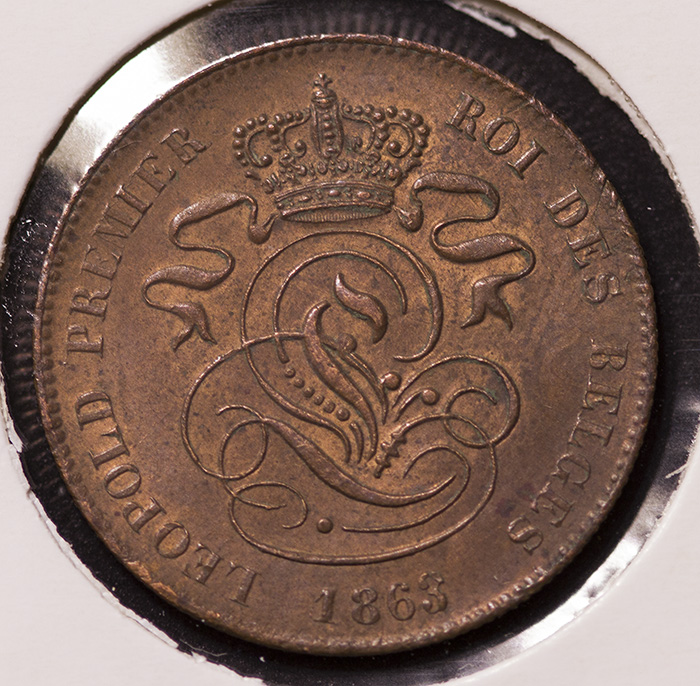 |
|
Valued Member
Australia
370 Posts |
In my opinion the original looks much better than the "cleaned" version. It now looks just like a cleaned coin.
I would not have used acetone on it.
|
|
Valued Member
Belgium
54 Posts |
That's something you don't know in advance unfortunately
|
|
CCF Advertiser
United States
1533 Posts |
A trick that some people would do when selling copper with some minor residue on it is rub a small amount of olive oil on the coins. This soaks into the residue and makes it dark while making the surfaces glossy. Of course an acetone bath removes the oil and then the residue stands out.
|
|
Rest in Peace
United States
18456 Posts |
Your coin before the Acetone soak was nicely toned brown .
That's good ,no problem . I would have used just Verdi-care on it probably with great results .
|
|
Moderator
 Australia
17006 Posts |
Acetone never discolours bronze coins under normal use (if you're soaking coins for 18 hours, and letting the acetone all evaporate away, then sorry, but you're doing it wrong). What acetone can do, however, is reveal damage that has been done in the past and has attempted to be hidden, as Andrew99 suggests. If the coin now "looks cleaned", then I suspect it actually was cleaned by a previous owner, perhaps treated using oil, verdi-care, or something similar. The acetone has removed the cleaning agent, showing the true nature of the coin.
The nature of the grey deposit cannot be determined by the pic, but it is one of two possibilities: "dirt" (which should eventually come off with distilled water and acetone rinses) or "corrosion" (which isn't going to come off without harsh chemicals that will destroy the coin). If the coin has actually been previously cleaned, then I'm afraid the likeliest answer is "corrosion" - whoever did the cleaning tried to remove the corrosion from the coin, but whatever they used to clean it didn't get down into these recessed areas of the coin.
Don't say "infinitely" when you mean "very"; otherwise, you'll have no word left when you want to talk about something really infinite. - C. S. Lewis
|
|
Valued Member
Belgium
54 Posts |
Thank you for the suggestions. I'll try a distilled water rinse this week. Not much of a gamebreaker if its corrosion since I didn't pay much for the lot but nevertheless...
Edited by jagoedo
03/19/2018 02:00 am
|
|
Moderator
Canada
10477 Posts |
I have examples of Canadian small cent George VI specimen strikes, in PCGS holders (no less) and within 5 seconds of looking at the coin, I knew it was acetone soaked. Specimen strikes are different animals though, the surfaces of those fields are like mirrors (equivalent to early US proof strikes of 1-cent coins)... the effect on the mirror fields leaves a "gasoline on water" appearance to the coin's mirror surfaces, and halos around the devices.
I have a few examples in my collection, including a 1950 specimen strike that became a "sacrificial lamb". I'll try to remember and post a few photos later this week.
"Discovery follows discovery, each both raising and answering questions, each ending a long search, and each providing the new instruments for a new search." -- J. Robert OppenheimerContent of this post is licensed under a Creative Commons Attribution-NonCommercial 3.0 Unported License. See: http://creativecommons.org/licenses...0/deed.en_USMy eBay store
|
|
Valued Member
Belgium
54 Posts |
Quote:
A trick that some people would do when selling copper with some minor residue on it is rub a small amount of olive oil on the coins. This soaks into the residue and makes it dark while making the surfaces glossy. Of course an acetone bath removes the oil and then the residue stands out. How do TPG's react to this kind of "manipulation"? |
|
CCF Advertiser
United States
1533 Posts |
^ If they detect it, they will return it as non-gradable, as it could deteriorate further in the slab. I got taken this way once 20 years ago with a nice, glossy large cent that a quick acetone dip revealed hidden green in the recesses.
|
|
Moderator
United States
196572 Posts |
After soaking in acetone, did you give the a rinse with fresh acetone? If not, whatever the acetone removed will just redeposit on the coin after it evaporates.
|
|
Valued Member
Belgium
54 Posts |
Quote:
After soaking in acetone, did you give the a rinse with fresh acetone? If not, whatever the acetone removed will just redeposit on the coin after it evaporates. Of course. I'll post an update later this week. |
|
Moderator
United States
196572 Posts |
Thank you for the clarification.  I really did not want to assume, but did feel a need to point this out to those who may not realize the importance. |
|
Valued Member
Belgium
54 Posts |
Well, I couldn't really get rid of the dullness but it became much less visible after a few additional baths which is good. It's not perfect but it means the hunt for te perfect example is still on :)
Thanks for the wonderfull insights and tips.
Really love this community!
|
|
Moderator
United States
196572 Posts |
Happy to have you here.  |
|
Page 2 of 2
|
Replies: 24 / Views: 7,564 |
Page 2 of 2
|







 First Page
 Posted 03/18/2018 3:53 pm





