| Author |
 Replies: 16 / Views: 2,904 Replies: 16 / Views: 2,904 |
Page 2 of 2
|
|
|
|
Moderator
 United States
34570 Posts |
@ikuna, first welcome to CCF. Second, yes please attached pics of both sides of the coin to this thread so that we can help you.
"If you climb a good tree, you get a push."
-----Ghanaian proverb
"The danger we all now face is distinguishing between what is authentic and what is performed."
-----King Adz
|
|
Pillar of the Community
Canada
695 Posts |
|
|
Valued Member
 Trinidad And Tobago
490 Posts |
|
|
Valued Member
Trinidad And Tobago
490 Posts |
 uploaded/ikuna/20180318_C2.jpg[/img |
|
Valued Member
Trinidad And Tobago
490 Posts |
|
|
Moderator
United States
34570 Posts |
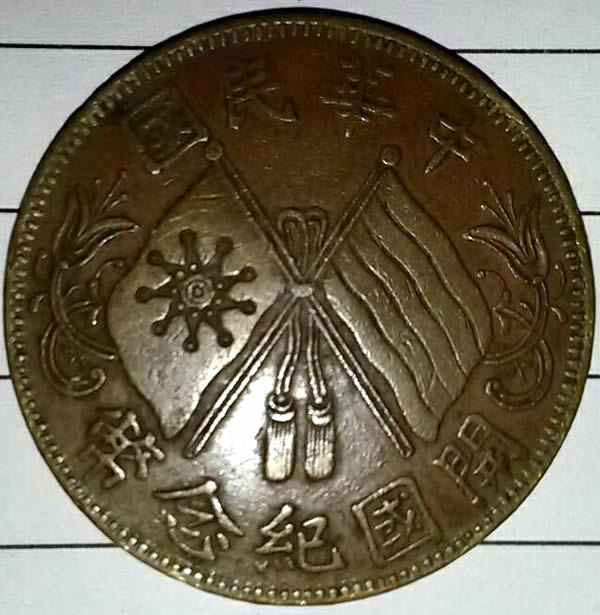
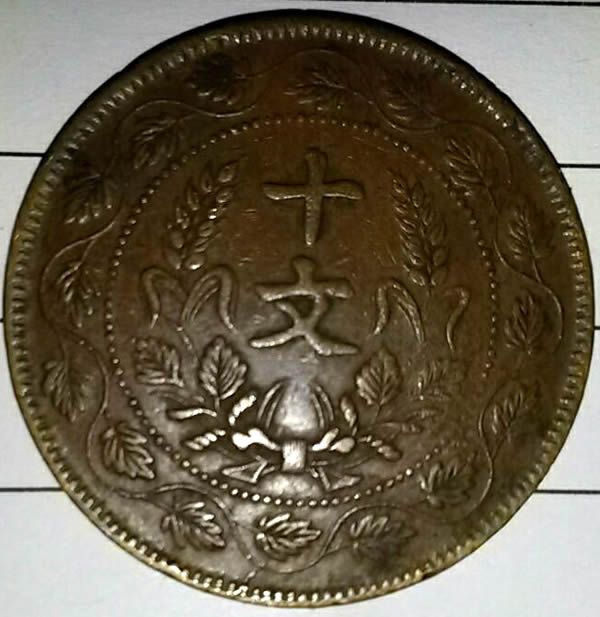
Ok yes, it looks like @aiglet7 nailed it. You have a 10 cash from China that dates to about 1920 AD. Very nice!
"If you climb a good tree, you get a push."
-----Ghanaian proverb
"The danger we all now face is distinguishing between what is authentic and what is performed."
-----King Adz
|
|
Moderator
Australia
17030 Posts |
The star-flag-and-striped-flag design is only used on Republic-era coins, so any coin depicting them must date from before the founding of the Republic in 1911. Imperial-era coins all usually have a dragon on them.
These coins were made over a couple of decades of the early Republic at numerous mints. There are dozens of different types of ten-cash coins and thousands of varieties, from almost every province in the country. This coin does not bear a mintmark, date or province of origin; this was a deliberate design choice of the mint that made it, as they were probably made using a cheaper alloy and lighter than the official government standard allowed, in an unofficial attempt to save money. Mints in China at the time were not under direct central government control, but rather under the control of provincial governors and warlords and the whole process was mired in inefficiency and corruption.
Don't say "infinitely" when you mean "very"; otherwise, you'll have no word left when you want to talk about something really infinite. - C. S. Lewis
|
|
Pillar of the Community
Canada
695 Posts |
Possibly from the Kwangtung mint, located in Canton.It used machinery imported from Ralph Heaton & Sons of Birmingham, England. The leaf design shows up on Canadian cents of the Victorian era.
|
|
Valued Member
Trinidad And Tobago
490 Posts |
Does this coin have any real Numismatic Value?
|
|
Pillar of the Community
Singapore
631 Posts |
|
|
Valued Member
Trinidad And Tobago
490 Posts |
I just thought that the coin being all in Chinese with no date,no mint mark, no TEN CASH written on it nor the Province it was from made it kind of special.
Don't most common coins in that era have some or all of what this coin did not have ?
|
|
Moderator
United States
197800 Posts |
 to the Community! |
|
Pillar of the Community
 United States
6514 Posts |
Impressive aiglet7. Well done pre picture.  |
|
Valued Member
Trinidad And Tobago
490 Posts |
Thanks everyone for the warm welcome greetings. I hope to learn a lot from you guys.
Thanks again.
Ikuna
|
|
Moderator
Australia
17030 Posts |
Quote:
I just thought that the coin being all in Chinese with no date,no mint mark, no TEN CASH written on it nor the Province it was from made it kind of special.
Don't most common coins in that era have some or all of what this coin did not have ? Many do, but the most commonly encountered types do not. You will find them listed under "general issues" in the catalogues, although the purpose for omitting any indication of date or mintmark was not to produce a "general issue" coin for China as a whole, but rather, to produce a coin that people would not be able to tell which province made it. The monetary situation in early Republican China was complex and chaotic, as I said earlier. Central control was non-existent; the provincial mints could in effect be considered as mints from separate countries. Many provinces passed laws and edicts that only coins of their own province would be accepted as legal tender for full face value; coins of other provinces would be accepted only at a discount (say, 300 cents to a dollar) or were rejected outright. For criminally-inclined warlords who were making money by melting down heavy coinage of neighbouring provinces and using the metal to strike coins of their own that were more lightweight, this posed a problem: how to get people in neighbouring provinces to accept your coins, if the governments of those provinces were actively discouraging it? The answer: hide the origin of the coin, to try to trick people into accepting them. It was not all that much different from officially sanctioned counterfeiting. The goal was the same: to try to fool ordinary people into accepting a coin that was worthless, or worth less than the face value stated on it. Don't say "infinitely" when you mean "very"; otherwise, you'll have no word left when you want to talk about something really infinite. - C. S. Lewis
|
|
Page 2 of 2
|
Replies: 16 / Views: 2,904 |
Page 2 of 2
|




 First Page


 Posted 03/18/2018 2:52 pm