| Author |
 Replies: 23 / Views: 3,324 Replies: 23 / Views: 3,324 |
Page 2 of 2
|
|
|
|
Pillar of the Community
 United States
8056 Posts |
How nice to be working part-time. I can spend endless hours on CCF!  Referring to the "Going back in time by decade" thread, antwerpen and I posted this type as well (p. 11, around Feb. 15, 2018). antwerpen gives a link to an online copy of Gaillard. The date ranges can be determined by the punctuation in the exterior and interior reverse legends. Yours looks similar to mine (three dots punctuation exterior, and leaves or branches interior) Gaillard 223, dated at 1373-77 (later edit: late 1360s). Antwerpen's has trefoils punctuating he interior legend rev., and is Gaillard 224. But others can check if that's right Edited by tdziemia
12/03/2018 4:55 pm
|
|
Bedrock of the Community
United States
37201 Posts |
|
|
Pillar of the Community
United States
8056 Posts |
Edited by tdziemia
12/03/2018 4:57 pm
|
|
Moderator
  United States
34562 Posts |
You rock @tdz! Thanks for this info.
"If you climb a good tree, you get a push."
-----Ghanaian proverb
"The danger we all now face is distinguishing between what is authentic and what is performed."
-----King Adz
|
|
Pillar of the Community
United States
8056 Posts |
Well, being a dog lover, you also rock with the cat and paper bag comment in the OP. I read that out loud here, and we got a major chuckle.
Though I think it's a lion with a helmet, and the crown on top of the helmet.
(And, for the record, yours truly DID use a paper bag with cutouts as a medieval helmet for Halloween perhaps 50 years ago).
Edited by tdziemia
12/03/2018 8:00 pm
|
|
Valued Member
Netherlands
91 Posts |
Awesome coin Spence! In the Dutch market, these botdragers are amongst the most common Dutch late-medieval silver pieces you can find, only to be beaten by the Leeuwengroten from the ruler by the same name, but can be extremely pretty with their large flan size and pretty design. The term 'botdrager' (in Middle-Dutch often spelled as Botdreger, Boddreger or boudrager) is fairly difficult to translate and how it became known as the name for a denomination is quite funny. Sadly I must disappoint you by telling you that this specific type, while having been called 'Botdrager' by the numismatic community for at least a century, sadly is not actually a botdrager! Multiple books and articles have tried to correct this mistake, but it seems to continue to this day. The true botdrager was not introduced until 1389; roughly five years after the death of Louis. These were rather called Plaques, Dubbele groten (double groats) or Lion d'argent (silver lion). The true botdragers (see image below) were first issued by Louis' successor, Phillip the Bold, and were called botdragers because of their obverse image. In it we see a rather similar lion, wearing a sort of 'cape' with the coat of arms on it. If we dissect the word 'botdrager', we see two words: Bot and Drager. Drager translates to 'wearer' and Bot is an archaic term for a special type of woven basket worn on the back; the cape apparently reminded people of this phenomena, and the name stuck and was even put in 'official' documents.  To further expand upon the information provided by tdziemia: - 1st emission: Gent, 28/03/1365 untill 11/12/1367 (I'm using d/m/y in case that wasn't clear). 14.583.450 pieces struck. Exterior legend punctuation: 3 dots, interior parsley. Round-backed E's. - 2nd emission: Gent, 21/01/1368 untill 18/06/1368. 1.353.750 pieces struck. Exterior legend punctuation 3 dots, Clover instead of parsley punctuation on the interior legend. Round-backed E's. - 3rd emission: Gent, 18/06/1368 untill 09/08/1369. 7.987.125 pieces struck. Exterior legend punctuation 3 dots, Clover punctuation on the interior legend. Acute-backed E's. - 4th emission: Gent, 18/06/1373 untill 27/06/1377. 5.721.375 pieces struck. Exterior legend punctuation: two dots instead of three, Clover punctuation on the interior legend. Round-backed E's again. - 5th emission: Mechelen, 30/01/1380-11/09/1383: 6.502.670 pieces struck. Exterior legend punctuation: two dots instead of three, Clover punctuation on the interior legend. Acute-backed E's again. -(6th emission: Mechelen, 12/09/1383 untill 29/02/1384. 797.500 pieces struck. A somewhat obscure emission with only limited specimens produced, sometimes grouped under the fifth. Usually specimens with lacking interpunction are put here, but this is a highly debated group.) All of these data are derived from administrative documents from the mint that somehow survived and have been carefully studied by numismatists over the past few decades. But keep in mind that these are rough estimates based on the amount of silver processed; the actual amount produced will likely vary by a few handful. Every 3-4 months the mint would report and file a document, meaning we have data on mint-output quite frequently! Some of these numbers are quite staggering. Between 28/3/1365 and 28/6/1365, the first period in which these were minted, the output was no less than 1.932.300 coins for this type alone! That's more than 21.000 coins PER DAY! Your piece belongs to this first emission; Parsley, three dots and round-backed E's. If you really wanna browse Gaillard: https://archive.org/details/recherc...es00gailuoft . But there are a few more up-to-date references for this type! Edited by AnYangMan
12/04/2018 1:55 pm
|
|
Pillar of the Community
2087 Posts |
I definitely want to do some digging about this issue. My speculative take. Groot is obviously from Grosso and its weight( reported by some else in the thread )being around 3.5-3.8 grams really matches up to the Gros Tornois( in Size also). Given the date range and that it was minted in the low countries I would be surprised if it were not part of the Gros Tornois family.
|
|
Pillar of the Community
United States
8056 Posts |
@austrokiwi, I agree this coin should relate to the gros tournois family. The face value is 2 gros (dubbel groot, or as described in Gaillard, "lion d'argent deux gros").
I think by 1360-1380 the French gros tournois may be lower than 4 g. in mass? But the comparisons across time and/or countries are always complicated by the issue of silver content of the coins. As this was during the 100 years' war (not sure what this is called on the continent) there is also the angle of debasment of the denomination in some countries that needed cash to pay their armies...
But I think you've researched this quite deeply already, so it will be interesting to hear your findings and thoughts.
|
|
Moderator
United States
34562 Posts |
@aym, thanks for making me smarter!
"If you climb a good tree, you get a push."
-----Ghanaian proverb
"The danger we all now face is distinguishing between what is authentic and what is performed."
-----King Adz
|
|
Pillar of the Community
2087 Posts |
Quote:
I think I might have found a match for your coin. One is listed in "Coins of Medieval Europe by Philip Grierson" as a AR Plak of Louis II of Male Ghent, 31mm x 3.59g Gaillard 223. I became interested in the name Plak. Did a little digging and found in Freys Dictionary of Numismatic names some interesting info. Frey notes the French equivalent was Plaque. Annoyingly Frey doesn't explain why he thought it was important to point out the French Equivalent. When I go to his entry on Plaque he refers the reader back to Plak. Frey does state that there are a variety of Meanings for plak: " flat surface, a plate, a Shield, a piece of tin etc. I suspect the coin was called Plak due to the large diameter combined with it thinness( I am assuming it is a typical thin coin, perhaps it even got that name form the mint workers who produced it. I also expect( but would like it confirmed) that the blank had been cut from a sheet that had been produced by hand hammering( using flattening hammers) bar. It is easy to see this( for those who might not know) just examine the coin edge on. If the sheet had been produced by hammering the coin will be of uneven thickness. Although I have stated what I think Plak might refer to it is just as likely PLak referred to the design on the coin. Edited by austrokiwi
12/05/2018 03:31 am
|
|
Pillar of the Community
United States
8056 Posts |
I know that the plaque denomination was used in Lorraine starting at least as early as the 1340s (regency of Marie de Blois for Jean I), and running through the reign of Antoine (1540s).
It, too, is approximately 4 g.
I don't collect royal France, so I don't know if they had this denomination.
It wouldn't surprise me if the Flemish or Brabant tried to do something "bigger and better" at this point in their history to flaunt their wealth.
I guess this does not represent a major advance in minting technology, but I would guess it is the largest diameter coin issued in medieval times up to this point? Unless those innovative Venetians (or Milanese) already had something larger.
|
|
Pillar of the Community
United States
8056 Posts |
At the risk of "scope creep" here is a sampling of this general type in NW Europe late 14th c. for those still following (and a well known U.S. type for size reference). Upper left: Lorraine (Nancy mint), plaque (= 2 gros) Marie de Blois regency for Duke Jean I. 1346-48. Upper right: Flanders (Ghent mint), dubbele groot, same as OP's, 1365-67. Lower left: Brabant (Louvain mint), double gros, Duke Antoine 1406-15. 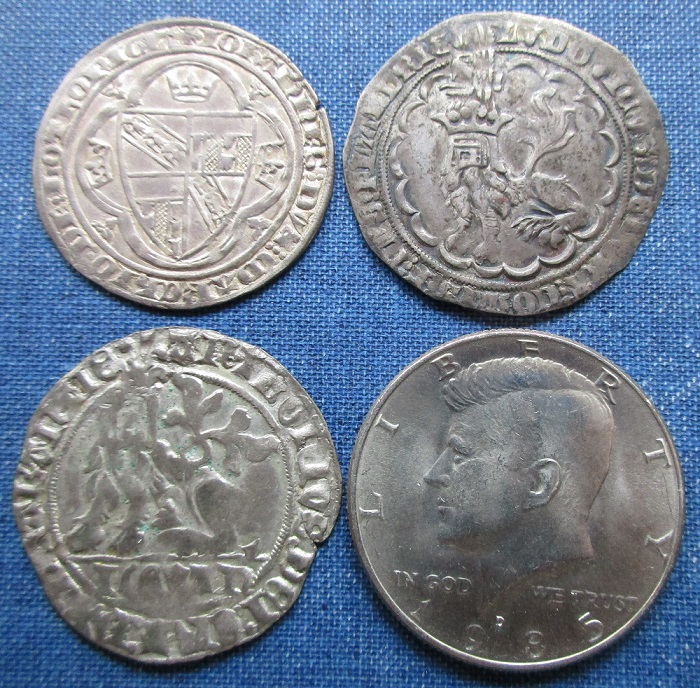 Edited by tdziemia
12/05/2018 3:19 pm
|
|
Pillar of the Community
United States
8056 Posts |
Quote:
@aym, thanks for making me smarter! That goes for all of us! We're now better able to attribute this type than CNG or Album, both of whom have sold Mechelen 5th emission coins in recent months without identifying the mint or the date range. (Elsen, of course, know their stuff, but still call it a botdrager). And for the OFEY gang, note that a 2d emission coin can be dated within a single year: 1368. Edited by tdziemia
12/05/2018 4:01 pm
|
|
Moderator
United States
34562 Posts |
Quote:
And for the OFEY gang, note that a 2d emission coin can be dated within a single year: 1368. noted! "If you climb a good tree, you get a push."
-----Ghanaian proverb
"The danger we all now face is distinguishing between what is authentic and what is performed."
-----King Adz
|
|
Pillar of the Community
2087 Posts |
I did a little more digging. Groot appears to relate to Grosso ( the Venitian coin of 2.18g) A gros tournois was just under twice the weight of the venitian coin and this coin was called a double Groot. Its quite an interesting relationship to me. I was so interested I even obtained an example for my self. When I compared it to the other coins in the "family"( that I have)namely, a gigilato, real and pragergroschen the dubble groot stands out in one way it is thinner and of larger diameter. It gives me the impression the Flanders mint wasn't as skilled as the other mints. Alternately they tried to make their coin look bigger than its competitors. You can see the issue with the thinner blank in the photo of my example, it can split on the rim when being struck.  Edited by austrokiwi
05/09/2019 01:15 am
|
|
Page 2 of 2
|
Replies: 23 / Views: 3,324 |
Page 2 of 2
|






 First Page


 Posted 12/03/2018 12:52 pm





