| Author |
 Replies: 23 / Views: 4,146 Replies: 23 / Views: 4,146 |
Page 2 of 2
|
|
|
|
Bedrock of the Community
United States
12477 Posts |
That's a keeper to me.  That's some severe die abrasion showing on a coin. In Memory of Crazyb0 12-26-1951 to 7-27-2020
In Memory of Tootallious 3-31-1964 to 4-15-2020
In Memory of T-BOP 10-12-1949 to 1-19-2024
|
|
Pillar of the Community
United States
5887 Posts |
Nice one. Looks to be severe die polishing. Maybe trying to remove a clash like stated above. It's a keeper in my book!
-CH27
Collector of U.S. Coins, Varieties, and Colonial Coinage
|
|
Moderator
 United States
56855 Posts |
Very interesting find,I would 2x2 it for sure. John1  |
|
Bedrock of the Community
United States
62064 Posts |
Feeder finger damaged. That's what it looks like on a dime.
|
|
Pillar of the Community
 United States
5888 Posts |
Thanks to all for the replies. Definitely saved to a Saflip.
First, in regards to the possible clashing, I would have expected clashing, and therefore the polishing as well, to show up on both surfaces since the gouging is so deep. But there is no clash marks on the obverse which is why I ruled out clashing, maybe erroneously.
To my way of thinking, an early die state example like this one would not have needed polishing for maintenance purposes either, which made me wonder why they would have.
Coops reply seems logical. So does that mean the feeder finger is moving in a slight arc as it swings past the coining chamber since the abrasion is deeper in the middle and tapers off as it passes the East and West areas of the gouge?
Thanks to all for helping me to understand the mechanics.
(Hopefully the gray matter upstairs will retain it for more than 37.8 seconds!  ) )
Words of encouragement are one of the major food groups.
We need to consume them regularly to thrive and grow.
|
|
Pillar of the Community
United States
987 Posts |
I always like die polish lines. They can show up and surprise you sometimes.
|
|
Bedrock of the Community
United States
62064 Posts |
Not the same as die polishing. 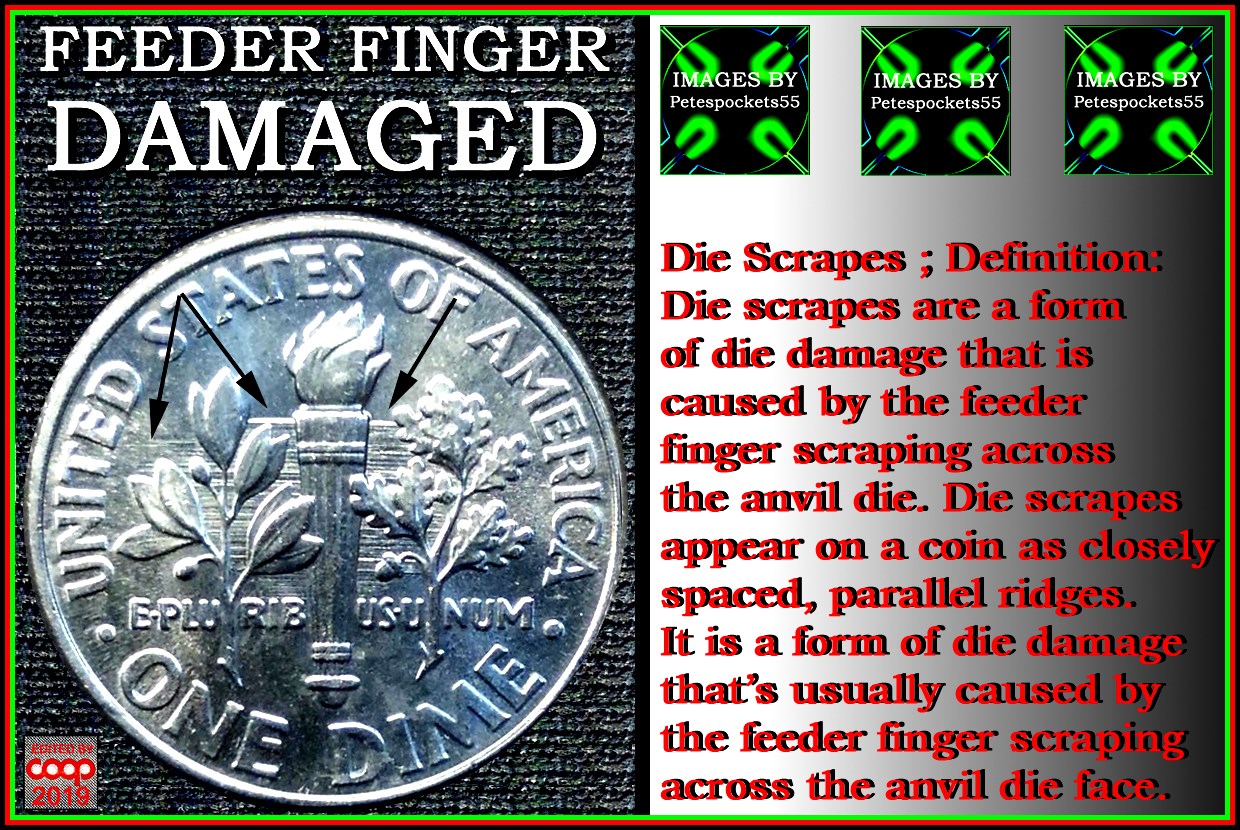 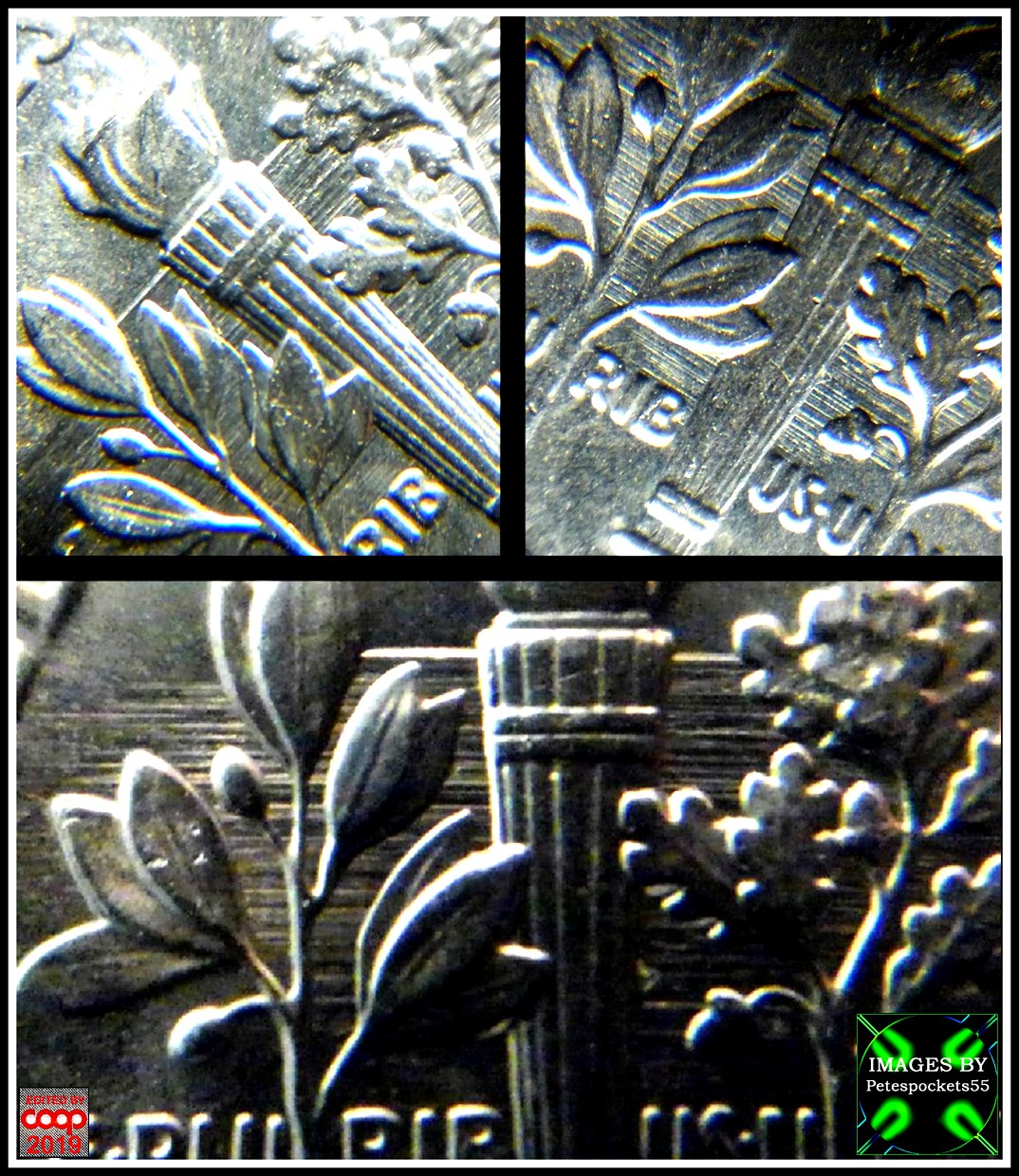 Die polishing is what they do to remove the problem with the damage to the die. Edited by coop
01/02/2019 4:21 pm
|
|
Pillar of the Community
United States
987 Posts |
|
|
Pillar of the Community
United States
5888 Posts |
Thank you very much Coop.
I'm familiar with them on the Lincoln series and now I know a little about dimes.
Words of encouragement are one of the major food groups.
We need to consume them regularly to thrive and grow.
|
|
Bedrock of the Community
United States
62064 Posts |
I spent the day looking for examples of Quarters with the Feeder Finger Damage, but didn't come up with any great examples, yet. But I did discover a one year event on the Proof quarters. It had a Type 'A' proof for just one year. But checked other sources, and they had already figured that out already. You learn something new everyday. |
|
Bedrock of the Community
United States
12477 Posts |
Thanks for the clarification, coop! I knew it was created at the Mint, but I completely forgot about feeder finger gouges and this definitely resembles that more than abrasion/polishing. In Memory of Crazyb0 12-26-1951 to 7-27-2020
In Memory of Tootallious 3-31-1964 to 4-15-2020
In Memory of T-BOP 10-12-1949 to 1-19-2024
|
|
Pillar of the Community
United States
5888 Posts |
Not trying to beat a dead horse here but I have a followup question regarding the feeder finger die damage. but I have a followup question regarding the feeder finger die damage.
Can anyone provide information on the mechanics and operation of the feeder fingers?
I'm just trying to understand how a flat piece of metal (feeder finger) traveling in a straight line would create a gouge that is deeper in the middle of the die face than towards the perimeter since the die face is flat?
Thanks again in advance for any and all help and info. CliffWords of encouragement are one of the major food groups.
We need to consume them regularly to thrive and grow.
Edited by Petespockets55
01/04/2019 06:43 am
|
|
Pillar of the Community
United States
853 Posts |
@coop Do you mind elaborating on the one year, type A proof reverse. I have never seen any info on this and would love to search for one of these. I am familiar with the 1952 proofs with Class 3 DDR (Type B/Type A or RDV-002/RDV-001 whichever you prefer), but not any with just a Type A yet. Thanks in advance! Link to the examples I am talking about: http://varietyvista.com/09b%20WQ%20...s%201952.htm |
|
Bedrock of the Community
United States
17884 Posts |
Quote:
So does that mean the feeder finger is moving in a slight arc as it swings past the coining chamber since the abrasion is deeper in the middle and tapers off as it passes the East and West areas of the gouge?
No, the die face is not completely flat, The die faces are very slightly convex. So the feed fingers as they move back and forth are making contact with the die toward the center but do not touch it out by the edges. The slight convexity of the dies means they contact the planchet first near the center this helps to force the metal outward to help fill the lettering around the edges. It is also one of the reasons the planchets are upset, because the edges of the dies are further apart than in the centers. |
|
Bedrock of the Community
United States
62064 Posts |
When I got back online, I'm adding a thread on this subject.
|
|
Page 2 of 2
|
Replies: 23 / Views: 4,146 |
Page 2 of 2
|







 First Page


 Posted 01/02/2019 02:35 am





