Coin Community Family of Web Sites Join Thousands of Coin, Bullion, & Money Collectors
Coin, Banknote and Medal Collectors's Online Mall Specializing in Modern Numismatics Royal Canadian Mint products, Canadian, Polish, American, and world coins and banknotes. Royal Estate Auctions - $1 Coin AuctionsVancouvers #1 Coin and Paper Money Dealer 300,000 items to help build your collection! Join Thousands of Coin, Bullion, & Money Collectors


Username:
Password:
Save Password
Forgot your Password?


This page may contain links that result in small commissions to keep this free site up and running.

Welcome Guest! Registering and/or logging in will remove the anchor (bottom) ads. It's Free!

1844 Go Pm 8 Reales - Counterfeit Or Real?

To participate in the forum you must log in or register.
First Page  Showing last 15 replies.
Author Previous TopicReplies: 21 / Views: 5,105Next Topic Page 2 of 2
Valued Member
United States
325 Posts
 Posted 03/17/2019  5:36 pm  Show Profile   Bookmark this reply Add Pauldog to your friends list
"Pauldog Sorry but PCGS simply lacks the expertise to authenticate Cap and Ray 8 Reales."

I learned something, more than one thing. If I get into these kinds of coins, I'll have to check out your book.

If PCGS is passing itself off as knowing enough to register one of these coins, it doesn't give me movitation to send anything to them. It reminds me of the very expensive fine art counterfeits that experts verify, and then some other experts debunk.
Edited by Pauldog
03/17/2019 5:45 pm
Pillar of the Community
United States
5362 Posts
 Posted 03/17/2019  6:16 pm  Show Profile   Bookmark this reply Add swamperbob to your friends list
Pauldog The person who submits a world coin to PCGS is the actual guarantor of authenticity. Only professional dealers can become members of PCGS and make submissions. It is taken as a "fact" that the submitter knows what he is doing. If a coin is later determined to be counterfeit - PCGS has the right to go back on the original submitter for compensation.

That may not be what the average party expects but that is often what happens.

NGC often will not certify 8 reales that are not in their database. In those cases, they have an appeal process to one of the "series experts". At one time for added compensation it was possible to have NGC send an 8R to Richard Ponterio for his opinion of authenticity. I know this to be the fact because I have done this.

ncsuwolf74 I agree it is nice to have a collector with similar interests nearby. We will have to get together and compare notes.

Regarding authentication of 8Rs, anyone who wants an opinion just ask. I will always do that - as long as I survive that is..
Valued Member
United States
414 Posts
 Posted 03/21/2019  11:48 am  Show Profile   Bookmark this reply Add cableguy815 to your friends list
To be honest, I have lost much of my respect for PCGS after the recent screw up I saw in the world crowns thread http://goccf.com/t/297914&whichpage=48). PCGS graded a 1 1/2 thaler and labeled it as 2 thalers. It is inconceivable to make such a mistake... the weight of a 1 1/2 thaler is MATERIALLY different from that of a double thaler, so to me it would seem like PCGS didn't even weigh the coin as part of their "authentication" process. It's one thing not to perform an XRF or even an SG test, but not to weigh the coin also? SHAME ON PCGS!
Pillar of the Community
United States
5362 Posts
 Posted 03/21/2019  6:37 pm  Show Profile   Bookmark this reply Add swamperbob to your friends list
cableguy815 You say:
Quote:
It's one thing not to perform an XRF or even an SG test, but not to weigh the coin also?


I checked with the 4 TPGs (the 4 acceptable to ebay) at the 2017 Winter F.U.N. Show and only ICG indicated that weighing foreign coins was done as part of an authenticity check (not always but sometimes). ICG is also the only TPG that will encapsulate and identify a Counterfeit Coin as it turns out.

cableguy815 I agree with you entirely. An accurate weight would eliminate many errors by the TPGs including 2 of the encapsulated 8 Reales I posted (based on comparable average weights for matching counterfeits). The TPG's do not do it because it is too time consuming. The most common answer.

I worked as a part time authenticator for several coin shops since I retired from the Telephone Company in 1997. I still do that on occasion as a call out service.

I also worked as a volunteer for ebay as a full time world coin authenticator. There I learned that it was absolutely possible to spot 95+% of counterfeits / forgeries from good photographs alone. I know that form of authentication is "frowned upon" but it does work as my bidding history with ebay would indicate.

The ebay job required considerable speed since I looked at a minimum of 1000 posts in the World Coin section ( ebay US) daily. I spent up to 8 hours doing that review, but I only targeted coins that were often forged not modern or common coins. When I had any suspicion, I slowed down and took my time (a few minutes). At ebay we did not have access to the coins nor their weight. We could and I did often contact the owner and asked questions (weight magnetism). To reject a coin required that we provide a specific reason to convince a majority of the voting members that the coin was bad (usually 3-5 votes).

When I am asked to authenticate a coin privately, I routinely weigh the coin on a 1/100 gram scale to start. I then check for magnetism. Then I do a visual microscopic inspection of all three die surfaces starting with the edge of the coin.

Then if any uncertainty exists, I perform a Specific Gravity measurement using a 1/1000 g balance. At this point I am usually sure of what I have 99+% of the time and I have spent no more than 10 minutes to do it.

So what should the average collector do?

Learn to authenticate scientifically for yourself.


Then follow the old adage to
Quote:
Buy the coin - not the Slab.
Pillar of the Community
United States
1915 Posts
 Posted 03/24/2019  3:20 pm  Show Profile   Bookmark this reply Add Albert to your friends list
It's remarkable that I now see here that my 1842Zs 8 Reales coin has the same die characteristics (cactus needle, wreath, bird tail) that swamperbob shows in this topic.
I see that detail now that I know to look for it and thank swamperbob for taking the time and interest to share what he has learned over a long time of careful study.
This next coin of interest is one I am thinking abut buying and is described as:
"1780-MoFF Silvered AE Contemporary COUNTERFEIT 8 Reales. Unlisted Gurney. Well made
machine struck. 25.59 gms. VF."
Pillar of the Community
United States
5362 Posts
 Posted 03/24/2019  5:11 pm  Show Profile   Bookmark this reply Add swamperbob to your friends list
Albert You say:


Quote:
1780-MoFF Silvered AE Contemporary COUNTERFEIT 8 Reales. Unlisted Gurney. Well made
machine struck. 25.59 gms. VF.


Do you have pictures of this item? I would like to see if I would have included the coin in my book or not. Unlisted in Gurney can point to a numismatic forgery, a simple casting, a damaged or altered original or anything else that I might not have listed.

I ask because 1780 is one of the years found on El Cazador and some people have tried to pass off these as Contemporary Counterfeits because they know the CC types bring more than shipwreck damaged coins from that particular wreck.

Regarding your 1842 Zs OM I am glad you see the differences.

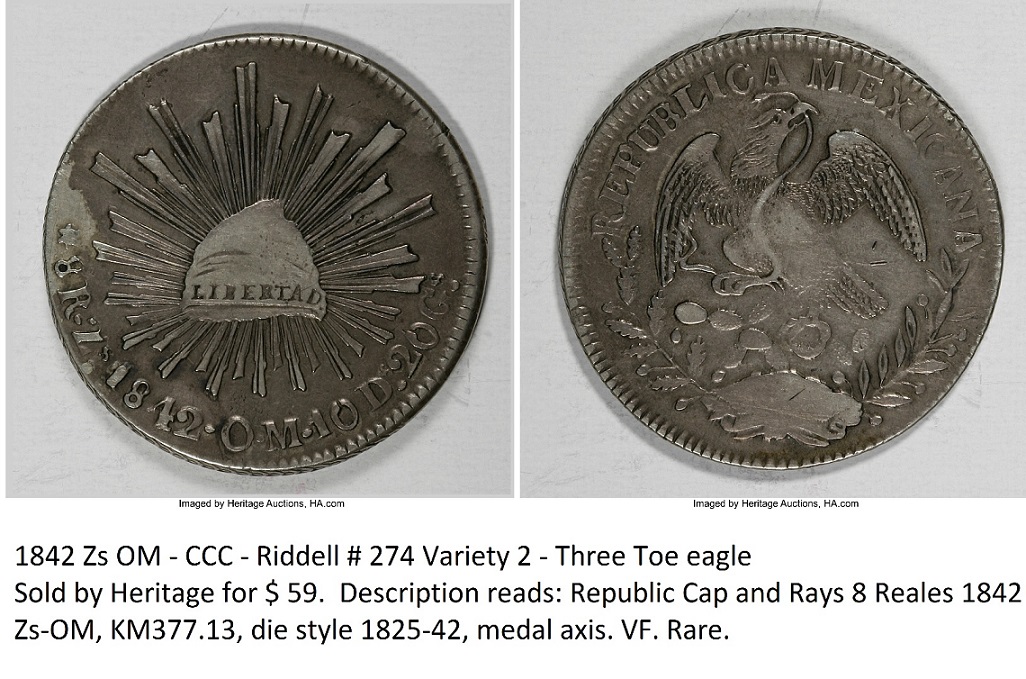
If you go to the Heritage Auctions website and search in their archive for "1842 Zs Mexico" - you will get 16 listings. All are 8 Reales. There are 14 that display the Type 2 Eagle (square tail). Only one has the rare type 1 eagle (rounded tail). But if you were not looking closely and believed the descriptions as written, there is a SECOND RARE type 1 (rounded tail). However, this is a Contemporary Circulating Counterfeit that Heritage sold for $59 as if it was genuine. To make matters MUCH worse they identified the coin in their description as the RARE variety the Type 1 (rounded tail). Here is the picture from their auction.

1844-Go-Pm-8-Reales---Counterfeit-Or-Real?

The tail is indeed rounded - but it is not genuine.

This is another Riddell family coin. The Riddell # 274 is a close relative to this coin and clearly uses some of the same die punches but BOTH dies are different. It is extremely common (for a counterfeit). I have seen a few hundred examples.

It is also another 5 second call. But only if you know precisely what an 1841 Zacatecas eagle punch looked like.

Why it ever got listed is quite frankly beyond me.

My caution is to always look at all the coins that you can find for a given year - do not presume that any coin in any auction is properly described.

This coin is also an exception to one of my "general rules" about counterfeits. The rule says that;
Quote:
Rare coins were rarely copied by contemporary counterfeiters


In this case just as in the case of your coin the counterfeiter, modeled his coin on the earlier type 1. To me this infers that it was part of a high output industrial operation who were making dies ahead of the time they were needed. They were in effect a private but illegal mint. Had they made the die in 1842 it is unlikely that they would have chosen a "round tail Eagle" coin for their model.
Pillar of the Community
United States
1915 Posts
 Posted 03/24/2019  6:07 pm  Show Profile   Bookmark this reply Add Albert to your friends list
Swamperbob,
I do not have pictures of the mentioned 1780 coin. I have to buy it to see it unless I can get the seller to send it on approval.
Now that you have seen my 1842 Zs, here is what the seller described:
"1842-ZsOM Contemporary COUNTERFEIT 8 Reales (struck in lower grade silver). As DP.Zs22
old die style (Rare). Bold VF, several raised "scratches" plus some actual scratches."

I wanted to add this coin because it looked like a nice new page in the binder and I wanted to make measures in order to know what his idea of "low grade silver" was. At the time I was not aware of the details regarding the tail, cactus & wreath leaf. I also did not know what "old die style" meant.
If I do get the 1780 coin I will certainly share it with you to see how correct or incorrectly it is described.
The education I got from your help on the Cap & Rays piece is well worth more that the $69 I paid for the coin. The 1780 coin price is $159, so I'm not sure what to make of that.

Updated info: The seller says that Mike Dunigan has seen this coin and says that although it is an excellent copy it is a counterfeit. And if not listed in Gurney, I am enthusiastic about getting it and sharing the data followed by a new page entry into the binder with weights, measures, photos and comments. The seller is sending it to me so please expect pictures within several days or so. Mike's book is one I plan to buy.
Edited by Albert
03/24/2019 11:04 pm
Pillar of the Community
United States
5362 Posts
 Posted 03/25/2019  12:17 am  Show Profile   Bookmark this reply Add swamperbob to your friends list
Albert The seller's description is informative as long as you know what he means by the terms he uses. He said:
Quote:
1842-ZsOM Contemporary COUNTERFEIT 8 Reales (struck in lower grade silver). As DP.Zs22
old die style (Rare). Bold VF, several raised "scratches" plus some actual scratches.


1. Contemporary Counterfeit (better stated as Contemporaneous Circulating Counterfeit) is a name typically assigned to those non-genuine coins that were intended to circulate alongside the genuine coins as monetary units in general commerce. The value may or may not be related to actual intrinsic metal value and includes non-genuine examples of fiat coinage. Contemporary is a word that causes confusion since contemporary often means Modern or at the current time. Coin collectors use it in the general sense of contemporaneous or coterminous circulation which means the counterfeit was made during the period of circulation of the genuine coin. For some types like the Portrait 8R or the Maria Theresa Taler that can mean a very extended period of time. The Portrait 8R was still used in general commerce in China until 1935, so it is possible to view an example of that coin made in 1930 as a legitimate CCC coin even though it would have been made 105 years after the last genuine Portrait 8R was made.

2. "Struck in lower grade silver" may not be a correct statement of fact. The 1842 Zs OM that you own was made over a period of time that covers several different potential alloys. Below are the primary categories of alloys seen in this family of counterfeits:

A. Cast or struck copies in grades of silver below 800 fine but normally exceeding 200 fine. These tend to be the oldest types seen in Riddell but they are scarce to rare in the family in question and were most likely melted long ago to recover the silver value. If your coin is actually low grade silver - you got a genuine bargain.

B. Struck Sheffield plate copies rarely exceed 200 fine in terms of total silver content but can approach a lower limit of 10 fine based on the thickness of the silver layer. Sheffield plate counterfeits made before 1835 used an almost pure copper core (technology introduced about 1780) and used onward until after the Civil War. Copper cores usually are associated with thicker silver plates to avoid wear through exposing a dark under-color. The technology can still be duplicated today but after German Silver was introduced in 1835, GS proved to be far superior metal for either the core or the entire coin.

C. Cast or struck base metal coins that are plated with a silver amalgam paste or some form of silver color like paint. These tend to have a grainy or flakey look in protected areas and can be identified by microscopic examination. These are very rare within this particular family. There are surviving copies struck in copper on which no trace of any plating remains - also VERY rare.

D. Sheffield plate struck copies silver over a German silver core starting 1835 are rather common.

E. Solid German Silver struck copies. These predominate as the method of choice after 1835 and MOST of the surviving members of this family are solid GS. There was no incentive to destroy these coins since they have a zero intrinsic value. They were kept in junk boxes and survived in great numbers.

F. Silver electroplating was introduced after 1840 but did not replace Sheffield plate as predominant until the 1850s or later. The plate produced is 100% pure silver which is unlike the Sheffield plate which used a variable thickness silver alloy near 900 fine. Electroplated coins are darker in color and lack the "soft warm whiteness" seen in 900 fine alloys. Silver electroplating occurred after the strike and is very thin. I have observed some members of this family that have been electroplated over an underlying silver coating to extend the period of circulation. These are not common but are not of significant extra value because they could be plated today to take advantage of a higher price. I would therefore view them as altered or damaged. I have never observed a version of any copy falling into this family that was originally made using an electro-plate directly on a base metal core.

3. DP Zs22 old die style (Rare) is a reference to the book "Resplandores" by Mike Dunnigan with co-author credit given to J.B.Parker the owner of the most complete set of Cap and Ray 8Rs ever assembled. Hence DP. The Zs22 is an example of the DP numbering system which begins with the mint mark and a number starting at 1. It changes with each variety. The method does not allow for new intervening varieties and there is no consensus on what to call these. The old die style refers to the "round tail" eagle or Type of 1841 as noted by NGC on slabs. Dunnigan rated the genuine coin as rare, the counterfeit version is far from rare.

4. The final statement "several raised "scratches" plus some actual scratches" is what you typically see when examining these counterfeit coins under magnification. Many of these have what appear to be raised lines and at the same time open scratches with exposed internal metal. The raised scratches are actual scratches that were made before the coin stopped circulating. Circulation after a GS coin is scratched often makes the old scratch look like a raised line (a die scratch). However, I have observed many of these and when magnified to 100X or more all the examples I have examined are simply scratches that have been closed by the effects of circulation. I see this as a clue that these GS coins were scratched tested over a fairly long period of circulation. I suspect that the seller is simply stating what he sees not what actually happened to the coin.

Hope that helps to evaluate the description of the owner.

Pillar of the Community
United States
1915 Posts
 Posted 03/25/2019  01:15 am  Show Profile   Bookmark this reply Add Albert to your friends list
Yes it does and I am very much looking forward to getting the 1870 coin.
I eagerly await its arrival so that you may see pictures of it as well as measures.
As previously posted, Mike Donigan has seen the piece saying it is a counterfeit and it is described as not listed in Gurney.
I can make photos of selected scratches on the 1842 coin under my microscope if you wish to see any. I'm well equipped for doing that.
New Member
United States
4 Posts
 Posted 03/28/2019  12:48 pm  Show Profile   Bookmark this reply Add ncsuwolf74 to your friends list
With regards to the 1844 Go PM I posted and now knowing it's a contemporary counterfeit, I can't find a lot of information on the value. I know that some contemporary counterfeits are worth more than the original coins in some series (doubt this is the instance here), but would curious as to any idea of the value. Regardless of the value, I am thrilled to own it.
Pillar of the Community
United States
1915 Posts
 Posted 03/28/2019  1:20 pm  Show Profile   Bookmark this reply Add Albert to your friends list
I can't help much here. I can suggest looking at dealer coin sale sheets or auction results that often offer contemporary counterfeits.
From time to time I see $ numbers like 59,69,89,149,159.
Pillar of the Community
United States
5362 Posts
 Posted 03/28/2019  4:00 pm  Show Profile   Bookmark this reply Add swamperbob to your friends list
ncsuwolf74 Here is my take on value of counterfeits.

First a counterfeit is worth just as much as you are willing to spend for it.

That is not as curious as it sounds. There are not that many collectors of counterfeits active today. Many are incorrectly labelled and get missed by some of us on each auction. But if two people are really interested in the same counterfeit - you need deep pockets. Buy Bids can be dangerous.

I collect primarily Cap and Ray 8R counterfeits made during the US Hard Times when there was a hard money shortage. That era 1835-1845 is the period when counterfeiting flourished in the US in particular. The need for some kind of change meant more forgers were at work but it also meant that even identified obvious counterfeits seemed to circulate as some form of token currency. This was likely informal and local but there are many worn out counterfeits that spent years kicking around.

To answer your question about value more directly you need to consider many factors. You are correct that for common date coins sometimes counterfeits are worth as much or more that genuine coins in the same grades. Rare types were not normally counterfeited so a rare date, mint, grade or variety should be looked at with MORE caution since it is more likely to be a numismatic forgery.

So first you must be sure that a coin is an actual counterfeit and not a numismatic forgery. Counterfeits were made to circulate as money alongside genuine coins. Those are historic and old so they tend to be the most valuable. Numismatic forgeries made to defraud collectors are essentially worthless because they may still be in production (like the Chinese fakes). Some collectors like myself do collect them but I limit myself to $15 over actual intrinsic value. Odd looking NF types can attract me to pay more but not often.

So I advise caution because several coins which were called "contemporary counterfeit" on ebay in the past few weeks were actually Numismatic Forgeries. A couple have sold for what I consider to be outlandish prices.

Some counterfeit examples are recovered from shipwrecks. A shipwreck provides (in most cases) a guaranteed made no later than (sinking) date of manufacture. Those are very rare and when noticed can go upwards of $500.

Coins listed in Riddell's book an 1845 publication also create an effective known date of manufacture. So Riddell coins tend to sell for more, but are rarely properly identified by the sellers.

In my opinion actual scarcity tops condition for most counterfeits. I say this because some of the examples seen in Riddell's 1845 book are still unknown to exist in any condition and some are known from only 1 or 2 examples. So if you want to try to assemble the full Riddell list of near 290 counterfeit varieties good luck. I sit at about 112 right now and I know of few collections that have more varieties.

I chart rarity of the various types and that more than any other factor will influence my decisions on prices.

Struck counterfeits tend to be worth more than casts because more people are interested. Cast counterfeits conversely attract fewer bidders. Some counterfeit collectors avoid casts altogether, but I see that as extreme.

Crude or outlandish designs tend to attract more bidders that counterfeits that are very close to original in appearance. Fantasy dates, mint marks and assayers also attract more interest often from very gullible buyers who think they have discovered a new variety (similar to calling your coin a Guanajuato mint coin with no o.)

In addition the alloy used gets involved because the higher the silver content of the fake the more likely a counterfeit would be melted to recover the silver. Since Base metal strikes survive in far higher percentages condition plays more of a role with them.

In the early 1800s, platinum was a waste metal thought to be valueless. I some rare cases platinum was substituted for silver. More often Pt was substituted for gold.

Now for your coin: The coin that you have is part of a large family of related dies that can be tied to coins in Riddell's book meaning they do generally date to the Hard Times era. That is a plus for me and I place the related to Riddell counterfeits very close in value to actual examples of plate coins.

Your coin is made from VERY common dies used on hundreds of known surviving examples. That is a negative favoring a lower price.

The die pair itself the 1844 G PM mated with the "Beautiful eagle" is also a very common mating. The G mint is a fantasy so you can think of them as offsetting and call that a wash.

The great majority of examples of this family are made of German Silver a worthless base metal. That is a simple fact. About 90% of the coins I have examined from this family (about 500) are GS. Survival rates for any base metal counterfeit are high. Specifically for early GS types so are destructive test cuts and V shaped edge cuts to recover metal for fire assay. When German silver first came on the market business men were cautious and tended to scratch the coins to see if copper showed below a thin outer layer.

Your coin is well above average condition for the type and family. It has almost no detracting marks and no test cuts or drill holes. This is big plus for a common variety.

In open competitive bidding I would value the coin at about $125 - $150 and that would be my limit.

If this coin was in a TPG holder - add $100 for NGC or PCGS. If it got by ANACS the premium would be higher at least $125-150 but all other grading services would rate little to no premium - for me anyway.

The same coin in VF with test cuts or scratches would only interest me to a $25-35 level. Low grade or drilled would not attract any bid.

If your coin was 80% silver (the highest known silver content for that family), the price would be much higher. VF with test cuts $75, no test cut VF $125. If your coin tests 80% silver, I would value it in the $250 - 300 range or about double the base metal price.

There are also collectors who are interested in the test cuts themselves so odd methods of cancelation (for example a punch spelling "COUNTERFEIT" stamped into the coin) can add value. Also counterfeits re-tasked for another purpose like workhouse tokens, business store cards or theater cards are very popular.

Hope that helps. I am very glad to hear that you like these little coins with the dark history.

New Member
United States
4 Posts
 Posted 03/29/2019  11:59 am  Show Profile   Bookmark this reply Add ncsuwolf74 to your friends list
Thanks! Very Helpful!
Pillar of the Community
United States
1156 Posts
 Posted 03/29/2019  12:27 pm  Show Profile   Bookmark this reply Add jgenn to your friends list
For such an often asked question, swamperbob's incredibly informative answer should be moved to its own (sticky) topic.
Valued Member
United States
414 Posts
 Posted 03/29/2019  5:19 pm  Show Profile   Bookmark this reply Add cableguy815 to your friends list
I think we should collect all of Bob's responses and make one "mega sticky". The amount of information Bob conveys in his responses often times exceeds my ability to comprehend and absorb, and I literally have to re-read his answers over multiple days to maximize my education.

God Bless you Bob.
Page 2 of 2   Previous TopicReplies: 21 / Views: 5,105Next Topic Page 2 of 2
First Page  Showing last 15 replies.
To participate in the forum you must log in or register.


Disclaimer: While a tremendous amount of effort goes into ensuring the accuracy of the information contained in this site, Coin Community assumes no liability for errors. Copyright 2005 - 2026 Coin Community Family- all rights reserved worldwide. Use of any images or content on this website without prior written permission of Coin Community or the original lender is strictly prohibited.
Contact Us  |  Advertise Here  |  Privacy Policy / Terms of Use

Coin Community Forum © 2005 - 2026 Coin Community Forums
It took 0.44 seconds to rattle this change. Forums