| Author |
 Replies: 23 / Views: 3,648 Replies: 23 / Views: 3,648 |
Page 2 of 2
|
|
|
|
Bedrock of the Community
United States
10635 Posts |
PLEASE, one coin per thread. Your coins suffer from PMD, nothing more. |
|
Bedrock of the Community
United States
62064 Posts |
There is a wave splashing out on the rim and the opposite side is showing metal disturbance from a contact mark on the opposite side. PSD |
|
Valued Member
 United States
117 Posts |
Thank Coop - You always have an excellent observation. I will look for that.
Merclover - PLEASE read posts before commenting!
|
|
Bedrock of the Community
United States
10635 Posts |
Windex, YOU need to read posting guidelines.
|
|
Moderator
 United States
56855 Posts |
|
|
Valued Member
United States
117 Posts |
John1 thank you. I did read it last night. It was a very good read. My curiosity remains on how a coin could get damaged like that accidentally or on purpose. Such matters will never be solved - still curious.
|
|
Pillar of the Community
United States
2752 Posts |
I no longer consider the imaged cent as having a Rockwell planchet test mark. As far as I'm concerned ALL purported Rockwell planchet test marks are now suspect. As far as the quarter goes, the perturbed letters on the reverse are consistent with post-strike damage. It's also too large, its location is all wrong, and the presence of scour marks all disqualify this depression as a Rockwell test marks.
Error coin writer and researcher.
|
|
Valued Member
United States
117 Posts |
Thank you so much for weighing in. Your articles are a treasure. I appreciate your feedback and clarification of the withdrawal of the 1981S as a rockwell test error.
|
|
Pillar of the Community
United States
5896 Posts |
The Rockwell Hardness test would be interesting to find but the indent on the OP's coin is much too large. (Thanks for the link John1. Every time I read that article I get to remember how much I forgot!!) In the article, the author Pete Apple, said Quote:
The strike of the die will also adjust the diameter a bit (making it smaller)... This statement made me wonder if the surface of the coin (where the test mark was widest from the testing tool) would be reduced in size more than the lower part of the indent. Please see the diagram I made to illustrate my question. Here's my question, after being struck by the die, would the top of the indent be smaller in relation to the lower part? I hope someone here is able to add some insight. Thanks in advance. PP55 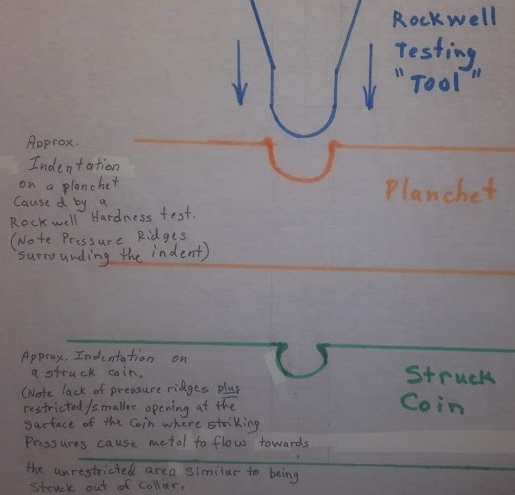 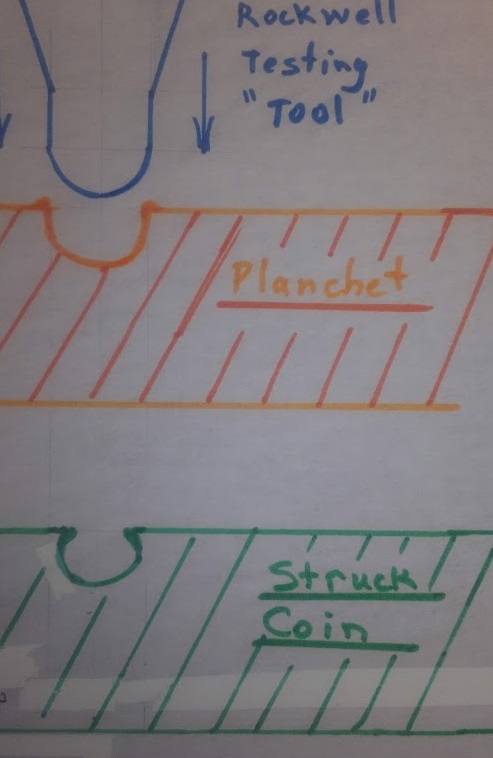 Words of encouragement are one of the major food groups.
We need to consume them regularly to thrive and grow.
Edited by Petespockets55
05/06/2020 2:22 pm
|
|
Pillar of the Community
United States
2752 Posts |
For the 1971-S cent, the pit is too distorted for its location, which is near the center of the coin where radial lines of stress all converge, cancelling each other out. Furthermore, the pattern of distortion is exactly the opposite of what one would expect given where it is in the design. It overlaps a pillar, and the metal flowing into those recesses should have flattened the ellipse in a north-south direction.
Error coin writer and researcher.
|
|
Valued Member
United States
117 Posts |
Mike, you and coop are scary smart. The expertise you bring to the Coin World is exemplary. I wanted to post this coin mostly to bring out an intelligent discussion, evidenced by your comments and the one prior from petespockets55. I think that is what a forum should be about. So again - great appreciation to you and those who so thoughtfully post. |
|
Pillar of the Community
United States
5896 Posts |
Mike,
1)Do you think the test would create a pressure ridge around the indent on an unstruck planchet?
2)Do you think the "top" of the oval would be restricted in size, more so than the lower area of the indent? (or is this what you are referring to when you said "the radial lines of stress all converge, cancelling each other out."
Thanks again for your time and commitment to helping us understand.
Words of encouragement are one of the major food groups.
We need to consume them regularly to thrive and grow.
|
|
Pillar of the Community
United States
2752 Posts |
The hardness test could conceivably generate a pressure ridge around the pit, but this would be flattened by the strike. As to your second question, the farther away an indentation is from the coin's center, the more likely it is to be stretched out along the radial line it falls on (in this case a line leaning slightly to the right of the N-S axis). That said, I don't think there would be any differential stretching in a pit this small, with side farther away from the center being more stretched out. Again, the pit lies along a column, so any tendency toward stretching toward 12:15 (or thereabouts) would be counteracted by the metal flowing into the die's recesses and into the edges of the pit. Deformation would also be limited due to the fact that the coin was struck in-collar. Not much radial expansion in that circumstance. Sorry for the complicated explanation.
Error coin writer and researcher.
|
|
Pillar of the Community
United States
5896 Posts |
Thanks Mike. I don't feel your explanation was complicated but very informative.
I wasn't sure how the strike pressures would come into play but now understand what you said about less metal flow towards the center of the coin.
I just thought that the top edge of the indent might affect the metal flow similar to a coin struck out of collar. By the metal flowing towards the center of the indent from all directions, with the metal closer to the surface (or different composition ie; Cu & Zn) moving slightly more than the lower layers.
I can't thank you enough for taking the time to help us understand this.
Words of encouragement are one of the major food groups.
We need to consume them regularly to thrive and grow.
Edited by Petespockets55
05/06/2020 3:02 pm
|
|
Pillar of the Community
United States
7344 Posts |
 Thank you Mike...  |
|
Page 2 of 2
|
Replies: 23 / Views: 3,648 |
Page 2 of 2
|







 First Page


 Posted 05/05/2020 10:50 pm





