realeswatcher You replied to the following comment by jgenn :
Quote:
You seem to think that Birmingham only produced Sheffield plate CCs.
You said:
Quote:
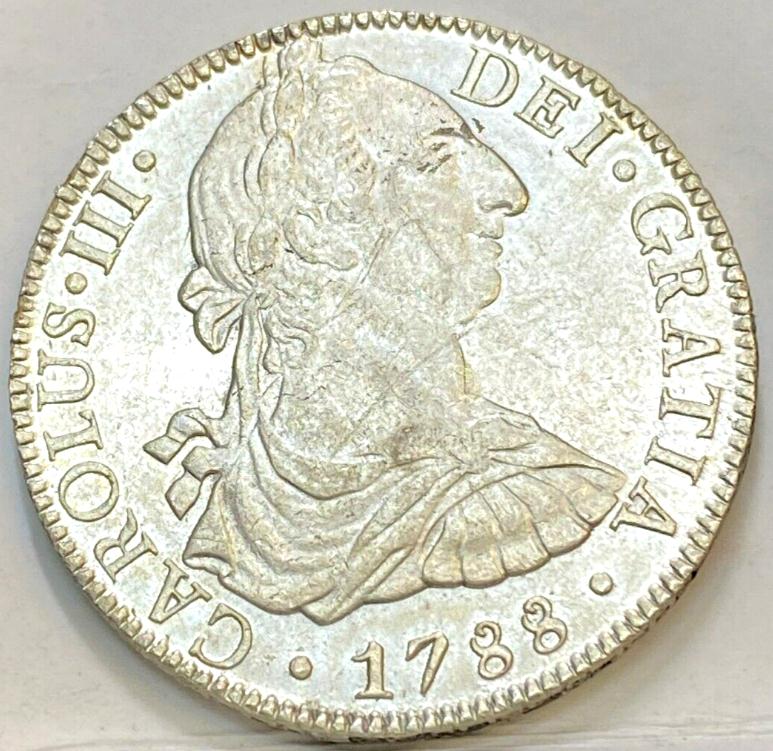
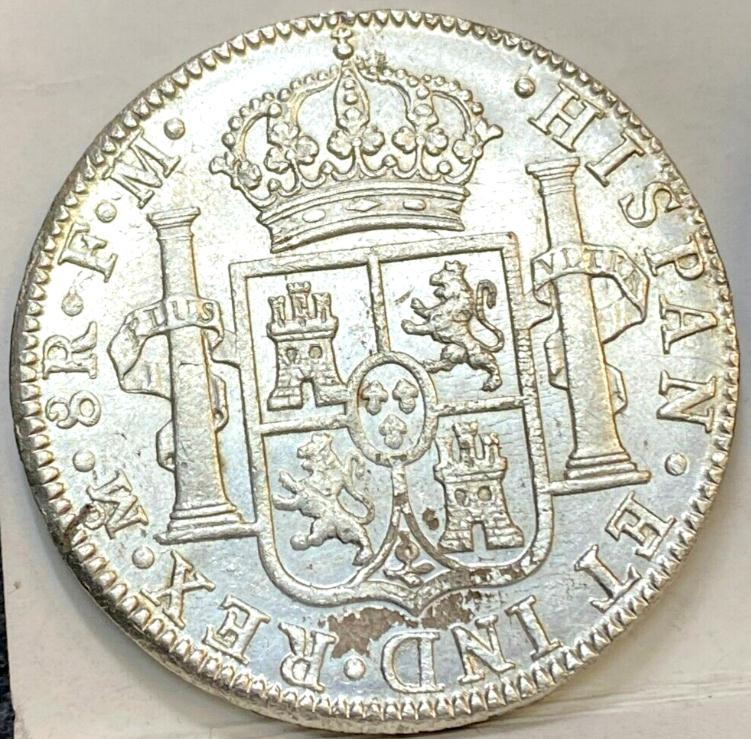
They certainly DIDN'T produce counterfeits that were EXACTLY perfect regal-looking, good silver (solid) alloy pieces... which all of these examples shown are!
The only legit question on these is whether they could have been later 1800s bullion restrikes... and the evidence points to that not being the case.
Jgenn is actually correct and yours makes assumptions that are incorrect.
Birmingham created many counterfeit coins including solid full weight 850 fine silver copies beginning BEFORE 1820. Those were used by English Merchants in China at Canton to decrease the balance of trade deficit with China. The premium on older Bust coins of the Carolus type began a few years after the introduction of the unpopular Ferdinand VII dollars. By 1835 England was complaining of the fact that the Chinese were making their own "Bustman dollars" that were debased even further than the ones made in England and they didn't want to take them in payment for English goods.
So the basic contention that all Birmingham counterfeits are easily detected by SG is incorrect. Some were made with silver but with an alloy that was
5% short which the Chinese could not detect.
To detect an 850 fine silver coin (distinguishing it from a 903 fine coin) requires a very accurate scale - accurate to 5 decimal places. A scale of that accuracy was just not available in 1835 in China.
A ten point deficient coin the size of a dollar can be detected with very careful use of a scale accurate to 4 decimal places. But even today scales of this accuracy are only seen in laboratories. So in 1835 the British saw it as perfectly safe for them to manufacture coins that were short of silver by 5% and on top of that to collect the premium of 12-14% more offered by the Chinese for Carolus dollars and make a very healthy profit. To do this the English ordered the coins from Birmingham made with 850 fine silver. They copied the Mexican dies somehow rather accurately.
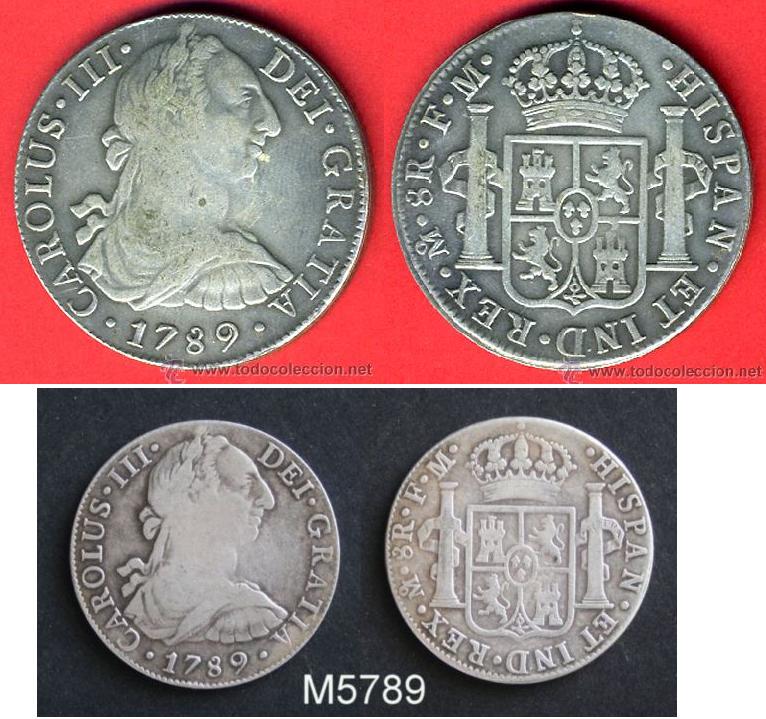
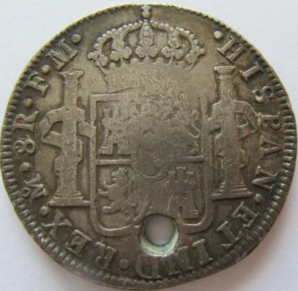
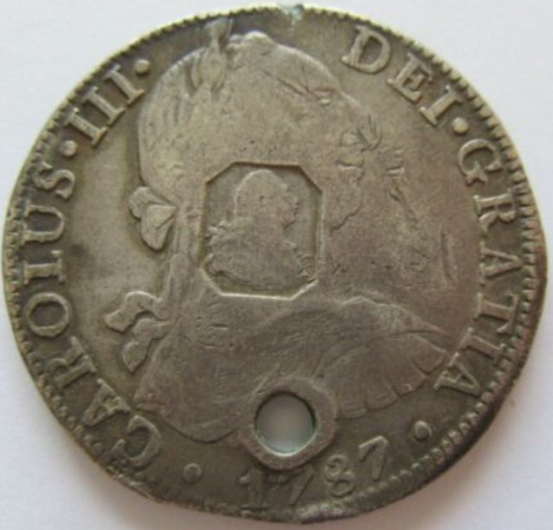
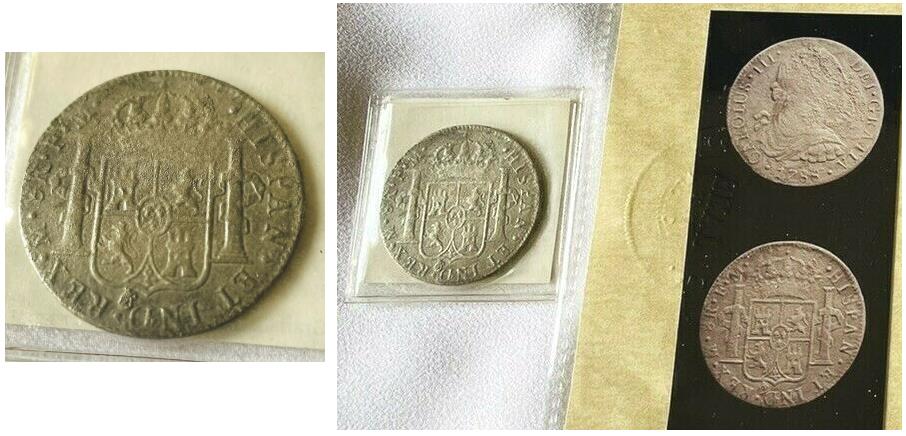
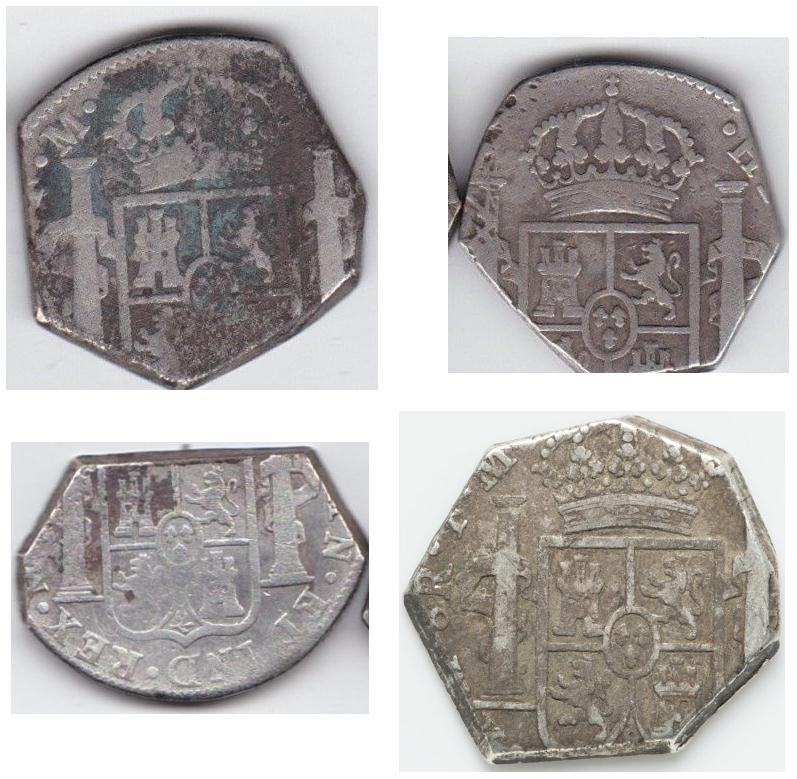
I want to point out the absolute FACT (unless someone cares to call me a liar) that there are counterfeits of this type that do exist. Some are effectively heavy Sheffield with a copper core. Others seem to be solid and debased. The one thing linking these coins is the window shapes. The fact that there are also modern Numismatic Forgeries using the same KHPH design is not at all surprising. It is a very commonly seen detail as evidenced by all the pictures above.
Are all KHPH coins bad ? I do not know because I have not tested all of them. I have tested some that seem to be genuine - BUT I do not own a scale accurate to 5 decimals either. The the most I can say is that some seem good silver (better than 800 fine) and others are definitely BAD (under 800 fine). That is the accuracy of my present equipment until I can purchase a new analytical balance scale.
It is my belief that all coins should be checked with SG to eliminate those examples that are easily detected as BAD because visual examination is definitely inadequate to detect some of these counterfeits.
Later on in the discussion realeswatcher says:
Quote:
Either they could do exact transfer die imitations - like the late 1800s bullion restrikes, like the Micro-O Morgans... or they could not. At that point, in the early 1800s, they could not. The best you would get at that time - in terms of EXACTLY replicating the detail of genuine pieces - would be a really good cast. And with those, the surfaces and/or weight will almost always give those away.
Let's examine that statement carefully. Is transfer technology the only way to duplicate a die? I know for instance that there are Birmingham counterfeits that were made using perfectly correct fonts. A second point where the statement above is incorrect is by assuming that in the early 1800's there was no way to replicate a die. The line of argument seems to presuming that a full die replication was needed. It is absolutely proven that by the mid to late 1830s in France as well as England that dies could be copied accurately using some sort of approach which Riddell did not specify. See J.L. Riddell's comments regarding the copying of dies written in 1845.
It is also inaccurate to say that the only option open to counterfeiters in the early 1800s other than striking with engraved dies was casting. Casting technology usually is easy to spot. However, there were earlier methods of die creation available.
How was that possible? The very earliest was recreating the Matrix blocks used to make genuine coins. A letter by letter, number by number approach to copying the punches used to create original dies was definitely within the capability of some Birmingham factories BEFORE 1820. Such an approach could produce dies that looked quite genuine. Spacings of legends vary but that matched original coins as well. The King punches were problems (Like the King's portrait) but not the smaller die elements like the Lions and Castles.
This was long before the period of the Micro-O dollars which I am quite sure was in the early 1930s - over 100 year later.
There are simply stated counterfeit coins made before 1845 that are almost exact copies of genuine coins. In Riddell's correspondence are allusions to dies themselves being copied (he uses the word abstracted) in France and England before 1845 for the creation of Cap and Ray coins.
The period from 1797 to 1820 was a period of astounding progress in mint technology at Bolton's Soho Factory and
in France as well. It did not stop at that point either. The US was significantly behind the European mints in terms of mint technology.
My research on this topic has progressed since I wrote my book on Counterfeits in 2013. If I live long enough I plan to do an update to add significant new findings.
I am answering here, once again, to correct errors in explaining my theories that have been presented. I also think this discussion has sufficiently covered the facts of the case.
Any more is in my opinion








 First Page
 Previous Page


 Posted 12/20/2020 1:40 pm