| Author |
 Replies: 21 / Views: 2,899 Replies: 21 / Views: 2,899 |
Page 2 of 2
|
|
|
|
Moderator
 United States
34538 Posts |
@landy, first welcome to CCF. Second, at least according to simmons gallery, this seems to be a coal miner's tag. With that said, most of the other examples of this seem to have counterstamped numbers and a more cleanly punched hole. I recommend reaching out to Simmons as this specific piece was in their possession at one point. If nothing else, it helps to establish some provenance for you.
"If you climb a good tree, you get a push."
-----Ghanaian proverb
"The danger we all now face is distinguishing between what is authentic and what is performed."
-----King Adz
|
|
Pillar of the Community
Australia
1617 Posts |
Hard to say without the token in front of me but I'm having trouble making a 6 from the image. Looks like 1092. Good luck...
|
|
New Member
 Australia
25 Posts |
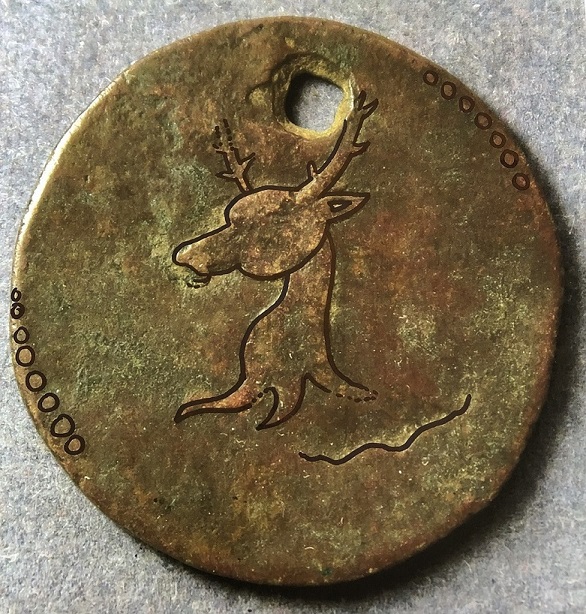
I decided to do a bit more research based on the assumption that a number of Scottish clans use the 'stag head erased' as an emblem and that the numbers (1692, or possibly 1092 given the "6" is indistinct) represent a year. Two options with a Scottish/date link were found. The option I believe offers the best fit is that the token was issued to commemorate the Glencoe Massacre which took place on 13 February 1692. The other (in my view less likely) option is that the token commemorates the William II led invasion of Strathclyde which took place in 1092.
|
|
Pillar of the Community
United Kingdom
945 Posts |
Well done for getting further with this!
The style and strike is all wrong for a 1092 date, unless it was struck a lot later.
I am not convinced of the Glencoe link. If this were the case I would expect to see some reference to the MacDonald clan crest, and I don't believe the stags head links to that at all.
The number still looks more like 1092 than 1692 to me, and so I would suspect this is a tally number of some sort - whether for mining or some other form of trade.
Another thought - the deer could be a Hind, taking you to the town of Hindhead?
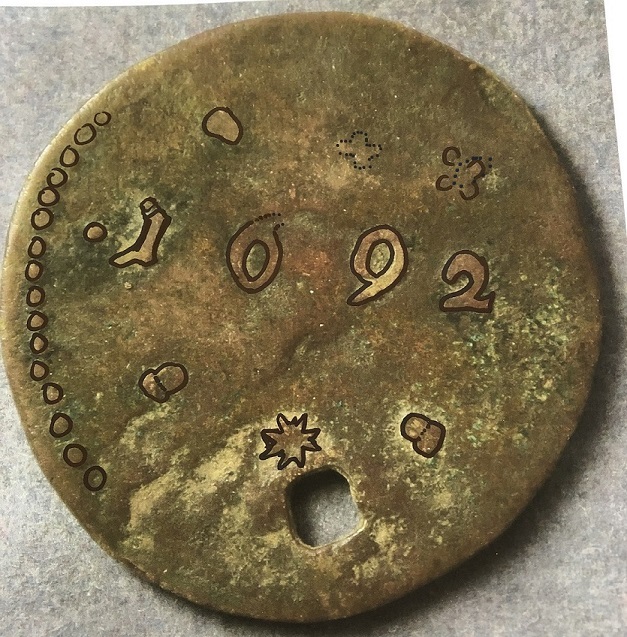
Also the "8"s on your drawing look to be acorns - I wonder if that takes you to forestry?
|
|
Moderator
United States
194816 Posts |
Very interesting. Thank you for the follow-up posts.  |
|
New Member
Australia
25 Posts |
PaddyB - thanks for your reply and suggestions. I agree that a date of 1092 is unlikely and that the "8"s are acorns (as per my original post). I'll add forestry to my list of clues but acorns have appeared on a number of coins and tokens unrelated to that industry (the Parys Mines token series, George V threepence and sixpence etc. immediately spring to mind). Their use may symbolise fertility, growth and fresh starts.
Although the styling of the "1" is curious I am still leaning towards the number being a date as it is part of the die strike rather than being added later. This would rule out a sequence number as a new die would have to be created for each number. I have trade tokens that were used as a receipt for a specified amount of goods transferred but 1692 would be an odd amount to specify. The number could represent the year for which the token is valid (a hunting/access licence or toll or receipt for rent paid perhaps?) Interestingly, Land Tax was first introduced in 1692!
I still favour a Scottish link even though the MacDonald clan crest does not include a stag head. The stag head is a common feature in Scottish symbolism and in this form is used by a number of other clans and may signify clan solidarity, allegiance or support following the 1692 massacre. The antlers would rule out the head being a hind.
The star below the date may offer another clue. It has eight points and on closer inspection is similar to the eight-pointed Maltese cross form (and cross of Saint John) - a possible Scottish Knights Templar or Freemasonry link?
The obvious question with any of the options is why haven't more examples survived? I have other tokens for which the source has yet to be identified but for each I have been able to find other documented examples.
The research continues.......
|
|
Bedrock of the Community
United States
27269 Posts |
Landyman, you have a fascinating piece and the mystery is absorbing! Please keep us updated on your quest.
Inordinately fascinated by bits of metal with strange markings and figures
|
|
Pillar of the Community
Russian Federation
5186 Posts |
 on the number being almost surely 1692 rather than 1092; probably a date and not-implausibly a date of issue. Is that a cloud under the stag head? |
|
Bedrock of the Community
United States
12057 Posts |
Bushel or colliery token or barrel stave marker, perhaps
There was a Stags Head Colliery in Durham, and another in Flintshire; and the famous Stags Fall Quarries in the Dales, Yorks.
And, of course, a great many Stags Head restaurants, pubs, guesthouses, and inns (with or without the greengrocer's apostrophe!)
Member ANA - EAC - TNA - SSDC - CCT #890 "Most of the things worth doing in the world had been declared impossible before they were done." -- Louis D. Brandeis |
|
Pillar of the Community
United States
1077 Posts |
 I feel your [pain, Landyman, having spent a few years, like PaddyB above, working to attribute what turned out to be a obscure "manorial token," that circulated on the grounds of a tiny family-owned estate encompassing no more than a couple of square miles in Kent. I feel your [pain, Landyman, having spent a few years, like PaddyB above, working to attribute what turned out to be a obscure "manorial token," that circulated on the grounds of a tiny family-owned estate encompassing no more than a couple of square miles in Kent.
One of my more helpful resources has been the "Heraldry of the World" website, where the gentleman who maintains this wiki will even answer individual questions to help identify civic and organizational crests, escutcheons, arms, etc. He helped me narrow my token down to a family name and county, and then I managed to gently impose on a couple of local museums, churches, and libraries to come to my rescue. Please note that e-mail correspondence with multiple sources over a period of many months was required -- no instantaneous results.
With respect to your token, I just did a quick search on "stag" and came up with several hundred blazonry citations. That's a hot link, so you can check it out easily from here. (Just click on the "500" at the bottom of the page to show all the references at once.)
Almost forgot: You can try WorldCat.org to see what library near you has a copy of Mitchiner for you to look at. (I'm actually finding it on the shelf in Perth and Brisbane!) That's Jetons, medalets and tokens: British Isles circa 1558 to 1830, by Michael Mitchiner. There's an e-book edition available via HathiTrust.org, but I believe that's permitted to circulate only in the US.
Hope you'll keep us all posted...interesting mystery token!"If everything seems to be under control, you're just not going fast enough."
--- Mario Andretti
Edited by daltonista
01/18/2024 12:39 pm
|
|
New Member
Australia
25 Posts |
Thank you to all for your comments and suggestions and apologies for this long post. I will add further images in a separate post.
january1may - I initially thought the 'wave' was a coiled rope often seen beneath family crests but on further examination it is only evident to the lower right of the stag head and appears to be a later dent from a heavy strike (perhaps a hammer miss-hit when punching the hole.)
paralyse - I originally purchased the token as a colliery ticket (my area of interest) so that is still a possibility. After my earlier research drew a blank I moved away from that as a probability so thank you for pulling me back out of the rabbit hole I had fallen into!
The barrel stave marker is an interesting idea to add to clues but the two-sided design and reeded edge would suggest something other than a marker.
daltonista - thank you for your support - I am still enjoying the chase! I also have an example of the manorial token you are referring to (I*H together with bear arms and crescent) but at least there are several known examples of that token. I have another mystery token for another discussion (same as D&W 298/175 numbered 23) - again, several examples are known. The references you suggested are very useful - using 'stag head erased' narrows the search to a more manageable number many of which can be discounted due to being a more recent grant. If it does represent a family crest, then the best of the rest from that source suggests either the clan Fraser of Lovat (but that stag head erased normally rests on a coiled rope) or one of the Clare families of Ireland.
Further observations after detailed examination in various light conditions and scans in colour, B&W and negative:
I find the style of the "1" in the date intriguing given the simple and somewhat crude forms of the 6, 9 and 2. The "1" is more gothic in appearance.
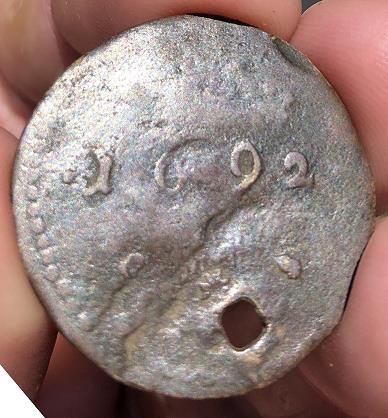
The die axis (obv/rev rotation) is 180 deg and the later damage to the obverse has largely obliterated the upper design of the reverse but there appears to be something between the upper pair of acorns that, with a lot of imagination, could be a cross/star meaning the lower decoration (two acorns with a cross between) may be repeated above the date.
I note that in reflected light (image in my next post) the acorn above the "2" could be interpreted as a four or five petalled flower but that may just be an imprint of whatever the token was sat on when damaged.
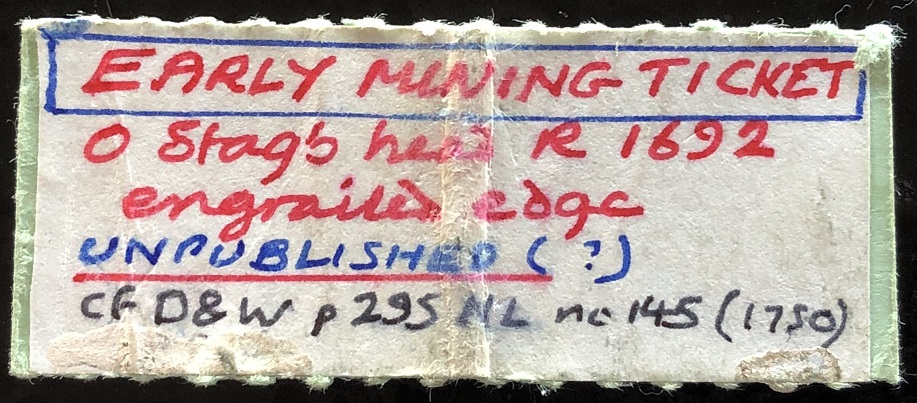
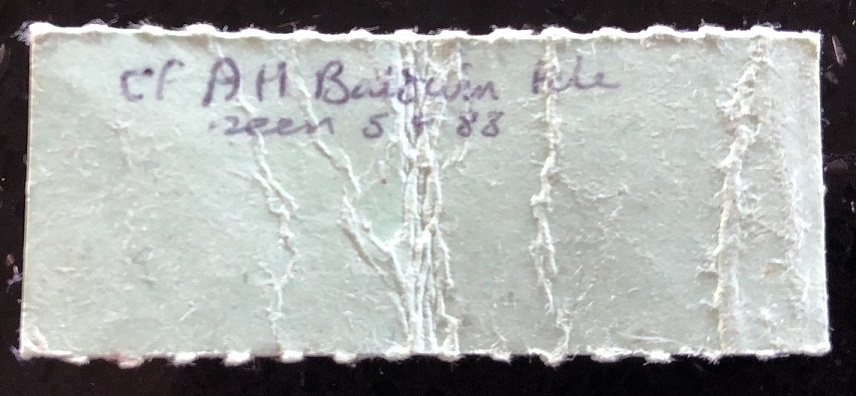
Finally, I recently found the collector's ticket that came with the token - I thought it had been lost but was only misplaced. The token is from the collection of Emyr George and purchased via a Simmons Gallery auction in 2021. It was listed as "Mining?" (hence my interest). The old ticket clearly shows that Emyr thought it was an early mining token and reads "Early Mining Ticket" "Unpublished (?)" and "CF D&W p295 NL No 145 (1750)". The back of the ticket has a note "cf A H Baldwin File seen 5 4 88" (or possibly "5 + 88"). I'm not sure the D&W reference will help as 'Tickets and Passes of Great Britain and Ireland' is not illustrated. However, I have recently purchased a copy (still waiting for it to arrive.) I'm not sure about the Baldwin reference - does it refer to the previous owner's file of Baldwin auction sales or perhaps a reference to Baldwin correspondence files?
|
|
New Member
Australia
25 Posts |
|
|
Pillar of the Community
United States
1077 Posts |
Sorry I'm just catching up...I could have gotten this D&W citation to you weeks ago! 
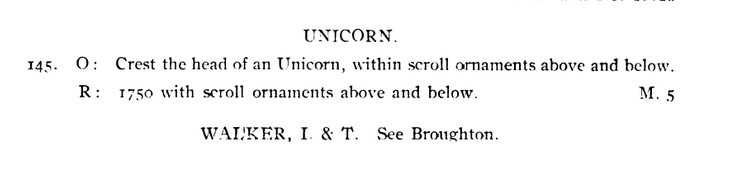
It's hard to imagine why someone would have written up that ticket for your piece....
Have you been able to make any progress?

"If everything seems to be under control, you're just not going fast enough."
--- Mario Andretti
|
|
Bedrock of the Community
United States
12057 Posts |
You could ring up Baldwin's and see if they've got catalogues from 1988.
Member ANA - EAC - TNA - SSDC - CCT #890 "Most of the things worth doing in the world had been declared impossible before they were done." -- Louis D. Brandeis |
|
New Member
Australia
25 Posts |
Thanks paralyse and daltonista for your ongoing interest and help.
The reference to the unicorn token in D&W with its further note to "Walker, I & T. See Broughton" (Colliery?) is strange. The colliery was only leased to John and Thomas Walker for 14 years from 1823 (ref. Finlay, The Mining and related tokens of West Cumberland). I have examples of a Walker I & T token dated 1834 (Finlay 80) and that token has no similarity with the stag head or unicorn head tokens.
However, Broughton Colliery did issue (issuer John Lamplugh) trade tokens circa 1665-1670 in response to a shortage of coinage at that time. Apparently locally-issued token coinage of halfpenny and farthing denominations, although strictly illegal, became commonplace with "many thousands of issuers" (not helpful!) and tolerated by the authorities. A royal proclamation of 1672 forbade the further use of such tokens which adds a further question about the numbers (date?) on my token - 1692.
I will be travelling to the UK later this year and will make contact with Baldwins to see where that leads. I will post any findings on here.
|
|
Page 2 of 2
|
Replies: 21 / Views: 2,899 |
Page 2 of 2
|






 First Page

 Posted 10/18/2021 10:37 pm